My father has a bar billiards table. He got his from an American family. The old fella had been big in Hollywood back in the day and had worked on several films set in England; I believe American Werewolf in London was one of them. He picked up the bug for the game while he was in the UK and, as he had the money, he brought a table to his Bermuda home. However, all things pass and so did he, and the family wasn't interested in lugging what is quite a heavy object back to [wherever they may have been then]. So we picked it up.
The big thing to bear in mind, as Wikipedia helpfully reminds us, is that:
The play is time-limited. A coin will usually give around 17 minutes of play, dependent on region. After this time a bar drops inside the table stopping any potted balls from returning, leading to a steady decrease in the number of balls in play. The last ball can only be potted into either the 100 or 200 hole having been played off either side cushion.
Which lends itself to pub play and is probably why the coin slot was invented in the first place. You can't be at the table all day. Someone else has to have a go.
The table we have used to have a coin slot but someone deactivated it at some stage, presumably because it became too much of a faff to find old British coinage. Even if you can open up the slot and get it back again, at some point someone will lose your only two-half-groat-a-billibong, and then the table's shot.
The game is practically built for gambling. You bet on whether or not the player will make the shot, you bet on who will win, you bet on how much by, you bet on any number of things.
Which is interesting, because Bookhounds doesn't include a gambling mechanic. Never mind the Thrilling mechanic that Night's Black Agents uses. More than that, the game (in its current form) is new in the 1930s, which means all those pubs the Hounds go to probably have a bar billiards table. It's the modern fashion. The coming thing.
In Millionaire's Special I faced the same problem with Trail, and I'm going to adapt that solution to this problem as follows:
Use Athletics as the General ability if you're playing honestly and Filch if you're cheating.
If plot does not depend on the outcome of the game, then whoever has the highest Athletics or Filch wins.
If plot matters, then use dice. It can either be a lengthy competition (mechanically, like an Auction scene) or a one-roll game, depending on how important the result is.
With an additional rule if there are books involved:
If this game is determinative in an Auction, for whatever reason, then Auction can be used in addition to Athletics or Filch.
What do I mean by that? Well, this is gambling. I can foresee times when a book scout might want to wager, say, some nice 18th century German pamphlets on vampirism on the outcome of the match. That makes the match a species of Auction, which is what the Auction ability is all about. When someone wants to spend from the Auction pool they do that instead of spending Athletics or Filch.
Why do it this way? Well, as Storage Wars reminds us, an auction isn't about meekly standing in a row making bids. It's about showmanship, finagling, angling for an advantage, screwing over the competition. Sounds a lot like a game of chance to me. But as a mechanic it's only worth using if there's a book as the prize. The game is Bookhounds of London, after all, not Poolhounds.
All that said, let's talk about a scenario seed. To do that, I'm going to set this in a location I've discussed before: The Three Bucks pub.
This elaborate Edwardian building resembles an Italian palace gone slightly awry, complete with statues of saints and a copper-clad cupola roof. It was built on the site of an old Georgian traveler's inn, as a speculative venture by Gregory Harris in 1908 ... [the pub is haunted by a spirit] obsessed with blood and violence, particularly cutting ...
Snookered
Book Scout Allan Chessover (main text p85) is known to be a billiards fiend, and the Three Bucks has installed a new table. He’s there every Thursday night without fail, for a round or two with the lads.
The Three Bucks has an unusual reputation as it stands, but ever since the table came in the rumors have been flying thick and fast. People see lights where there oughtn’t be lights, hear the sound of billiard balls clicking when there cannot be players. Not least because Paddy Green and his sons don’t let anyone on the premises after midnight, not for any reason or for any inducement.
The Hounds want something from Chessover. It doesn’t matter what that something is, but for the sake of this example it’s a lead on a book they desperately want to acquire.
Right-o, says Chessover. I’ll do that little thing. If, and only if, you beat me at bar billiards at the Three Bucks. After midnight.
Option One: Action Room. It’s all a bluff. Chessover has no intention of showing up at the Three Bucks, whether after midnight or at any other time. He pays a group of Rough Lads to attend in his stead. The Rough Lads having a sense of humor, they propose a little game of their own: play billiards, and every ball you pot is a bone I don’t break. Miss the pot … well … What none of them appreciate is that the restless spirit of Gregory Harris, the pub’s former owner, will want in on the fun.
Option Two: Dirty Pool. Chessover has his own troubles. He’s been on a losing streak for weeks and is deep in the hole, financially. He owes a remarkable sum to the ghost hunters who frequent the Three Bucks looking for Captain Kidd’s revenant; one of them is a talented billiards player. The ghost hunters have been wanting to visit the Three Bucks after midnight for ages. Chessover can sneak them in but doesn’t want to be blamed for letting them in. Not if he can rig it so the Hounds get blamed instead …
Option Three: Silent Partner. Mike Green, Paddy’s eldest son and a fellow who never wastes a penny, lets a select group into the Three Bucks after hours to play the billiards table. Chessover is one of the lucky few. If Paddy knew about this he’d be furious. There’s just one odd little stipulation. Rather than pay cash for the table, you have to put a few drops of blood down the coin slot instead. Otherwise the table seems normal … just don’t go looking too long at any of the shadows …
When war breaks out and the Phoney War becomes all too real, as the Germans push through Belgium in May 1940, as the Battle of France begins and ends in a heartbeat, Dion Fortune does her bit to save England from the Germans.
She organizes the Magical Battle of Britain, with a cycle of rites beginning July 1940.
Bear in mind, that’s a busy month. You’ve got bombing raids on mainland Britain, the Cardiff Blitz; the Germans are chewing up the RAF in the Kanalkampf in preparation for Unternehmen Seelöwe; Vichy is the new French government, allied with its conqueror Germany; the country’s plunging into debt to fight a war in which it seems it will soon be the sole Allied combatant, with Churchill telling the country they’d fight on alone, seeking no terms or parley; the buying and selling of new cars is banned, the first of a series of stringency measures; everyone thinks the German invasion is imminent, including the Germans. It’s one of those times when you daren’t read the newspaper because you know what the headlines will be. It’s enough to scare someone into spiraling depression.
In all this, Fortune marshals the occultists of Britain to … actually, it isn’t entirely clear what the point is.
With a title like ‘Battle of Britain’ you expect, well, combat. Of some kind. Lonely duels high in the sky, where life and death is seen as a scattering of contrails punctuated by crashing aircraft. Explosions. Derring-do, that kind of thing.
What actually happens is a little less exciting.
Fortune gathers together a number of people, not all of them occultists but all known to her personally. She persuades them to meditate on a particular subject at a particular time and write to her with the results of their meditations. She then wrote back, instructing her correspondents that they weren’t to open or read the letters until just before the next session, at which point the cycle begins anew.
Fortune openly admits that what she’s attempting is more about morale building than anything practical. Victory, if it is to be had, must be fought for and won in the physical realm. What she’s after is more of a spiritual victory.
You know what that reminds me of?
ITV News
Again, bear in mind when this is happening. This is the bleakest point in the war, for the English. The news isn’t going to get better any time soon; the actual Battle of Britain is about to see some of the heaviest casualties, the most significant engagements. The Hardest Day is coming in August. Everyone knows a family where someone’s died, or is that family mourning a loss. Food is running short. Meanwhile Charles Lindberg the celebrated American aviator is telling his fellow Americans not to get involved; that so long as America is strong, none will dare invade her, and she need not intervene on another’s behalf.
People need to feel as though they’re doing something, even if it’s a gesture of defiance.
Foreign Correspondent (1940, Hitchock)
I have to wonder whether Fortune was drawing on her own war experiences in the Women's Land Army during the First World War. That was all about rallying round and doing your bit, even if it was less than spectacular and didn’t require a lot of derring-do. It’s also where she allegedly had her first serious spiritual experience and began her communications with the Ascended Masters. Was she intending some kind of mass recruitment to the esoteric cause? Introducing her followers to the Ascended Masters that first intrigued her so long ago, during another war?
As the war news improves, Fortune loses interest in the effort. It becomes more about what will happen after the war, when peace returns to the green and pleasant land. She begins developing ‘the Arthurian Formula’ where Arthur and his knights become dim and distant reflections of Atlantean forebears. Not that she has long; leukemia will claim her by 1946.
OK, that’s what actually happens.
How to gamify?
Probably the simplest method is to assume that Fortune embarks on the Arthurian/Atlantaen bit a good deal earlier than she does. The occultists she recruits - the player characters - are all Knights in her Arthurian army, and there are dragons on the horizon attacking the very soul of Britain itself. Their job is to use scavenged Atlantaen rituals (and later, technology) to establish a perimeter - castles, in her vernacular - first on the coast and, later, when those are bombed in the Battle of Britain alongside the coastal airfields, further within. From these castles the Knights defend the realm against foreign psychic incursion. The intent is to provide aid at first, when the country's need is greatest, and later, when the tide turns, a base for assault across the Channel against those same foreign dragons who were ravaging the countryside a few short months prior.
All Arthurian stories need a Mordred figure and in this instance there's one ready-made: occultist Aleister Crowley. He seems friendly enough to Fortune, but his smiles hide evil intent. He may present as an ally at first, but someone's working with the dragons, and it may well be the wickedest man alive.
Now, some options:
Option One: Yithian Malice Fortune isn't a free agent. She's been corrupted by the Yithians, who see the outbreak of war as their last chance to scoop up as much Pnakotic material and lost technology as they can before the war ravages what's left of their network. The Yithians intend to gather all this at their Oxford Camelot, a secret base where they'll hide all of their secrets until some future date when they can re-establish their network. The Yithians see this as a rescue mission - shades of Three Damsels of the Fountain - but the player characters may disagree, particularly since the Yithians follow an old human maxim: no witnesses. In this version, Crowley is Mordred, but Mordred isn't the real enemy of mankind.
Option Two: Dragons of Dream Fortune is facing real threats, but these are threats to the English Dream. The Dragons ravage the nightmares of all who listen to Haw-Haw's broadcasts and it's up to the player characters to perform miracles of resistance. They may be assisted in this effort by whatever's left of the Dreamhounds of Paris who may be trying similar methods of resistance in occupied France. In time the characters may become a kind of psychic Special Operations Executive; entirely unofficial, but there were many such unofficial, undocumented operations. A supernatural Small Back Room, with Fortune as the lead brain and Crowley as the greasy politico.
Small Back Room
Option Three: Accidental Arthur This borrows from Pagan Publishing's Golden Dawn and Pelgrane's Dracula Dossier, but neither are required reading. In the dying days of the last century Golden Dawn occultist Randolph Northcote attempted to bring back King Arthur to save Britain, but his attempts ended in disaster and Arthur's plans to reestablish his Shub-Niggurath cult were thwarted. Temporarily, at least, though some of Arthur's ideas and forbidden texts he and Northcote consulted found their way into the archives of a secretive supernaturalist organization within Military Intelligence. Now that same obscure branch of Military Intelligence is drawing on those old ideas to create a new Arthurian cycle, and in the process bringing back Arthur's Shub-Niggurath cult. Fortune the Golden Dawn inheritor, in this version, may be the heroic resistance, or may be a willing catspaw of British Intelligence; if the latter, then Crowley/Mordred is what little's left of the heroic resistance. The ultimate goal is to bring back Arthur the same way Northcote did, but Northcote didn't realize what he was bringing back, and neither does Military Intelligence.
That's all for this week! Next week, something completely different.
Violet Firth (born 6 December 1890 died 6 or 8 January 1946) was introduced to the Hermetic Order of the Golden Dawn in 1919, when she would have been in her late 20s. MacGregor Mathers, the founder of the Golden Dawn, had died the year before during the influenza epidemic and the Golden Dawn was under the occasionally shaky leadership of his widow Moina Mathers, working in partnership with an ageing J.W. Brodie-Innes. Brodie-Innes was himself not long for this world and would pass in 1923.
Firth came from a wealthy background and was well educated. Her father, anxious not to be seen as a money-grubbing parvenu, adopted the motto God, not Luck - Deo, non Fortuna - from which she would derive the pseudonym by which she is best known. Though in her view Dion Fortune wasn't so much a pseudonym as Violet Firth was her deadname.
Fortune had a long-standing interest in occultism before being introduced as a neophyte in Alpha et Omega in 1919. She was well versed in psychotherapy, the works of Freud and Jung, and had experience as a medium and psychic sensitive. She'd also served in the War in the Woman's Land Army but had never been posted overseas.
King says something interesting, though it's a bit of a non sequitur. He describes Fortune as a 'slim young girl' in 1919 and goes on to add that 'later she was to become very fat; for some reason most mediums seem to do this - probably there is some relationship between mediumship and the glandular balance of the metabolism.' Which, frankly, sounds like utter garbage, but in a game world where Y'Golonac exists there is something to be said for a fictional universe where mediums become enormous under psychic influences.
Fortune soon becomes disenchanted with the Golden Dawn's mismanagement and its lack of a rigorous training program. It doesn't help that Mathers is milking it for every spare dollar, pushing Alpha et Omega as if mystical learning is a self-help experience. Initially Fortune counters this by trying to bring in new blood, with Mathers' blessing. New recruits were a good thing for Mathers the Empire-builder. This creates the Fraternity of the Inner Light, a sub-group within Alpha et Omega, in which Fortune is a leading player. Mathers hates that idea; in Alpha et Omega, Mathers is Imperatrix, the only leading player.
Fortune and Mathers soon fall out, and Fortune alleges that Mathers engages her in psychic assault. This takes the form of a plague of cats. "I suddenly saw, coming down the stairs towards me, a gigantic tabby cat, twice the size of a tiger. It appeared absolutely solid and tangible. I stared at it petrified for a second, and then it vanished. I instantly realized that it was a simulacrum, or thought-form that was being projected by someone with occult powers." Fortune beats off this attack with her own occult powers but not without cost; when she goes to bed, she sees she has been scored as if by claws.
Again, going back to gaming, this can be significant in a game world in which dreams, mystic cats, and Bast worship exist. Was Mathers secretly a worshipper of the cat god, or had she, by chance, discovered a means of using Bast's powers? Was Mathers a Dreamer?
This becomes even more important later, when Ms. Netta Fornario, a member of Alpha et Omega, dies under very mysterious circumstances. She travelled to Scotland in 1929, evidently engaged in some kind of ritual exercise on the Isle of Iona, and was later found dead there. Possibly her death was the result of exposure to the elements, but there were deep score marks on the body and, before her death, Netta claimed she was being attacked psychically. Fornario and Fortune were friends. Fortune believed Mathers was responsible for Fornario's death.
By this time Mathers was dead; in fact, she died the year before Fornario's trip to Iona. Any further breach between Fortune and Mathers was irrelevant, at least in the physical realm, though Mathers' psychic influences may have remained.
Again, going back to gaming, this could also become in-game relevant if Mathers was a Dreamer, and if her Dream-self survived. Particularly if you, as Keeper, intend this to run contemporaneously with Dreamhounds of Paris, since Mathers will be in the Dream fomenting occult dissent just at the time the Dreamhounds are sculpting the Dreamlands in their own image. What would Mathers do if her Egyptian, Bast-centric artistic vision is interrupted by French Surrealists while she, at the same time, is continuing her feud with Fortune?
By this point Fortune is utterly disenchanted with Alpha et Omega. Fortune has effective control over her own Fraternity, and she's more interested in personal development than getting bogged down in psychic attacks and the day-to-day bother of running an esoteric society. She begins corresponding with other occultists across Europe, expanding her horizons and generally making a name for herself. Not just living occultists either; through meditation she contacts Madame Blavatsky, and more esoteric entities. Her career as a writer begins to flourish, and her most well-regarded book, The Mystical Qabalah, is published in 1935.
Ultimately, she approaches paganism, abandoning her former Christian beliefs. She begins to develop a mystical practice entirely her own, based on rituals of her own devising.
War approaches. The mystical Battle of Britain is about to begin ...
In the old year (feh! Fooey!) someone asked if I would write about Dion Fortune and the magical Battle of Britain.
Happy to oblige. Before I do, let's set the scene a little and talk about ritual magic.
Ritual magic, in Western traditions, is all about the big favors. You use it when you want to achieve a major result. In fiction this is sometimes with machines and modern (or at least modernist) technology. The Electric Pentacle and peculiar devices of Thomas Carnacki are an example of this type. You never know exactly what makes those devices hum. That isn't the point; the point is that they work.
Same with rituals. If you really want to, you can find out how they're supposed to work. I have proof of this: academic tome after academic tome, Histories of Magic, long lists of names and attributes. All wordy, windy, esoteric. Filled with forbidden knowledge and tempting illustrations.
However, from the point of view of the observer, how ritual magic works isn't the point. How impressive rituals are, is the point.
Faust 1926, Murnau
The peculiar technology used by Doctor Frankenstein in the early films (and later, in Young Frankenstein) are in this tradition. Again, the desired result is something spectacular: the creation of new life, from dead clay. To achieve it an appeal is made to the heavens, and peculiar technology is used to make that appeal heard.
Frankenstein, 1932
Early cinema, and plays like Marlowe's Faustus, latch on to this scene-play. They have those central dramatic moments when someone goes out to the crossroads on a dark night and evokes the weird. There's a suggestion that Faust and the rest are completing an esoteric ritual, but the details of that ritual are, at best, sketched in. So long as the visual is suggestive the means of getting there can slide a little bit.
Video games pull much the same tactic. Whether it's the Rite of Thorns in Baldur's Gate 3 or any one of a dozen summoning rites in World of Warcraft, the implication is that so long as you get enough people chanting faux Latin and standing in something approximating a circle, you've got yourself some ritual goodness and can expect great results.
In the historical record this often causes religious qualms. Appealing to forces beyond reality? Clearly diabolic. Burn those books. However, even the religious are not beyond a little magical temptation, so up springs a series of tomes that promise power from angels instead. Know the right angel, make the right appeal (in the Lord's name, of course) and you too can have whatever it is you desire. Or, if you're into slightly less work for slightly less reward, you can practice simple bibliomancy. Take out your bible, flip to a random page, and take the advice offered. A very simple ritual designed to produce a simple result.
But the key to ritual, whether religious or otherwise, is to know your terminology. You need to know the proper name of the angel (or whatever it may be) you're appealing to. You need to know the offerings that being wants, or the tools you'll need to make the appeal. You need to be able to recite the prayers exactly right each time, in the right order each time, as often as the ritual requires. You need to be able to do this while fasting, or while only drinking or eating the right things, or by only consuming the holy spirit, or whatever it may be. You need to get everything exactly right, possibly over a period of several days or even weeks.
Get one little thing wrong, and the whole effort is for naught. Or, in the case of devils, get one little thing wrong and put your body and soul in peril.
The interesting thing about a ritual, I think, is that it doesn't rely on the magician, or the magician's innate power. This is the magician asking for a favor. Commanding a favor, really. They know the cheat codes, they press the correct button sequence, and boom! Magical gifts. Angels, demons, deities of the hearth or saints in charge of who-knows-what, beings that have existed before Man and which will exist after him, beings that have seen the face of God and tasted the eternal joys, suddenly bow down to some clown from Croydon, so long as that clown pronounces their name correctly and chants in the appropriate tempo.
In RPG terms, naturally the Bookhounds (or whoever it may be) aren't really appealing to angelic or devilish forces. They're relying on the Mythos to power their Megapolisomancy, their Rough Magick, or whatever else it may be. The ritual found in that collection of scrolls may reference Thoth, but to those who know it's really talking about [insert Mythos here].
Which raises a question. Most Mythos forces aren't interested in humanity and certainly aren't interested in anything humanity wants. Cthulhu could care less. Nyarlathotep is probably interested to a degree but isn't about to fetch and carry for any mortal sorcerer.
There are at least two ways to answer that question.
The first is manipulation. Humanity isn't drawing directly on Mythos forces. Rituals are ways of channeling power, leeching power that would otherwise go to waste or be used for something else. This may be deliberate manipulation, or it may be an accidental effect, something that's survived from the days of Mu and which some mortal lucked into. When a sorcerer uses a ritual to achieve an effect that sorcerer is accessing Mythos forces that exist around us all the time, in the same way that we might dam a river or redirect a stream to irrigate cropland. We didn't create the river. We merely adapted it to our use.
The other is natural tendencies at work. Humanity is Mythos. There's some lurking corruption at the heart of us all, and when we manipulate forces to create a ritual result we're drawing on the Mythos inside us to do it. We bring ourselves closer to Cthulhu, or whichever Old One it may be. Perhaps that's what is meant by 'the stars are right' - not that some anticipated conjunction of heavenly bodies will bring about a result, but that we are the stars spoken of in prophesy, and when our devotions over however many millennia finally bear fruit, we will be the reason why Ry'leh rises and why the Old Ones return. Like ants building a mountain, we strive in our own cause, but build something beyond our scope or our ability to understand.
Last post before the holidays! No post next week. Next post will be the first week of January 2025!
Hind Horn is a Scottish traditional ballad with many, many variations. The story goes that Hind Horn, the hero of the tale, is given a ring as a token of love from the King's Daughter. The ring has diamonds, and she tells him that when those diamonds grow pale and lose their luster, it means her love for him is fading.
They part. He notices that the diamonds are in fact fading. He returns to the kingdom to find that she is being married to another. He approaches the wedding party disguised as a beggar and contrives to show her the ring. When she sees it, she offers to go with him, beggar or no, and they go off together.
This legend is one of the reasons why it became traditional that, should a beggar come to a house where there is a wedding, the beggar be given whatever reasonable thing they ask for.
With that in mind:
Hind Horn in Winter
The Hounds find a job lot of old ballads, loosely compiled, in one of the boxes from the last auction.
On inspection, most of them seem to have come from a house sale somewhere up North, and the Hounds find with the ballads notes on someone's academic work. The parson, or some other minor church functionary, was amusing themselves between sermons by collecting, transcribing and examining old ballads. Most of them seem to have been local to wherever the parson was (that part's not clear) and some of them seem to be much older than first glance.
If the Hounds examine the documents very closely they find (1 point) that one of them is in fact a 15th Century manuscript, 3 pages long, apparently a version of Hind Horn written/transcribed by Charles of Orléans. God alone knows how that treasure found its way into an obscure parson's trove.
It's not quite a Windfall but it is a very valuable find.
The air is chilly, the mornings frosty, and it's getting more and more difficult to heat the shop. As winter draws ever nearer the Hounds find three customers all determined to purchase (or steal) Hind Horn: A Scot cleric, Andrew Baird, lean and corpselike; a young man, John Egan, poor as dirt and importunate; a young woman, Hattie Keeble, an upper middle class coquette. They all want Hind Horn. They seem to know, without telling, that the Hounds have it. If one of them gets it, the other two will be outraged and cause all sorts of scenes. Diplomacy is called for ...
Just as this becomes a problem, a peculiar item turns up in lost property: a diamond ring. A wedding band. Nobody recognizes it or knows how it ended up on the shop floor.
Option One: Dusty Memories. None of this is real. There's a Dust Thing attached to Hind Horn which, in fact, is not a 15th Century original but an 18th Century forgery. It's quite a good forgery, so it will pass muster for all but the most eagle-eyed of experts. The Dust Thing is drawing on the Hind Horn story to create ring, Baird, Egan - but not Keeble. Hattie is real enough. She saw the document at the auction but lost out to the Hounds, and now she wants another bite at the apple.
Option Two: Dead Men's Tales. Baird is in fact what's left of the parson who, all those years ago, compiled the documents. Baird was also an experienced Dreamer and picked up some very peculiar, Mythos-oriented, views on the origins of human folklore. Baird became convinced that stories like Hind Horn are actually about Mythos narratives, and spent his life trying to prove his thesis. His life, and beyond; his compulsion leads him to defy death itself. Egan, Keeble, the ring and the fable are all dreams, part of Baird's delusion, though he believes they're real enough. If this goes too far, the shop may find itself incorporated into the dead parson's fantasies.
Option Three: Hind Horn Redux. The document was never written by Charles but it is a 15th century manuscript, a Mythos text hidden in a literary code. It is in fact dedicated to Gol-Goroth, the Fisher; it is the Old One who created the ring, which is a holy thing. Gol-Goroth uses text and ring as lures, and it has three on its hook: Baird, Egan and Keeble. Possibly the Hounds as well, if they get too close. If Gol-Goroth manages to lure someone close enough, that person becomes part of the narrative, and the text grows ever longer. Those too close to the story begin to dream of cold climes, far, far colder than London, and of peculiar dark mountains where strange treasures are hid. The text of Hind Horn is part finished; if Gol-Goroth gets all three - Baird, Egan and Keeble - then the text will be complete. Much more valuable, too, from the Hounds' perspective.
It's not the book's fault. It's meant to be a jolly romp, all about holidays and where you can go, how much you're likely to spend, how long you'll be. I picked it up at the Argosy for a nominal sum, not expecting to be brought to tears.
Picture this: a stunning cruise across the ocean, from some coastal US town to wherever you care to go. Nothing fancy; no Cunard prices here. This is holiday on the cheap. This is around the world on a buck a day.
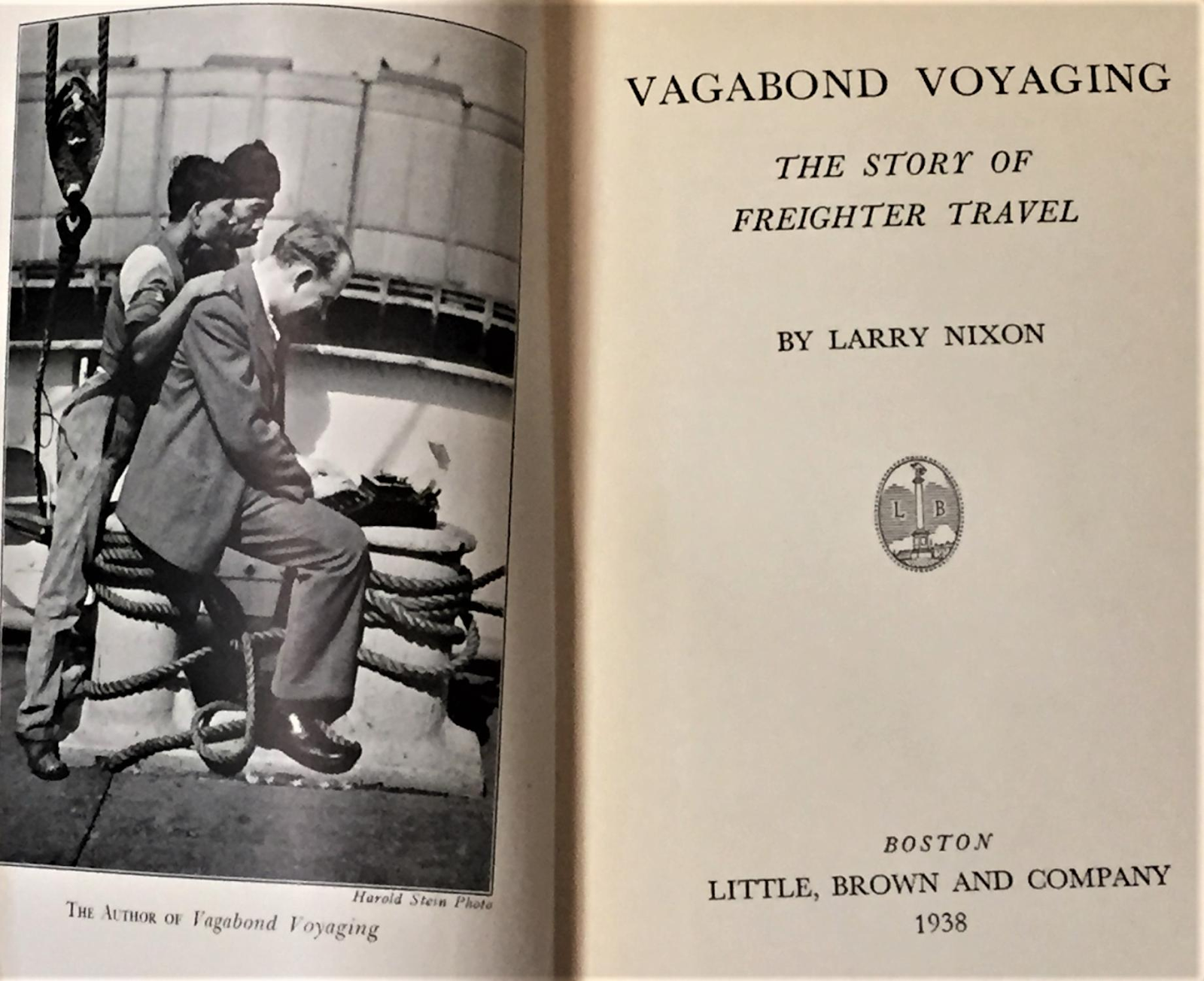
This is Vagabond Voyaging: The Story of Freighter Travel, written by Larry Nixon, press agent, newsman and travel author, he who wrote See Canada Next. Published by Little, Brown & Company.
In 1938.
He published See Canada Next in 1940 and What Will Happen And What To Do When War Comes in 1939. I admit, I'm tempted to seek out that last one. I'd be very interested to see what Nixon had to say to travelers in the Bogart/Casablanca era.
I don't have much information about Larry himself. His name is sometimes given (on Ye Olde Internet) as Laurence A Nixon but I can't help but wonder if that's a typo, since there's a much more famous gent with that name and Vagabond doesn't give him as Laurence anywhere in the text. The copyright's in Larry's name, not Laurence. To my knowledge these are the only three books he ever wrote, though he probably published plenty of articles in magazines and papers.
This one flew off the shelves. My edition is a fourth reprint, November 1938. It first came out in July of that year and was republished three times in 1938 alone.
It probably would have been republished many more times were it not for ... circumstances beyond the author's control.
You hear about girls fresh out of high school who catch a boat across the Pacific to visit their brothers stationed with the Naval Air. You know full well what's going to happen to that brother in short order, but in the book it's all smiles and dances with handsome cadets.
But the story that really got me was the one about the young bride who goes all the way across the waters to meet her Royal Navy beau. "'The Captain gave me a dinner,' years from now she'll tell her guests at tea. Her grandchildren will hear: 'All the passengers were so nice, they gave me presents when I left the boat.' Now you understand the Why of the gifts for the departing guest. You're attending a shower for a bride! She's up to reply, poor girl, she is embarrassed, but happy ... 'And you must all come and visit us in our little home on May Road, the Peak.'"
Yeah, those grandchildren might be a little theoretical.
It comes to something when you wish you had a time machine to tell a bride to be to be careful about having children in the first year or two of marriage.
People say Americans don't like to travel but, if this book and its four printings in four months is any indication, there was a time when they were incredibly adventurous.
Every single freighter that pulled into an American port kept a half-dozen births or more aside for passengers. That argues insatiable demand. Moreover, it was cheap as chips; round the world on a couple dollars a day. The biggest constraint, as Nixon points out, isn't money but time. It takes weeks or months to cross the ocean in a freighter. But, if you have the time, you can go round the world. Nobody's stopping you.
Money really isn't a constraint, if you're determined. Remember my other bit of book loot from a while back, Head-Hunting in the Solomon Islands? This is exactly what those two kids were doing. They got on a ship headed roughly in the right direction and, when they needed extra cash, they painted a few portraits. They saw it all and paid almost nothing for the privilege.
The people who boarded those ships were willing to go wherever the ship went, because there was no absolute guarantee that a ship bound for Toulouse wouldn't, say, be redirected to an African port on the way. These were jobbing vessels, after all; they went where the cargo was. If that happened and you were on board your options were get off or go to Africa.
They ate what the crew ate. A Japanese ship served Japanese food, and so on. There was no all-day buffet, nor was there separate dining. You ate with the crew. They'll do their best for you, but they won't change their meals just because you're used to whatever they serve in Peoria.
You're traveling on almost nothing. This is an age before passports and what we now think of as international banking. You carry hard currency and letters of credit. You carry letters of introduction to prominent citizens at your proposed destination, so you can prove you are who you say you are.
If you want to, you can just vanish.
Honestly, it's the kind of book that changes your whole perspective. Without it you might be tempted to think that the airplane opened up the world. It did no such thing. The world was already wide open. Moreover, it was open to anyone, regardless of income or class. It was the war that closed down travel, not opportunity.
Do you need this book? No, absolutely not. But if you're a Keeper looking to run a travel scenario set anywhen from the 1900s to the 1940s, this is the kind of resource you'll find useful. It has destinations, costs, travel times, accommodations, plus a decent picture of the kind of thing you'll find when you get wherever it is you're going.
It's worth a trip to the library, put it to you that way.
Some housekeeping: no post next week, as I'm off-island wandering through the bowels of New York.
Also, a question to the masses: what GUMSHOE title would you like me to see write about in 2025? Bookhounds, NBA, Trail, something else?
Now, an extract from the Folklore of Guernsey (Marie De Garis, 2014 reprint, original 1975):
Until the First World War, the purlieus around the town church constituted a popular pied-a-terre for several charlatans and sorchiers. These were largely patronized by country people who, sure that they were being bewitched by certain neighbors or acquaintances, would visit those town quacks in hope of being given some counter-charm or advice ... The credulous wife of a well-known farmer residing in the higher parishes, used to be a regular visitor to one of these consultants, a certain Mrs. H. The wife's husband bore one of the most respected and honored names in the Channel Islands and was a man of standing in his parish. The foolish woman gave Mrs. H such huge sums of money that she beggared her husband entirely. The shame of being declared bankrupt so affected her husband that he hanged himself. The house was broken up. The mother went to live with her son but, so far from having learned her lesson, still continued to visit the town crone, passing her son's money to her until she nearly ruined him also. Her two unmarried daughters had to fend for themselves. One followed her father's example and committed suicide, while the other went to work as a maid somewhere ... When the mother finally died, her children felt so bitter about the ruin that she brought upon them that not one of them even wanted her portrait.
Purlieu: The area directly around or outside of a place.
The Town Church of St. Peter's Port, aka Town Church of St Peter, Apostle & Martyr, dates back to the 1400s in its current form. There has been a church on that spot since the year 1000, more or less, and the building's history probably goes back to the Romans.
It's extremely close to the Market and there's a pub, the Albion House, a mere 18 inches away. That pub has been there since the 1700s, so when the writer talks about the church's purlieus, she probably means in or near the pub and what is now the market.
St. Peter Port is the capital of Guernsey and, at the time of Bookhounds, it would still have been much as it was for centuries prior: a sleepy fishing port, occasionally enlivened by smuggling and war. It's watched over by Castle Cornet which, again during Bookhounds, is largely reduced to watching over the pond for toy boats built nearby, in the 1880s.
All that said:
Mrs. H.'s Library
The Hounds buy a job lot in an auction, only to discover that most of the books they bought in that box of miscellanea belonged to a notorious fraud from Guernsey.
Mrs. H, a well-known character in Guernsey circles, recently passed, and what's left of her family wanted to make sure that her memory was properly expunged. This meant, among other things, disposing of her belongings outside Guernsey. They could have burned it all, but her children share one thing with their parent: they're far too covetous to pass up a chance to make a shilling.
This means her hand-written witchcraft journals and the scraps of knowledge that Mrs. H apparently picked up from a genuine Mythos text are now the Hounds' stock.
As books these texts aren't worth much; about 1 point stock, more or less, History (witchcraft). If the Mythos text Mrs. H cribbed from could be found, that would be worth more. That, presumably, is in Guernsey. Lord alone knows precisely where, or even if it still exists.
Soon after the Hounds buy the job lot a widow from Guernsey turns up at their shop, a Mrs. De Beauvoir. She was a regular client of Mrs. H and, since the Hounds now have Mrs. H's books, they must be as knowledgeable as Mrs. H used to be. Mrs. De Beauvoir is being plagued by witchcraft. Can the Hounds help?
Options:
Ghost Hunters: Mrs. De Beauvoir has driven her family to penury thanks to her obsessions and she brings with her a collection of ghosts, all of whom hate her guts. That's why she thinks she's being plagued; she is, just not by witches. If the investigators aren't careful, these ghosts will turn their attention to the Hounds and the shop. When that happens, Reversals are sure to follow.
Crawling Chaos: Mrs. H isn't as dead as people like to think. She picked up just enough knowledge to become a kind of crawling one after death, only to find that Guernsey isn't as accommodating to her after death as it was during life. The undead Mrs. H is looking for a new home, and as 'Mrs. De Beauvoir' she's hoping that the Hounds will be gullible enough to assist.
Family Pressures: Mrs. De Beauvoir thinks that her family doesn't know that she's stolen their savings to make a trip to London to see the Hounds. They very much do, and they want that money back, along with anything that Mrs. De Beauvoir might have given the Hounds. Break-ins, ambushes, tearful scenes at auction houses in front of God and everybody - anything is possible. This may cumulate in an accidental Megapolisomantic effect, as a slice of Guernsey interacting with London mystic forces is just the kind of spice that creates a very peculiar soup.