Showing posts with label Mythos Expeditions. Show all posts

Sunday, 15 December 2024

Vagabond Voyaging (RPG all)

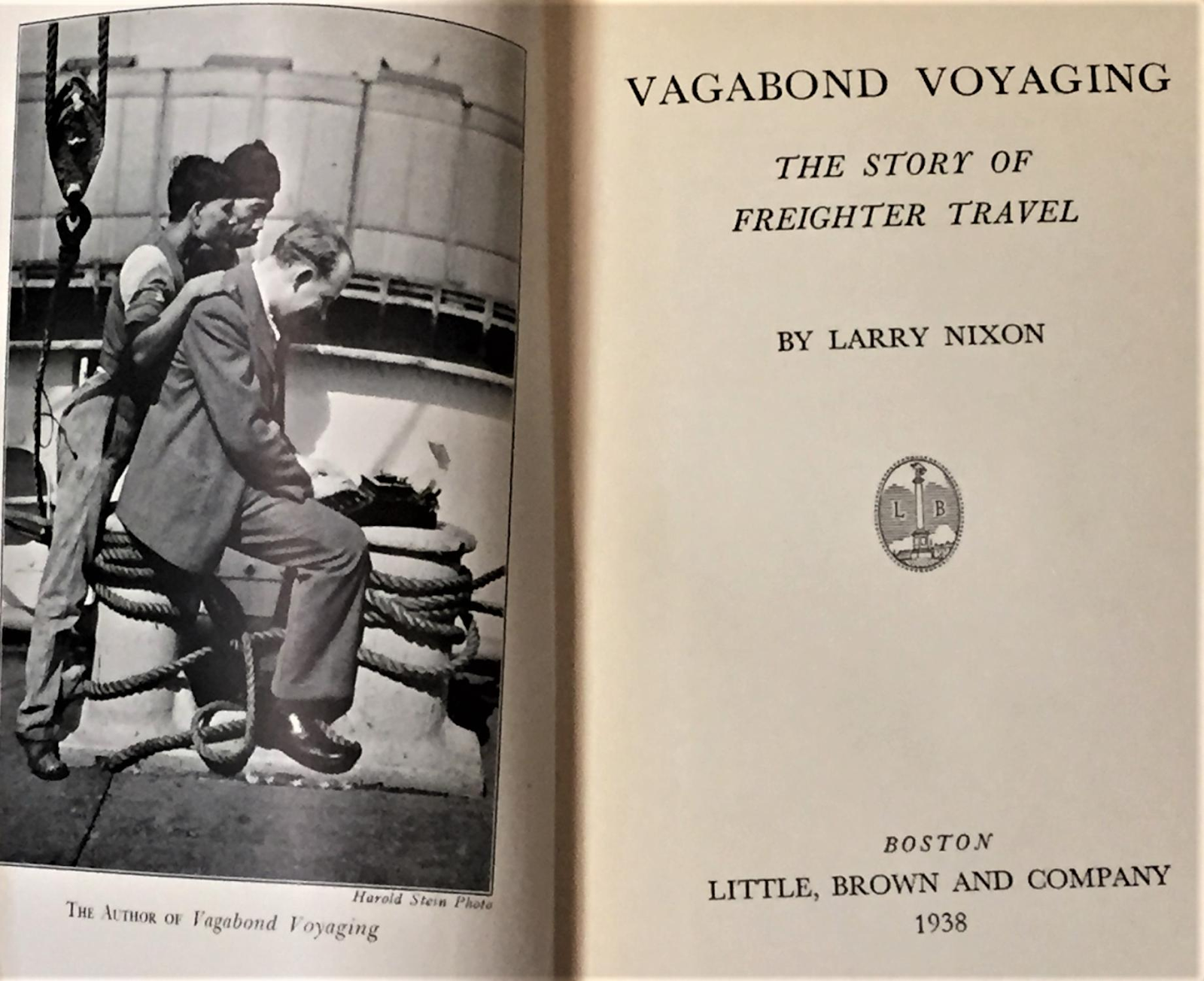
I've been reading the saddest book.

It's not the book's fault. It's meant to be a jolly romp, all about holidays and where you can go, how much you're likely to spend, how long you'll be. I picked it up at the Argosy for a nominal sum, not expecting to be brought to tears. 

Picture this: a stunning cruise across the ocean, from some coastal US town to wherever you care to go. Nothing fancy; no Cunard prices here. This is holiday on the cheap. This is around the world on a buck a day.

This is Vagabond Voyaging: The Story of Freighter Travel, written by Larry Nixon, press agent, newsman and travel author, he who wrote See Canada Next. Published by Little, Brown & Company.

In 1938.

He published See Canada Next in 1940 and What Will Happen And What To Do When War Comes in 1939. I admit, I'm tempted to seek out that last one. I'd be very interested to see what Nixon had to say to travelers in the Bogart/Casablanca era. 

I don't have much information about Larry himself. His name is sometimes given (on Ye Olde Internet) as Laurence A Nixon but I can't help but wonder if that's a typo, since there's a much more famous gent with that name and Vagabond doesn't give him as Laurence anywhere in the text. The copyright's in Larry's name, not Laurence. To my knowledge these are the only three books he ever wrote, though he probably published plenty of articles in magazines and papers.

This one flew off the shelves. My edition is a fourth reprint, November 1938. It first came out in July of that year and was republished three times in 1938 alone.

It probably would have been republished many more times were it not for ... circumstances beyond the author's control.

You hear about girls fresh out of high school who catch a boat across the Pacific to visit their brothers stationed with the Naval Air. You know full well what's going to happen to that brother in short order, but in the book it's all smiles and dances with handsome cadets. 

But the story that really got me was the one about the young bride who goes all the way across the waters to meet her Royal Navy beau. "'The Captain gave me a dinner,' years from now she'll tell her guests at tea. Her grandchildren will hear: 'All the passengers were so nice, they gave me presents when I left the boat.' Now you understand the Why of the gifts for the departing guest. You're attending a shower for a bride! She's up to reply, poor girl, she is embarrassed, but happy ... 'And you must all come and visit us in our little home on May Road, the Peak.'"  

The Peak in Hong Kong. 

Yeah, those grandchildren might be a little theoretical.

It comes to something when you wish you had a time machine to tell a bride to be to be careful about having children in the first year or two of marriage.

People say Americans don't like to travel but, if this book and its four printings in four months is any indication, there was a time when they were incredibly adventurous. 

Every single freighter that pulled into an American port kept a half-dozen births or more aside for passengers. That argues insatiable demand. Moreover, it was cheap as chips; round the world on a couple dollars a day. The biggest constraint, as Nixon points out, isn't money but time. It takes weeks or months to cross the ocean in a freighter. But, if you have the time, you can go round the world. Nobody's stopping you.

Money really isn't a constraint, if you're determined. Remember my other bit of book loot from a while back, Head-Hunting in the Solomon Islands? This is exactly what those two kids were doing. They got on a ship headed roughly in the right direction and, when they needed extra cash, they painted a few portraits. They saw it all and paid almost nothing for the privilege.

The people who boarded those ships were willing to go wherever the ship went, because there was no absolute guarantee that a ship bound for Toulouse wouldn't, say, be redirected to an African port on the way. These were jobbing vessels, after all; they went where the cargo was. If that happened and you were on board your options were get off or go to Africa.

They ate what the crew ate. A Japanese ship served Japanese food, and so on. There was no all-day buffet, nor was there separate dining. You ate with the crew. They'll do their best for you, but they won't change their meals just because you're used to whatever they serve in Peoria.

You're traveling on almost nothing. This is an age before passports and what we now think of as international banking. You carry hard currency and letters of credit. You carry letters of introduction to prominent citizens at your proposed destination, so you can prove you are who you say you are. 

If you want to, you can just vanish. 

Honestly, it's the kind of book that changes your whole perspective. Without it you might be tempted to think that the airplane opened up the world. It did no such thing. The world was already wide open. Moreover, it was open to anyone, regardless of income or class. It was the war that closed down travel, not opportunity.

Do you need this book? No, absolutely not. But if you're a Keeper looking to run a travel scenario set anywhen from the 1900s to the 1940s, this is the kind of resource you'll find useful. It has destinations, costs, travel times, accommodations, plus a decent picture of the kind of thing you'll find when you get wherever it is you're going. 

It's worth a trip to the library, put it to you that way.

That's it for this week!


Friday, 12 June 2015

Knights of the Air: Trail and the Great War

If you're looking for a video series to absorb hours of your time, I highly recommend The Great War, a YouTube channel that focuses on the events and personalities of that world-shattering conflict. The production team has chosen to focus on some of the undeservedly obscure elements of the war, like South Africa's role in the conflict, which makes it invaluable for Keepers wanting to set a scenario somewhere unusual.

All of which brings me back to Dulce et Decorum Est, and the air war. I've talked previously about mixing game types, linking several different Trail concepts in a single, overarching narrative. This time let's consider what it would mean to mix the air war rules found in Flying Coffins as well as Dulce, and the survival rules found in Mythos Expeditions.

The Middle Eastern theatre of operations is one of the least studied, unless you happen to be a fan of Lawrence of Arabia. However from an air war perspective it is very interesting. Germany began sending the Turks aircraft very early on, and by the end the Turks had the benefit of some of Germany's best fighter designs, such as the Albatros and Halberstadt. Even as the original Eindecker was making mincemeat of allied aircraft over the Western Front, the Germans were sending its latest designs to the Ottomans. They were opposed by the British and Australians, operating out of Egypt as part of the Expeditionary Force. From a Keeper's point of view, possibly the best time to stage a scenario in this conflict is early 1917, as Allenby is forming the Palestinian Brigade in a desperate attempt to stave off air defeat by a superior German-backed air force.

The Arab Revolt is already well under way at this point, Lawrence is busy blowing up train tracks, and the Ottomans are beginning to feel the pressure. The British are poised to take the Sinai Peninsula, and are looking hungrily at Rafa, an important military stronghold. Number 1 Squadron AFC is moved closer to the scene of the action to support ground assaults. The protagonists, it can be assumed, are part of Number 1 Squadron. They need to be able to establish and hold air superiority, which is going to be next to impossible since the Germans have very strong air combat capability. During the battle, German air raids are going to be a very difficult challenge for the allied attackers.

The Keeper might consider a few prelude scenes before the main action, perhaps set in Cairo, as these dashing young pilots arrive in the Middle East and begin training. Here they learn about Mordiggian for the first time, and discover that there is a small group of quasi-cultists within the Palestinian Brigade, blessing bullets, as they have been taught to do by home-grown Mordiggian cultists, possibly even agents of the Brotherhood of the Black Pharaoh. These bullets require blood sacrifice to make, but if they are used against the enemy then their effectiveness is greatly increased. The protagonists may be intrigued by this, and even be tempted to use them, so long as the blood sacrifice is limited; goats, say, or other small animals. Of course, the most effective bullets require human sacrifice ...

Then battle begins, and the pilots are tested, perhaps even found wanting. German air operations are taking their toll, and allied command  is not happy at the losses suffered as a result of successful German bombardment. A big push is on to take Rafa; the protagonists had better up their game. At this point the Keeper ought to throw in several fierce air engagements near the scene of the battle, as troops begin to deploy. Personalize these defending German aircraft; perhaps one or two of them become nemeses for the attacking Australian pilots.

Close this scene with a demand from the cultists: perform a blood sacrifice, and all will be well; we can ensure you defeat your enemies. But if you don't, our curse be upon you! A personal appearance from an avatar of Mordiggian, or a particularly dangerous creature, would be very useful at this point. This is the entity that has to be fed. The protagonists don't have to find their own victims. The cult is happy to provide the sacrifices, but it has to be the protagonists who decide whether or not to carry out the ritual.

Then they take to the air, fighting over Rafa. If they chose to carry out the ritual, then they enjoy tremendous success, as their new bullets seemingly cannot miss, and do great damage. Perhaps those German nemeses go down in flames very quickly, now that the protagonists have access to these magic bullets. If they didn't, then the German forces are all but overwhelming. Attack after attack leaves the Australian planes in shreds, low on ammo, smoking and about to crash.

The scene should end with the aircraft forced down. If they didn't carry out the ritual then this shouldn't be difficult to arrange. If they did, then the pilots are horrified to discover that their own aircraft are turning against them, becoming monstrous things, demanding blood. If the protagonists don't immediately land and abandon ship, then these vampiric entities will drain them dry. This is definitely worth a Stability check.

Now the pilots are on the ground in Palestine, somewhere near the fighting. They don't have psychic powers, so there's no way to know who's in control of Rafa; they need to get somewhere safe, and eventually back to their squadron. They also need to avoid Ottoman patrols.

This is where the Survival Pool needs to be established, and I would base it on the number of pilots, on the assumption of 2 points per pilot, representing any charts, navigation equipment, and water that they may possess. Naturally they ought to destroy anything that the enemy might find useful, like documents which show current Allied positions, but since those are also the charts that they might be using to find their way back, they may be reluctant to do this. If they do, then feel free to reduce Survival by 2. The area around Rafa is best described as hot semi-arid, which means Survival tests are either Hostile (in the area immediately around Rafa) or Very Hostile (everywhere else).

Now the pilots have to make their way back. Possible challenges include desert Arabs (are they on our side, or in the pay of the Ottomans?), attacking enemy aircraft, dust storms, leaking water bottles, and mine fields. If the Keeper feels that the protagonists might be about to snuff it, perhaps those Arabs turn out to be friendly, or perhaps the protagonists find an unexpected source of water; say, from dead soldiers' canteens, which would mean a Stability test.

On their way they spot a landmark that isn't on the map. It is an abandoned fort, possibly dating all the way back to the crusaders. Nobody would establish a fort without ensuring it had a water supply, would they?

Here is where they have their final encounter with the forces of Mordiggian. Of course the fort isn't truly abandoned; this is one of the Old One's fanes, where it is worshiped in nightmarish, bloody ritual. Did the protagonists make sacrifice and get those magic bullets? Then they are welcomed with open arms, and the scenario may end with them descending into madness as they embrace the blood rites, and become one with Mordiggian's worshipers. If they did not, or if they choose to avoid the fort altogether, then they are pursued across the desert by the creatures that live within, and spend the final scenes of the scenario on a knife edge, low on Survival, throats dry, water out, no way of knowing how far away safety is, and pursued relentlessly by things they cannot, dare not, comprehend.

That's it for now! Enjoy. 

Tuesday, 1 July 2014

Mythos Expeditions

I probably oughtn't say too much about this here, but since Pelgrane's been spreading the word on Facebook I suppose I can talk a little about my contribution to Mythos Expeditions.

Expeditions, for those not familiar with the product, are 'a collection of adventures designed to be run as a stand alone with new rules tailored for expeditions or as part of the Armitage Files campaign setting in the core rules.' My contribution is Lost on a Sea of Dreams, about a trip to Bermuda to assist William Beebe. Again, I can't tell you much about the scenario, but I can tell you that when Beebe was in Bermuda he didn't get on at all well with the scientists already in place at the Biological Research Station, now known as BIOS.

The BRS had been in operation for over twenty years by the time Beebe showed up in 1928. It had been established by Harvard and New York University academics who realized early on how useful Bermuda could be for oceanic research; it probably helped that the climate is exceptionally pleasant year-round. For that matter the island was a major staging post for Prohibition blockade runners throughout the 1920s and early 1930s, a fact which can't have escaped the scientists' notice. It must have been quite pleasant to get a secondment out to a bucolic sub-tropical island, where the booze flowed freely and there was valuable work to be done.

But the established academics viewed a chancer like Beebe - who had no actual scientific credentials, and a reputation for being fast and loose with the facts as well as with women - with grave suspicion. "To tie up with such an explorer and exploiter would certainly kill our chances [of getting a cash grant from the Rockerfeller Trust]," said Professor Mark, one of the BSR's top people, and Dr Wheeler, the then director, took statements like that very seriously. It was the Great Depression, and the BSR had a significant cash flow problem; without grant money from the British Government and charitable donations from institutions like the Rockerfeller, the BSR was sunk.

The end result was a kind of 'live and let live' truce between Beebe and the BSR. Beebe was told not to use the BSR's name in any of his publicity or reports, and for its part the BSR pretended Beebe didn't exist. Beebe was given Nonesuch Island to use as his staging post, which suited BSR very nicely as it meant he wouldn't be using its facilities. No doubt when Beebe finally left the island eleven years later, the academics of the BSR breathed a quiet sigh of relief.