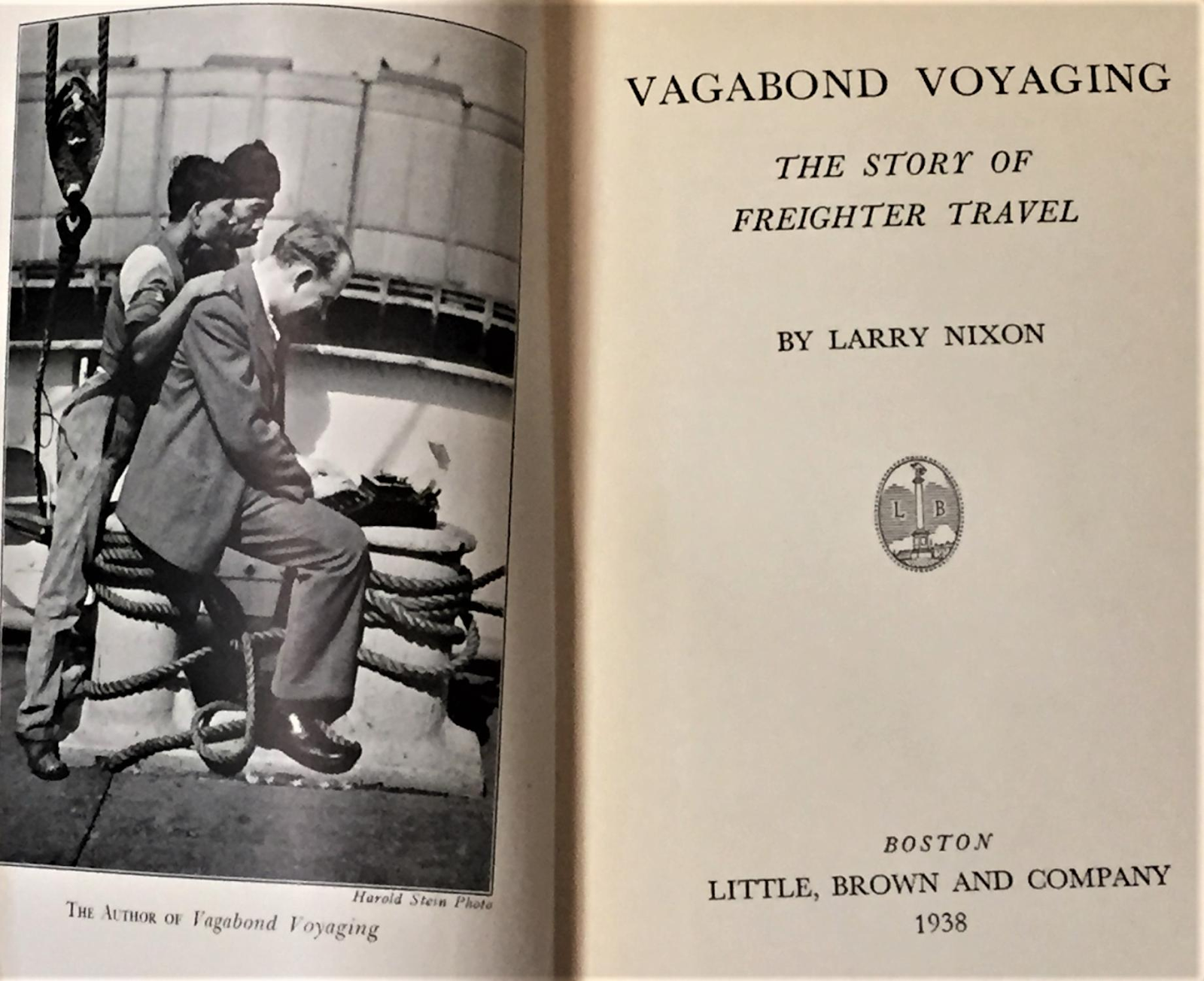
The last time I mentioned Larry Nixon it was because I'd picked up the saddest book, Vagabond Voyaging. That got me on a bit of a Nixon kick, because he also published What To Do When War Comes and I was so fascinated to find out what a travel guy thought about the upcoming global conflict I kept seeking it whenever I went into an antiquarian bookstore.
Finally I broke down and bought a copy off of the internet (boo!) and since the internet was so helpful I also decided to pick this up. Because why not.
It's the same concept as Vagabond Voyaging. Go on vacation for a dollar a day. The difference being this time it's within the United States, not on a packet steamer going heaven-and-commerce only knows where.
In and of itself there's nothing wrong with the idea. There's a lot in its favor.
He starts the book with a chapter called Shank's Mare.
The cheapest form of vacationing is found when you do all the work yourself. Spend no money for transportation on train or bus. Walk! Shoe leather's cheaper than gasoline, and while you're out burning some of the winter's fat, you'll add strength and endurance to help you face the long grind in the coming months. Don't pass out your coin in tips. Be your own waiter, cook, bus boy, and hotel clerk. Hit the trail!
Sounds nice, doesn't it? Not relaxing, exactly, but meditative. An early iteration of touch grass.
Published 1940.
In 1942, at least a third of his American adult male audience is going to go on an extended walking tour of Europe, North Africa and, for some lucky few, selected parts of Asia and the East. If I had been one of those and had read this book, I would have come back and kicked that Nixon character right where it hurt the most. Never have I read an author whose work entirely failed to read the room.
Mind, as I said before, I've almost no idea what happened to Larry Nixon. About the only thing I've got on him is a Times obit, June of 1953, which I shall reprint here in full.
Larry Nixon, Director of Public Relations for Hewitt, Ogilvy, Benson & Mather, advertising, died on Wednesday in his home at 42 West Fifty-sixth Street. His age was 56. Mr. Nixon had been in public relations work for thirty years. He was the author of “Vagabond Voyaging” (1938), “American Vacations” (1939), and “See Canada Next” (1940), all published by Little, Brown & Co. He was born in New Orleans and had served as assistant to the publisher of The Billboard, theatrical periodical, editor of Airways, assistant public relations director for Pan American World Airways, and public relations consultant to the New York State Civil Defense Commission. In 1939-1940 he was press representative at the Bell Telephone Exhibit at the New York World's Fair. He also formerly was a partner in the public relations firm of F. Darius Benham and Larry Nixon. He leaves his wife, the former Dorothy Eiser; three daughters, Mrs. Cynthia Falkoff and Robin and Jan Nixon; his mother, Mrs, Leola Nixon, and two sisters, Mrs. Dorothy Younse and Mrs. Mildred Nolan.
No mention of what he did during the war. Presumably he was too old to serve. I note the obit doesn't mention his other book, What To Do When War Comes, of which he was editor. The company he worked for as DPR still exists; it's called Ogilvy these days.
Honestly, he reminds me not a little of Anthony Scaramucci. If it had been possible in his day, Nixon would have been a podcaster. Just exactly that level of not-famous-but.
Should Keepers buy this book? Well, not unless you absolutely want to. It's a fun read and there's lots of information to help you set sessions in the 1930s, but it's a specialist subject. If you can get it in the library, great! I'd class this in the same category as Ruth Brown Park's book about running book stores. It's handy to have, a source of inspiration. It's not absolutely necessary.
Keepers who might benefit the most from this are those wanting to run sessions of Campfire Tales. While I have a copy I haven't read it yet and don't feel familiar enough with the rules to comfortably run a session. But I am keeping this in mind ...
I will add a warning against period racism. It's not egregious, but it is there.
There are two parts of Larry's book I'm going to draw on today. One is the shank's mare chapter, the other The Farmer And His Daughter.
Shank's Mare spends a lot of time talking about Walking Clubs. This is the later 1930s and FDR ha spent a decade building up America under the Civilian Conservation Corps program. There are now plenty of walking trails, cleared and established, across the country. On their heels come hundreds of Clubs whose members walk those trails, and who establish cabins along those trails for overnight stays.
Supper-and-lodging is available for two dollars. That pays for your meal and bunk, mattress, pillows and blankets. There are dormitories for men and women. The campfire conversation is free - as is the advice you will get from the local huntmaster, who is always glad to help the stranger discover the beauties of the side trails. Breakfast is seventy five cents, lunch at the hut or in a parcel for eating out on the trail is only half a dollar. Visitors who want to stay all day pay three dollars for their meals and overnight bunk.
Sounds cosy, doesn't it? Much like the Conservation Corps, all this will come to an end in 1942. Parts of it will stagger on during and after the war, but this is a system that relies on civilian volunteers and there aren't going to be many of those in the next few years.
The Farmer and His Daughter describes the common practice of taking rooms at a farm house or plantation (again, period racism). If Larry's to be believed, not only was it all quite nice and civilized, it was a repeat business. Farmers would regularly rent out space to city dwellers looking for time out in the country. Whether they'd rent their own space or build special rental units was up to the farmer. An early form of Air B&B, effectively.
The food, like the quarters, varies with the territory, the farmers, and the insistence of the guests. If you complain long enough and loud enough the farmer will stock almost any kind of food you choose, but take what is put before you and you'll more than likely gain weight; farmers aren't known for underfeeding.
Beside the conventional sports and swimming, you'll often find specialized farm activities that interest the visitor. The farmer has discovered that his guests like to fuss around and pretend to work. Pitching hay is good for your back muscles and even chopping the garden does something to strengthen you. The first few days at the farm the average visitor will pull the weeds or hoe the corn in frantic energy while farm folks look with wonder at their unpaid helpers. It's the old story of the other fellow's work being more interesting than your own ...
What happens if you rent a farm in Lovecraft Country for your vacation?
A Little Place in the Woods
There's a cottage near Arkham, in Billington's Wood, part of a farmstead owned by Eugene Blanchford. It's something Blanchford got by marriage; his uncle married a Billington, died without issue, and the cottage became part of Blanchford's farmstead. Blanchford values the acreage (all the better for his apple plantation) but had no use for the cottage until four years back, when some Arkhamites seeking a rural vacation spot persuaded him to rent the place.
Since then, Blanchford's had enquiries from as far away as New York City. The cottage is a miniature gold mine, particularly in the off season just before picking time. He's even had a few who want the place over Christmas, in spite of its isolated location. The wintertime is just like a picture postcard, say his guests.
Mindful of his newfound success, Blanchford has started collecting furniture and other creature comforts to make his vacationers feel at home. There's even a small library, made up principally of books that his people leave behind them but also a small collection of things the family has gotten, over the years.
Including a dusty copy of Ward Phillips' Thaumaturgical Prodigies in the New-English Canaan, with annotations, nestled between the battered S. S. Van Dine locked room mysteries and the Mills & Boon romances.
Option One: Romancing the Stone. Blanchford asks for help uncovering the origins of a peculiar stone monolith that one of his guests has found not far from the cottage. It has markings on it that resemble Ogham, and Blanchford wonders whether this is a significant find. It turns out that the holidaymaker didn't find it, exactly; they were guided to it by notes in the Thaumaturgical Prodigies, and the stone dates back to the early 1800s, when it was put there by one of the Billington breed.
Option Two: Tree Loving. In a fit of boredom, and guided by notes in the Thaumaturgical Prodigies, some of the Christmas vacationers try out a 'pagan ritual' for jollies. After this, they report seeing something peculiar out in the woods, where they tried their magic spell. Are those trees moving? Why? Blanchford gets involved because it's his orchard; are those valuable apple trees moving about?
Option Three: Former Owners. Some of Blanchford's guests complain of noises in the night. Creaking and muttering that can't be explained by floorboards or rats. Blanchford doesn't want his gold mine to lose its lustre and he's willing to try anything once, so he brings in some bona fide exorcist types to cleanse the place. Turns out one of the pieces of furniture he brought in has an unsavory past: that four-poster bed has seen its share of deaths, and one death in particular lies heavy on it. Are those bedsheets moving?
That's it for this week. Enjoy!