Sunday, 18 September 2022

Let's Play A Game (Night's Black Agents)

Roundabout p. 187 of the NBA main book Ken Hite starts talking about possible scenarios, and gives nine active scenario examples:

  •     Destroy. The agents must destroy the local conspiracy apparat.
  •     Flip. The agents must flip an asset to their side.
  •     Heist. The agents must steal something
  •     Hit. The agents must kill someone
  •     Hunt. The agents must find someone.
  •     Rescue. The agents must rescue someone.
  •     Sneak. The agents must infiltrate a secure location.
  •     Trace. The agents must find something, possibly something that went missing long ago.
  •     Uncover. The agents must uncover a mystery.
Each scenario type can be reversed so a Destroy operation can become a Protect operation in which the agents have to defend something of theirs against enemy action.

I thought it might be interesting to discuss each operation in turn, using Bankhaus Klingemann of Bonn as the subject in each case. The Bankhaus is a Node I've developed before and if you're interested in knowing more about it I recommend the previous post. 

Briefly: the Bankhaus is an investment bank with a murky past and has offices in several major cities, of which the Conspiracy has control over the Paris and Zürich branches thanks to its control over Lisle Klingemann, daughter of the boss and a senior partner in her own right, and Albert Ahrens, controller of the Zürich branch and Lisle's devoted slave. The Bankhaus is mainly interested in software development companies, particularly in jurisdictions within Europe, though it has a significant sideline in mining, especially in East Asia, a holdover from its former interests.

It has swanky offices, lawyers, a ton of assets on the book and off, and when it makes calls they get answered by senior politicians and members of the financial elite. It almost doesn't matter whether this is a Supernatural, Damned, Alien or Mutant game; all factions are going to want a piece of the Bankhaus whether to get access to its bottomless bank vaults or for more esoteric reasons.

Let's talk Destroy.

Destroy assumes that the target has something that can be blown up, burnt down or otherwise wiped out, preferably in an impressive display of pyrotechnics. It also assumes that people are going to die or be ruined in some way, either because they end up in jail for a very long time or are otherwise taken off the board and put in a position where they can't return. 


Sony Pictures

Often this involves some kind of Infiltration. This may be an Infiltration in plain sight where the agents have to get access to, say, the Embassy Party by pretending to be guests and wait staff, or it can be the more usual kind of infiltration where the agents sneak in under cover of darkness.

It usually doesn't involve psychological or mystery tropes. As a rule, a Destroy scenario has a clear objective which has an identifiable value. It may be a bogus objective - your princess is in another castle - but the agents know at the start that the objective exists and can be found. 

It doesn't have to involve outright violence. Bond's Casino Royale is basically a Destroy scenario in which Bond is tasked with beating Le Chiffre at Baccarat, because Le Chiffre has been embezzling from his bosses and it's hoped that if Bond wipes him out the bosses will wipe out Le Chiffre. This works so long as your agents enjoy the kind of specialist play that the scenario demands. Thrilling Infiltration, say, or Thrilling Digital Intrusion. 

Double agents often provide spice to the narrative; in Navarone one of the team is revealed to be working for the enemy. This is problematic for the Director. Either one of the players has to be the double agent, which is fine up to a point but can cause group conflict out of game as well as in it, or one of the NPCs has to be the double. You can't over-use this idea, or the agents will distrust every single NPC they come across. It works best in Mirror-style games where the idea of betrayal is baked in.

Apply the Rule of Four to this and all scenario types. Four characteristics of this Destroy scenario which you can bring into play at any time. More than four and you will start to lose track.

Kreis 1:  Albert Ahrens has a home in Zürich's old town which he's kept carefully off the company books. He's owned it for more than thirty years and there are some dire secrets buried under those floorboards, secrets that he'd do anything to keep out of the light of day. Not least of which is his latest Lisle-a-like, who's undergoing psychological torture so she can better fill her role. Her predecessor is one of the things buried under the floorboards.

Slush Fund: Lisle keeps a special fund for her frequent, illicit trips to casinos. It's hidden under the company books as a special investment fund, the Raptors, and each Raptor holds the debts of the previous Raptor on its books as assets. Currently there are more Raptors than even the company accountants can keep track of and one of these days a whistleblower will make hay with them. Lisle isn't as clever about money as she thinks she is; she relies on bluff and a reputation for financial infallibility to keep the Raptors off the radar. 

Project Achilles: The Bankhaus is deeply vested in a French software development company, a start-up with a stellar reputation but not - yet - much in the way of product. The jewel in the crown is something called Project Achilles, a new kind of vulnerability testing software specifically designed to defend against resource stealing. It's garnered a lot of attention and several governments are thinking of buying into it. The firm, Kube Group, has its main offices in Paris with representation in Monaco, but for some reason it has a satellite installation in Rome - nobody knows why.

Tracfin: Allegedly the Traitement du renseignement et action contre les circuits financiers clandestins, France's intelligence service dedicated to defending against money laundering, is interested in the Bankhaus. This isn't exactly news; Tracfin is interested in pretty much everything that goes on in the financial world. What isn't nearly as widely known is that Lisle has infiltrated Tracfin and is using it against her company's rivals. Lisle's contact within Tracfin, senior investigator Claude Leroy, is rapidly becoming a Renfield and is Conspiracy-knowledgeable but doesn't have a way in other than through Lisle. Leroy can use Law and Heat to make life very difficult for the agents, and if necessary can brand them as terrorists or terrorist sympathizers to get the heavy mob involved.

With those Four Things the agents have at least two potential avenues of attack. They can ruin either Lisle or Albert by exposing their secrets, or they can Destroy valuable assets by going after the Kube Group's assets in Paris or that mysterious satellite in Rome. Any of these targets could weaken the Node if they were taken out. Meanwhile in addition to any resources the Node might have in its own right it also has that willing stooge at Tracfin who can up the agent's Heat or get the heavy mob involved, perfectly legally. All this is before any supernatural assets get in on the action.

Potential scenario locations include Paris and Zürich with a side trip to Rome or Monaco, if the agents feel like it. As Director you'd want to at least have a surface understanding of all those locations - nothing fancy, just a quick-and-dirty. 

The agents get to pick for themselves exactly how they Destroy the target. 

Now, let's flip this over and look at it as a Protect scenario. What exactly are the agents protecting from Bankhaus Klingemann?

They could be protecting allies within the French government or software development or the financial sector. The Bankhaus would be interested in Destroying any of these and have the tools to do so. Alternatively, the agents could have allies or assets within the Bankhaus or Kube Project itself that need protecting. After all, Lisle has an interfering brother who might be a crucial asset, or there could be a whistleblower in Kube Group providing valuable intel about that mysterious project in Rome.

The Four Things remain exactly the same. The difference is, if the agents go after any of these Four Things it's not to Destroy them necessarily; it's to Protect whatever asset needs defending. So the Kube Group insider, let's say, is Protected when Uncle Albert has to deflect attention from that peculiar house of his, or Lisle has to hide her gambling debts. Perhaps Lisle's brother Eric will breathe easier when Claude Leroy is out of the way. 

In any event the point I'm getting at is this: the terrain does not change whether it's a Destroy or Protect operation. What changes is the objective. Which means you can re-use the same terrain as a Protect scenario even if it was written as a Destroy scenario, if there's reason for you to do so.

This is something you should always strive for no matter what system you're writing for. Never kill yourself with work, particularly if it's the kind of work that nobody but you will ever see. Instead make sure that the scene, asset, or whatever it may be, can be used multiple ways for multiple reasons.

That's it for this week! Enjoy.


Sunday, 11 September 2022

Not Quite Book Review Corner: Mick Herron (Night's Black Agents)


via Waterstones

Mick Herron's Slough House series, a must-read for Night's Black Agents players and Directors alike, has two major themes that it rams home again and again.

  1. The English are their own worst enemy.
  2. Boris Johnson is an arsehole.
Which is fair enough so far as it goes. I don't think anyone would disagree with point 1. Point 2 depends largely on whether you believe Boris is a Blofeld or an idiot. Or both, but personally I lean towards idiot and have done for many years. For that reason I think Herron gives Johnson too much credit.  

The Slough House series is set in modern Britain of the mid-to-late 2010s. It presumes there is a dead letter office for spies, Slough House, where the cack-handed and past-it are sent to while away the days waiting for retirement. Its nominal leader is Jackson Lamb, a cold warrior whose glory days are so far behind him you couldn't see them with a telescope. He's the anti-Bond, charmless and bullying, who somehow manages to get things done despite everything. Underneath him are an ever-changing band of misfits. One or two may drop off the twig from book to book, but Slough House survives.

Despite being a spy series unlike a le Carré narrative nearly all the action takes place in London. The George Smiley lookalike is dead by his own hand after selling Her Maj's secrets to the Russians, and the current leadership is more Judi Dench M than anything else. Though you presume all these actual spies doing real jobs over at Park House - the ones who haven't been shitcanned to Slough House - have adventures in foreign lands, the ones at Slough House are lucky if they get a day trip to the Barbican which, as it happens, is right next door.

The main antagonist of the series is Joris Bohnson, aka Peter Judd, who crops up again and again in several different roles across the series. He doesn't have it in for Slough House per se, at least not in the early books (I haven't read the entire series). However, his latest wheeze always seems to involve Jackson's lambs somehow, whether on the periphery or as the main event.

Herron had a very tedious trick in his first novel, Slow Horses, which I'm glad to say he has dropped. Slow Horses revolves around a kidnapping by a British terror group, BNP-adjacent white supremacists who've decided to execute a British Pakistani Muslim in retribution for some tedious thing or other. In that novel Herron would strongly suggest in the narrative that X has happened when in fact it was Y, and when Y is revealed Herron does a little dance to show how clever he has been. This misdirection is fun once. Fun twice. On the three-hundred and forty-ninth repetition it gets wearisome. 

Thankfully he does not overuse it in the other Slough House novels. 

He does do one thing he deserves praise for: he mentions Brexit. Not by name. Rather like Yog-Sothoth, Brexit must not be named. However, it does turn up as a plot point, which is something I've not seen other authors working in modern-day settings do. 

Real Tigers has a plot device that Night's Black Agents Directors, and possibly Dracula Dossier Directors, ought to steal. Without giving the game away, the device is this: the British Secret Service keeps what it calls Grey Books, a series of files about conspiracy theories and the people who believe them. They do this for two reasons. First, the people who believe that the Queen was in fact a Reptilian are sometimes one Armalite away from doing something tragic. Second, there might (just might) be some useful intel in there somewhere. 

The villains of the piece want those Grey Books and coerce Slough House into getting it for them.

The Grey Books are plausible. You can imagine every intelligence service keeping something like them, and there are real-world examples. In Night's Black Agents there's every reason to think those Grey Books contain useful intel about everyone's favorite conspiracy theory: the vampires that secretly Rule The World. They'd be prime targets for every Night's Black Agents group and the great thing about it is, every national government would have something like those Grey Books. You don't have to restrict this to a London setting. It could as easily be the Vatican, or France's DSGE, or German's BND. 

To that end:

Tiger, Tiger Burning Bright     

Your tiger team is tasked with breaking into the national intelligence agency's archives and stealing the Grey Books, their version of the nutjob files. Every conspiracy theory that gained traction is in there. It's considered a relatively safe thing to steal; not exactly the crown jewels of the nation's security secrets, but important enough to be kept behind a door with more than one lock.

Your supposed Mr. Johnson (no, not that Johnson) is a high-ranking politician who wants to tweak the tail of the security services. They think that embarrassing the current Head of Security will get them leverage in their latest political scheme. What Mr. Johnson doesn't realize is that his second-in-command has personal reasons for wanting that file and will take the first opportunity to steal it from the group.  

That leaves the agents swinging in the wind. Mr. Johnson, seeing how his scheme has fallen apart, will deny all knowledge. Hire a tiger team to test national security services? Never! Not our Mr. Johnson. Meanwhile the second-in-command is in the wind and the agents are effectively on the run - unless they can somehow get that file back. Even if they do, will they be able to buy their way back into the government's good graces or are they permanently ruined?

On top of all this: just what's in that nutjob file that everyone seems to want so badly?  

Sunday, 4 September 2022

He Who Wields The Knife (RPG All, Serpentine)


They’re having a leadership contest over in the UK, don’t know if you noticed. A couple of has-beens are racing to become captain of the Titanic. One, Rishi Sunak, is known to have been jockeying for position behind Boris Johnson’s back before the leadership contest even kicked off. That seems to have given his rival Liz Truss the advantage, under the old political cliché ‘He who wields the knife never wears the crown.’ 

Although the phrasing is Michael Heseltine’s – he who famously drove a stake through Maggie Thatcher’s political career – the sentiment is one for the ages. It’s a generally accepted truth in coups, revolutions, and Shakespearean tragedies that the people who kick off the shooting match by taking direct action at the leadership do not survive the weeks, months or years of chaos that follows. Either the powers that be retain control, in which event there are bloody reprisals, or the knife-wielder ends up everyone’s target in the ensuing melee. 

Oddly enough it’s a factor that you’ve seen play out yourself more than once, though you may not have realized it at the time. In every competitive game you’ve ever played there has always been a point where one player is clearly in the lead, at which point every other player joins forces to bring the leader down. Even those who clearly have no hope of winning themselves start cooperating with those who do, or might.

Of course, if you wield the knife you might at least be remembered, as Richard III has been remembered. Buried under a car park, mind you, but remembered nonetheless. Whether the annals of history matter to you while the worms gnaw your desiccated remains is a matter for conjecture.

Knife follows knife, more often than not. Julius Caesar famously crossed the Rubicon and defeated Pompey Magnus in civil war, only to die at the hands of men who themselves died on the battlefield.  Robespierre saw Louis XVI to the guillotine and himself ended up under the guillotine, but he was not the last so to die. 

In RPG settings there’s a lot to be gained from bloody revolution. It’s an excellent plot hook and motivates action. Of course, the characters are likely to be on the sidelines at first, perhaps hired by [INSERT NPC HERE] to be one of the Act 3 Scene 3 Murderers. Or perhaps something else, but whatever their actual role adventurers are used to being hired by someone else to Do A Thing.

If this were Night’s Black Agents, for example, it is definitely in keeping for the agents to be hired by [WHOEVER] to Destroy, Hit, Flip, Heist, or whatever it may be. They may not realize, or care, that they’re working for vampires, at least not at first. A job is a job, after all.

The problem comes when they’re forced to realize that it’s not just a job. That the Heist they were paid to take on was carried out in furtherance of someone else’s scheme. That the Nodes at Tier 2 of the pyramid are looking hungrily at the undead at Tier 1 and wondering if they have what it takes to overthrow the leadership. To become Caliph instead of the Caliph.

After all, if he who wields the knife seldom wears the crown, what do you think happens to the lackeys of he who wields the knife? Shakespeare doesn't even tell you what happens to the murderers in Macbeth. It probably isn't pleasant but if Shakespeare can't even be bothered to say 'dead in a ditch' - well, that's just rude.

An alternative which puts the players at the heart of the action is to have them being the ones actively seeking power. Cyberpunk 2020 or Cyberpunk RED has an obvious means of making this work: have the characters be important executives in a corporation. Probably a smallish one; not Arasaka, but maybe a weapons supplier or manufacturer. A corporation that might be bought out by one of its competitors. That way the characters have a honeypot to reach for: being the ones with all the shares when the white knight swoops in with cash in hand.


Swords of the Serpentine has a section in the early part of the book that talks about a similar group concept: the Family Business. I’m going to quote that section here:

You may be a prestigious member of the Ancient Nobility, the merchant princes behind a major Mercanti guild, or even a close-knit family of commoners who have taken up a life of crime. For you, family is everything — and when family and friends get threatened by personal or political enemies, you turn to heroics to get your own back. This style of game deals with family politics and social pressure as much as external threats; you may have just slipped into a rival’s office to poison their wine, but is that going to make your mother proud of you?

In Serpentine the Noble Houses can be powerful, influential, wealthy – but it’s just as likely that they’re decayed husks of their former glory. Yes, they have property and titles, but no, they have nothing of actual value. Plenty of glory, and no bread to eat.

With that in mind:

The Gritti Saga

The characters are either members of the family proper, or part of the mansion staff. Perhaps they even hold a meaningless title – Keeper of the Falcons, when there hasn’t been a bird in the coop for decades. Or Nanny, in a house with no babies. The Grittis have a splendid history and plenty of property deeds for houses and ships that either no longer exist or are well out of reach. A squatter’s haven in Sag Harbor that used to be a Gritti shipbuilder, or concession rights to a particular business that has long since been carved up by rivals who care not a snap for rights on paper when they have the rights in practice.

At the top of this tree is Tomaso Gritti, your beloved … well, perhaps not so beloved. The characters have all sorts of ideas about how to revitalize the Gritti line. They may have allies, loyal servants and the like. 

What they don’t have is power. Tomaso is the one in charge and he will brook no defiance. Nor does he care very much for whatever scheme the characters have come up with. Why revitalize the house of Gritti? What need is there? Gritti is magnificent and needs no modification. Gritti shall be as it has always been - so long as Tomaso is in charge. 

If the players are to achieve greatness one of them has to wield the knife. Which one will it be? 

What will happen after Tomaso falls?  


Sunday, 28 August 2022

Deep Cover (NBA)

A team of investigators claim to have unmasked a deep-cover spy from Russia’s military intelligence agency, the GRU, who spent a decade posing as a Latin American jewelery designer and partied with Nato staff based in Naples. 

The investigators say the woman went by the name of Maria Adela Kuhfeldt Rivera, and told people she met that she was the child of a German father and Peruvian mother, born in the city of Callao, Peru. 

In fact, she was a career GRU officer from Russia, according to research by Bellingcat … 

You may recall a recent example of legend failure when Russian deep cover agent Sergey Vladimirovich Cherkasov managed to completely balls up an infiltration of the International Criminal Court. Here we have an example of a more successful agent, Maria Rivera, who for more than a decade managed to pass herself off as Peruvian even though the Peruvian authorities rejected her application for citizenship. Despite this setback she travelled on a Russian passport, claiming to be a Peruvian who happened to be born in Moscow thanks to an accident of travel. 

As has happened to us all, I’m sure. Airports are full of pregnant women who, through unforeseen circumstances, have to have their babies in foreign shores and promptly abandon them to the vagaries of fate and charity. There’s special charter flights for this sort of thing, you know. Nothing but screaming newborns for eight hours at a time. Or at least eighteen hours if you happen to fly via Singapore. 

This is exactly the kind of scheme a Night’s Black Agents Conspiracy would love to get away with. The Dracula Dossier was made for this sort of thing: a deep-cover mole in place for [however long], hoovering up data and passing it on to their shadowy bosses. 

Ideally if you’re the shadowy boss in this scenario you’d like to limit the possible connections between you and the operative, which is why Rivera tried to get Peruvian citizenship rather than rely on a fib an eight-year-old would reject as being too cheesy. Flimsy or not, that fib worked, but you can imagine the kittens Rivera's Moscow bosses were having.

In Dracula Dossier terms you’d prefer the deep cover operative to have no vampiric or supernatural connections whatsoever. No nibbling the hired help, basically. No working your witchy wiles on the watcher. If you agent has an adverse reaction to garlic it bloody well better be an actual allergy. 

Which is an interesting dilemma because one of the things the Conspiracy does very well is force its victims to behave through supernatural means. If that’s off-limits then you’re forced to rely on the traditional MICE – Money, Ideology, Coercion, Ego. Those do work. They work very well. They’re just not as reliable as alien mind control. 

Which, if your Conspiracy is the micromanaging kind, might be a problem for the powers that be. They understand mind control. They like Renfields. What they don’t like is the uncertainty that comes with having to rely on more traditional methods.  

Imagine what happens when a helicopter parent is also your boss. Plus, blood-drinking psychopath paranoiac.


The Atlantic

One other thing the Rivera story illustrates is how much better it is to be on the periphery. The socialite who runs a jewelry store is much easier to overlook than a postgrad student trying to get direct access to the ICC. One option requires detailed security checks; the other meets you at a nice little bistro round the corner for a cocktail. Direct access to the ICC would have been infinitely more valuable to the Russians, just as direct access to Ring would be infinitely more valuable to Dracula’s people. But then, you can’t always get what you want. 

Sometimes it's better to have the barmaid at the pub round the corner where the lads go after work on your team than it is the new hire with the dodgy CV. The barmaid gets less scrutiny and will probably hear a lot of juicy information once the drinks start to flow.

Finally consider these words of wisdom from the Edom Field Manual:

Edom is the player characters’ day job, but they have lives outside it. Include a scene or two every session which explores the player characters’ personal lives, their family and friends (especially if the Agents suffered a significant Stability loss that session). You can use these scenes to give an external perspective on Edom activities — they get to see what their cover-ups and intrigues look like from the outside. This gives them the conspiratorial frisson of knowing that, say, the recent fire in the London Underground was actually the destruction of Count Orlok, or who really pushed the Icelandic Diplomat over the falls at Barnafoss. 

It’s considered gauche to put a player character’s dependent NPCs in jeopardy too often, but in a Fields of Edom campaign, it’s almost obligatory. After all, you have the perfect literary antecedent; Dracula targeted the spouses and partners of his enemies in the novel, so you should do the same. If the Agents don’t take steps to protect their loved ones and keep them hidden, they’re fair game for attacks by Dracula, his minions, the Opposition, rival vampire programs, or even rival Dukes.

Why endanger those friends and family directly when it might be much more interesting to have someone on the sidelines taking down their every unguarded word? The fellow journalists down at the Frontline Club just having a natter, the waitress at the trendy little French place not far from Seward's Asylum, the Sculptor, almost any of the Legacies ... any one of them could have been bought off by sinster forces and be patiently waiting in the wings. If those friends and family learn more than they ought, will they tell that friendly face all about it?

Finally a scenario seed:

Background Checks

Someone close to your agents - a Civilian in every sense of the word - vanishes from the social scene one week and reappears a week later. An unexpected holiday perhaps, or an illness. The agent might think nothing of it but their bosses (and perhaps an unfriendly Duke who they've upset or burned Bureaucratically) calls them in demanding an explanation. This person was seen in Romania in the week they were away and has a Romanian passport. Why? What do they know about current operations?

Options:

  • The Civilian is really Romanian but passes themself off as English because they've been treated badly in the past by xenophobes. They claim to be English when asked to avoid conflict. This was an innocent trip abroad by someone with nothing to hide, but it doesn't look that way to the Dukes and treating this as anything less than serious will cost the agent Bureaucracy. 
  • The Civilian is an enemy operative who's been milking the agents' friends and family for [however long], managing to get one or two interesting leads. They went to Romania last week because the agent let slip something that the enemy operative needed to report on, soonest, and they couldn't rely on the usual means of communication. This will negatively affect the agent's career, if it comes out.
  • The Civilian is an enemy operative who was called in by the Fanged Powers that Be, who still don't like having someone on the team they can't supernaturally control. The Bosses demanded an in-person report. This, and other instances of micromanagement, has pissed off the enemy operative to such an extent that they're ready to Flip, if approached with subtlety and discretion. Subtlety and discretion are what your agents are known for, right?    
That's it for this week. Enjoy!

Sunday, 21 August 2022

Rose Colored Spyglasses (Night's Black Agents)

Russia's FSB overestimated Russia's chances of success in Ukraine, and Russia's army is paying for that mistake. As the Washington Post puts it:

“There was plenty of wishful thinking in the GRU and the military, but it started with the FSB,” said a senior Western security official, using the GRU abbreviation for Russia’s main military intelligence agency. “The sense that there would be flowers strewn in their path — that was an FSB exercise.” ... the FSB now faces difficult questions in Moscow about what its long history of operations against Ukraine — and the large sums that financed them — accomplished.

How did it come to this? Wishful thinking played its part, but this habit isn't limited to the FSB. Every would-be cardshark who's ever set foot in a casino knows that losing is somehow unthinkable, that the next turn of a card will be exactly the card you want.

Let's assume that they knowingly lied or exaggerated. Why might that be?

If your promotion depends on it, you lie.

If your bosses expect a certain outcome, you lie.

If your budget depends on good news, you lie.

If everyone around you tells you that the lie is the truth, you lie.

If an expert tells you something and you believe the expert, you lie. Unknowingly perhaps, but it's still a lie.

If there are no consequences for telling lies but there are consequences for telling the truth, you lie.

Where else might we see an environment where people's budgets, promotions, depend on lies? Where there are no consequences for lying but there are consequences for telling the truth?

Edom. 

The Edom files make it clear that each of the Dukes has their own department, their own agenda. Hound is the most obvious about her objective, but they all have objectives of one kind or another which may or may not advance the goals of the Edom project. Then of course there's always the possibility that Dracula left a gift behind in the 1970s. Are all the Dukes loyal? Is one of them deep in the enemy's councils?

Let's suppose for the sake of argument that Edom has a long-term project it's pursuing in, say, Romania. Not unlike the FSB in Ukraine Edom is going to cultivate assets in the project area, carry out punitive operations against enemy assets, and generally try to gain maximum advantage for minimum effort. 

But.

The people running those operations know Hound doesn't want to hear bad news. They know their budgets, promotions, depend on funneling good news up the chain. They have experts from Edom telling them one thing, and perhaps the situation on the ground is telling them something else but acknowledging that reality would mean admitting the experts were wrong.

Most importantly of all they know that if they keep telling lies there will be no consequences but if they start admitting unpleasant truths the bosses will not be happy.   

If things start going wrong it's natural to assume it's because of enemy action, but what if it's because your own side is letting you down?

Audit Trail

Location: Bucharest

Asset: Romanian Mortician

Task: Evaluation

Summary: an important location (doesn't really matter which, but for the sake of this discussion a Heal The Children office) was the target of a black bag job and the Mortician was assigned to make the initial evaluation. Elvis trusts her evaluation; Osprey does not. The agents are tasked with auditing the Mortician using a second opinion of the black bag job as an excuse. This may be their first visit to Romania; a nice, low-stress bit of fieldwork.

Possibilities:

  • The Mortician has given a straight, no-nonsense report on the black bag job that contains one nugget of embarrassing information. Heal The Children is meant to be an Edom asset, but it's been diverting funds - which means Edom's cash - to its own executives to fund a luxurious lifestyle. Those executives have direct, personal connections to Osprey; he helped them get their jobs. If the Mortician's evidence gets out and is believed by Elvis and the other Dukes, that's very bad news for Osprey. He'll do his best to make sure the agents get buried in Bureaucracy, if it looks as if they back the Mortician's story. Osprey would never take direct action against Edom agents, but those Heal The Children execs aren't above hiring a few goons to protect their interests.
  • The Mortician's report is pretty basic, and that's because the Mortician knows that Hound has taken a personal interest in Heal The Children and doesn't want to get in the way. As far as the Mortician's concerned she likes her job and wants to keep it. She knows that if she tells the truth Hound will make her life a living hell. What Hound doesn't want the rest of Edom to know, since Romania isn't her territory, is that she was following up on Tradecraft rumors that Heal The Children is connected to some Conspiracy actors outside Romania, in Saudi Arabia. Hound's information is false but by acting she's compromised herself and Project Montsieur, which is something she doesn't want the rest of Edom knowing about. Especially not Elvis.
  • The Mortician has told Elvis exactly what he wants to hear, which is that the Heal The Children job was backed by the Conspiracy. Elvis thinks everything in Romania is Dracula's doing. If his agents agree with him they get rewards and promotion; if not, they get punished. The Mortician is only doing what she's been doing for years: telling the bosses what they want to hear. In fact, the Heal The Children job was carried out by the mafia, and only so the mafia could use Heal The Children's computers as part of a crypto scam. Elvis will argue that the mafia's connections to the Conspiracy are well established, which is enough to foozle the other Dukes. Except Hound, who's often wondered whether the Romania desk wouldn't be better under her control.
That's it for this week! Enjoy.

Sunday, 14 August 2022

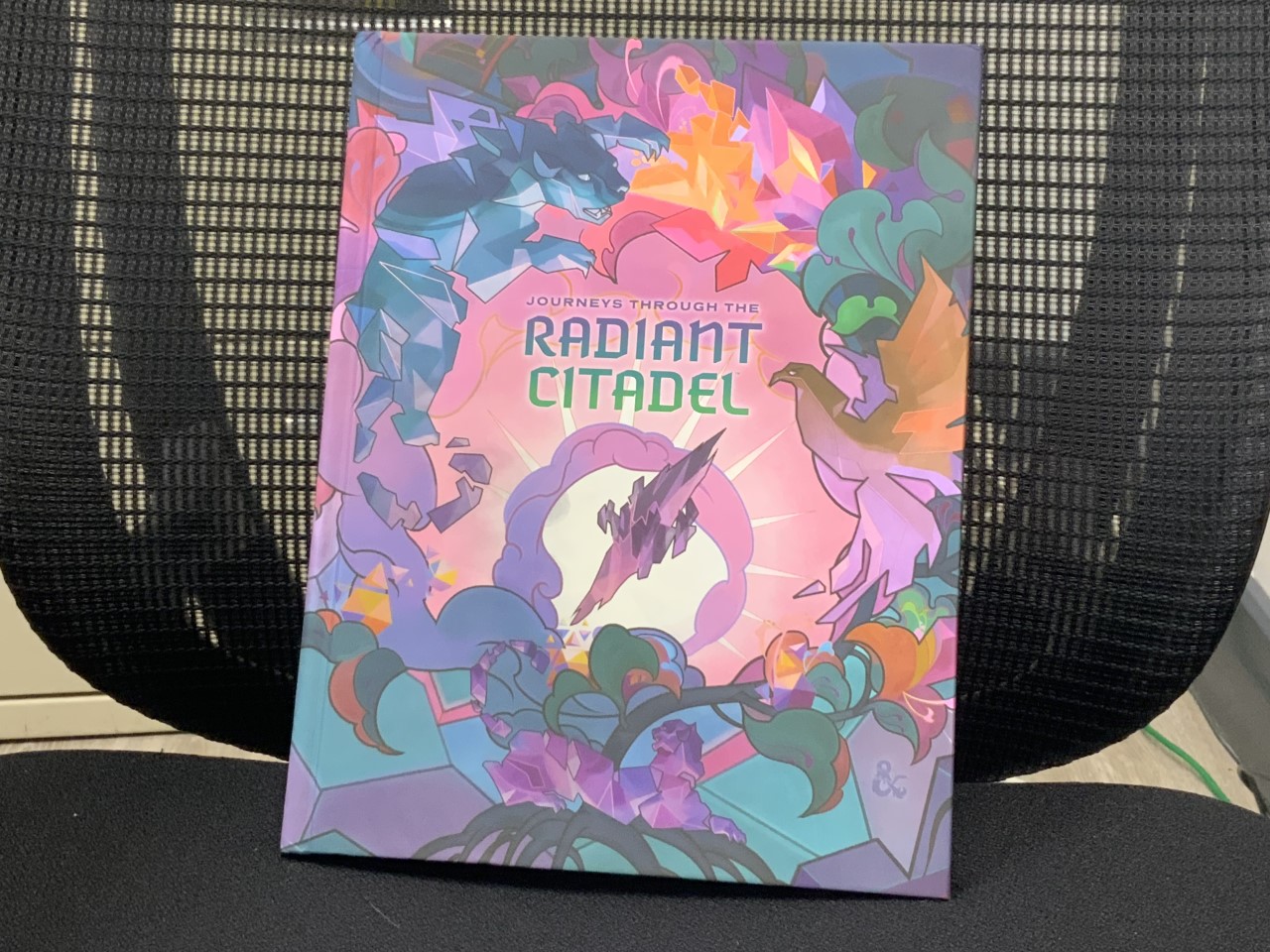
Not Quite Review Corner: Journeys Through the Radiant Citadel (D&D 5e)


Authors: Justice Ramin Arman, Dominique Dickey, Ajit A George, Basheer Ghouse, Alastor Guzman, D. Fox Harrell, T.K. Johnson, Felice Tzehuei Kuan, Surena Marie, Mimi Mondal, Mario Ortegon, Miyuki Jane Pinkard, Pam Punzalan, Erin Roberts, Terry H. Romero, Stephanie Yoon; June 2022 printing. 

I picked this up at Hex & Co way way way up by Columbia. I hadn’t intended to. I knew about it, in that vague ‘I saw it on the Internet and somebody tweeted once, I think?’ way that so many RPG products flash across my cortex these days. I didn’t know much, except that it was a different take from different authors.  

The variant cover was a selling point. Seldom do I see anything so beautiful – very dreamlike, it reminded me of Vertigo comics from back in the day. Sija Hong outdid herself! 

The Citadel drifts in the plane Ethereal linking twenty-seven civilizations in one central hub, itself speared through by the Auroral Diamond, a luminous gemstone shard that acts as a beacon for those lost in the twisting void. Lost for uncounted generations and reclaimed by explorers and heroes, the Citadel is a place where immigrants from across creation gather. They make their home in the great carved gem and use its portals to travel to and from other worlds. 

Those other worlds are what most of the book is about. Everything from the ghost-haunted streets of Yeonido to the suffering arid lands of San Citlan and the packed, happy bustle of Dyn Singh Night Markets – plus plenty more besides.  

As with all collections there’s going to be some ideas you’ll leap on with cries of joy and some that leave you going ‘ehhh …’ That’s not the issue. The issue is, is there enough variety, enough on offer, that even if you don’t like the idea of thus-and-so there’s something here you’re more than happy to have? 

If you’ll recall I said something similar about San Jenaro Co-Op’s Guide To Heists, which boasts 35 Heist scenario seeds. I lacked enthusiasm. The collection felt very weighted. I said at the time: 

So if you're, say, a fantasy or sci-fi Keeper looking for inspiration, you're going to feel left out. Ditto if you're a gamer looking for material set anywhere other than North America in the 2000s, really. The problem's fixable - change up some names, fiddle with the locations. Still, with about 40% of the scenarios set in the US or a US-centric location, mostly modern day, the collection feels unbalanced. 

Journeys doesn’t share that problem. 

God no.  

Journeys is bloody excellent.  

Do you want social roleplay? Done. Do you want to penetrate the heart of a ghastly, ghostly mystery? Done. Like Ravenloft? Here’s a setting. New and memorable creatures? Got you covered. Forgotten temples? Hidden mines? Yes, yes, and over here’s another sunken undersea yes for those of you seeking extra goodies. 

I shan’t go deeply into the production values or art since this is a 5E product and 5E is the top of the food chain when it comes to that sort of thing. I know I’m selling the artists short by not talking about their work, but I only have so many fingers, guys, and they’re being worn to nubbins against the unforgiving keyboard. Mercy! 

The tales I like best are the ones that focus less on saving the world and are more about interacting with it. The Dyn Singh Night Market and the fabulous vice-ridden city of Zinda are my two favorites, closely followed by hunting ghosts in Yeonido. In each the characters are asked to delve deep in the mystery, uncover secrets, perhaps gain renown by completing tasks or earning favor. That’s the kind of thing that really gets me going. 

There's a good spread of adventures from low level to high, and while I wasn't as fond of the high level stuff I think that's mostly down to my personal hang-ups about high level play and not the scenarios themselves. For me, high level play exposes some of the innate weaknesses in a combat-heavy system, and for all its tweaks over the years D&D is still a combat-heavy system. While I see the appeal of, say Orchids of the Invisible Mountain (14th level characters) it's never going to get my blood flowing the same way Wages of Vice (5th level characters) does, because I know in my heart that Orchids will end up being a dungeon bash where Wages is more of a race-against-time thriller.

The best thing about this collection isn't so much the scenarios themselves as it is the world Gazetteers that go with them. You don't have to play any of the scenarios if you don't want to. Each setting has enough detail for a campaign of your own, whether you want to have the entire plot arc in, say, bustling Yongjing or the holy lands of Akharin Sangar, or whether you just want someone to visit there briefly from their base in the Radiant Citadel. Each land has its own aesthetic, its own unique voice, and the Citadel is a handy means of linking all those voices in a conjoined narrative. It's a bit like living in a wide archipelago of nations, with a gleaming spire at its center drawing them all together.

Is it worth your $50? Absolutely. In fact, I'd recommend this to first-time DMs in particular because those are the folks who need the most support when running their games and there's plenty of support here. Someone lost for what to do or where to go next should have no problem working this into their ongoing campaign and perhaps the best thing about it is, with the Citadel at its center, you don't need to worry about ever getting bored. There's always a new adventure just over the horizon and unexplored lands awaiting discovery - or perhaps rediscovery. The Citadel isn't complete, after all; its dormant sections might be reawakened, by determined and clever heroes.

Enjoy!  

Sunday, 7 August 2022

Books, Glorious Books


via the Mercatus Center

I have returned from New York City and now know what Brunch is. 

I was sitting in my usual coffee shop about a week or so back building up the mental strength to go to work and someone sat next to me asked if I was a local. She went on to ask if I could recommend a good place to eat brunch, which puzzled the hell out of me. We don’t eat brunch down here. We don’t have a brunch culture. The hotels offer something like, but that’s a purely tourist thing so it’s not something I can comment about intelligently. 

It’s different in New York. 

Very different. 

I fried myself in NYC. I always forget just how hot it is in the summer. It’s so tempting to walk everywhere; after all, it’s only a few blocks from here to there, it won’t be that bad. Followed swiftly by repentance and heat prostration. Mind, some of the subway cars are air conditioned now, which I don’t remember being an option the last time I was in town. 

I got to see some people. Hello, people! It was fun. 

I spent a ton of money on books. Shocking, I know. The Strand was my first visit, and I was slightly taken aback by how gentrified it’s become compared to the version I knew when I first began visiting NYC. Tote bags and coffee mugs must be a significant part of its bottom line, these days.  

I went to the Mysterious Bookshop down on Warren Street, which I highly recommend to anyone who enjoys whodunnits, whatdunnits and howonearthdidyoudunnits. Also, Dracula puzzles. Very pretty looking Dracula puzzles.  

However, the prize was, as always, the Americana section of the Argosy, where I blew the budget and also my suitcase; as I was disembarking the plane on the way home the case handle gave up on life. ‘Alas, cruel fate!’ it wailed, as it snapped forever.  Today I bought its replacement. Here's hoping the replacement lasts at least as long as its predecessor; I had that one since Uni.

The Argosy was the only place in NY to insist on mask wearing. Theoretically you were supposed to wear a mask on the subway but very few people did. Pretty much everywhere else was mask optional, which meant no masks at all. Despite NY’s best efforts I avoided COVID, continuing my streak of testing negative. I attribute this to blind luck, mask wearing at the airport and other public areas, and the 2oz bottle of hand sanitizer I bought before the flight. Thanks, Handy; you did me proud. 

Seriously, Handy, good job. I've lost track of the number of people I know in Bermuda who've come down with COVID these past few weeks. Meanwhile I stroll through 42nd Street Station many times over the course of a few days without so much as a sniffle.

I’ll spare you the full list of purchases but thought it would be fun to talk about the Argosy haul. 

Lafcadio Hearn, Two Years in the French West Indies (1890). You’ve heard me mention Hearn before. Believe me when I say I laughed for joy when I saw this and immediately snapped it up. Anything Hearn wrote is worth your time. 

The Iron Gate of Jack & Charlie's, various authors, anniversary edition detailing the 21 Club’s history up to publication. God alone knows what will happen to the Club post-COVID; Jack and Charlie would weep to see it. However, if you have any interest in Prohibition or NYC club life you ought to know something about the 21. I’ve read this book before but never had the chance to own it. I’ve also visited the Club, once, and saw the fabled secret cellar. Fond memories! 

Critical Years at the Yard, 1860-89, (1956) Belton Cobb. True crime, and this paired with the title below were my two true crime purchases of the trip. I often go a bit nutty for this sort of thing. This one's about Scotland Yard's early years, shot through with bribery scandals and botched investigations.

The Newgate Noose, (1957) Howard Culpin. A collection of the hanged and their many, many crimes. As with a lot of true crime there's a strong risk of picking up something you already know or have read before. However, no matter how much you know about the luckless pickpockets, murderers and highwaymen who fed the hanging tree there's always a new story. I've just finished the tale of Jenny Diver, a new one on me. Industrious, clever, lucky for a long while, she and her fellow pickpockets ran riot for a long time before she was sentenced to transportation. Not liking America very much she returned to England and for a while avoided notice, but it was death to return from transportation. She swung in 1740 leaving a three-year-old child behind her - at least, according to the Newgate Noose, which may or may not have the right of it. Probably not, since the Noose says she was 'all but a child herself' when she died and Wikipedia puts her actual age at early 40s, which - let's be honest - isn't youth's first bloom.

That's the risk with collections like these. They often talk a load of old bollocks. However, even rubbish can be useful material if you're looking for inspiration for a character in a novel - or an RPG.

This Was New York! A Nostalgic Picture of Gotham in the Gaslight Era, (1969) Maxwell F. Marcuse. This, like the next one, is research material. New York in the misty far-off days when it was building itself into the metropolis we now know. 

The Boss and the Machine, Samuel P. Orth (1919, Yale Uni Press) volume number [something or other] in the [I don't care] collection of American history. For every great fortune there is a great crime. Or, put slightly more accurately, the secret of a great success for which you are at a loss to account is a crime that has never been found out, because it was properly executed. By that definition this is a crime that was found out and therefore not a great success for which we are at a loss to account - but it was a great success, nonetheless.

Now, enough! Hence! I have reading to do.