Showing posts with label Lafcadio Hearn. Show all posts

Sunday, 2 July 2023

Books! Glorious Books.

 I arrived home poorer financially, but not poor in spirit. I brought home a cargo of books, as you can see. But what, you ask, was the result?

Well!

David Wellington, 99 Coffins and Vampire Zero. If you remember Wellington, that’s because you read his Monster Island series of zombie apocalypse novels. I think I may have mentioned him in a Bookshelf, lo, these many moons past. In Monster Island, followed by Monster Nation and Monster Planet, he started off with a great idea: dude from UN shanghaied during zombie apocalypse is sent to NYC to pick up meds for a Somali warlord afflicted by AIDs, since the UN building is the only place anyone can think of where someone can reliably get said meds. Sold. Job done. Problem being, that plot didn’t quite sustain the novel, never mind the following two books. Here we have a situation where reluctant modern-day vampire hunter is, first, sent off to deal with Civil-War era shenanigans, and then, in the next novel, has to deal with her former mentor who’s gone rogue and joined the fang gang. I admit, this was a gamble purchase. I'll have to see whether it was worth the $7 or so the Strand charged me for them. [spoiler alert: ehhhhhh ... *shrug*]

Christianna Brand, Green For Danger. Classic crime from the British Library. I’ve already seen the film so I kinda know whodunit, but that shan’t stop me enjoying this one. World War Two drama in which a mysterious person is unceremoniously offed on the operating table. The person who says she knows what happened is stabbed to death moments later …

Agatha Christie Mallowan, Come, Show Me How You Lived. Period archaeology, and yes, it is that Agatha Christie. If nothing else this will be excellent research material, but Dame Agatha is always readable so I’m expecting great things.

Arthur Machen, The Three Impostors. I’m going to delve deeper into this in a separate post. Briefly, excellent horror fiction that GUMSHOE Directors should be poaching ideas from left, right and center. A group of disparate acquaintances discover that they’ve all had close encounters with mysterious forces, apparently led, coordinated or otherwise involved by the young man with spectacles – whoever or whatever he may be …Even if you've never read the novel you have almost certainly read The Novel of the Black Seal and The Novel of the White Powder, both of which are part of the Three Impostors and both of which have been anthologized in many publications since.

William Hope Hodgson, The House on the Borderland. Often called a classic of the genre, this is one I actually wouldn’t recommend to most people. It has a strong premise but no follow-through: two friends on a fishing expedition discover a mysterious house, and a diary written by the man who lived there. Expect much luminous and hallucinogenic imagery and almost no plot whatsoever. Worth picking up if you enjoy delving into the history of horror.

Bartholomew Gill, The Death of an Ardent Bibliophile. A policeman pays what amounts to a welfare check on a notorious bibliophile only to find him dead and naked. Or naked and dead, whichever way you’d prefer to read that sentence.

C. Daly King, Obelists at Sea. Another classic crime novel, with the added bonus that this is set on a classic cruise liner. Neatly involving two of my personal obsessions in one package. Job done.

Paul Halter, The Mask of the Vampire. A locked room mystery master tackles supernatural murder. This is a translation of the French original. Vampires and a Frenchman’s interpretation of the English countryside murder mystery? Oho!

Seishi Yokomizo, The Village of Eight Graves. I’ve mentioned his work before. Yokomizo-san struggled to find a market before the War and very nearly starved to death during it, but post-War found fame with his series of historical mystery novels. Once upon a time greedy villagers murdered eight samurai for the stolen gold the samurai were supposedly guarding. Nobody ever found the money; many died from the samurai curse. Now, it seems, the bloody work of vengeance is to begin anew as unlucky heir BLANK comes back to his birthplace, a village he has never seen in his life.

Ken Weber, Maximum Entertainment 2.0. Bought at Tannen’s Magic Shop, a place I thoroughly recommend to all visitors to NYC with even a passing interest in stage magic. I bought this for research purposes; I couldn’t card trick my way out of a rabbit’s hat. However, if you’re going to write about something – say, if you intend to write a novel with a magician as a main or major character – you need to know the business of performance. You need to know what it is to put on a show. That’s what Weber does, and he does it very well.

Lafcadio Hearn, Chita. I admit without shame that I'd buy/read anything Hearn ever wrote and I await the day when someone gathers all his newspaper columns in one anthology. This is his account of the hurricane of 1856 and, speaking as someone who lived through hurricanes: 110%, no error. Horror writers ought to at least read the first chapter, if you read nothing else. 

Radley Balko, Rise of the Warrior Cop If you want to understand how the US became what it is today, you need to read books like these. Balko charts the militarization of America's police, from its earliest days to the no-knock present. The downfall of the Castle Doctrine, one coffin nail at a time.


Sunday, 7 August 2022

Books, Glorious Books


via the Mercatus Center

I have returned from New York City and now know what Brunch is. 

I was sitting in my usual coffee shop about a week or so back building up the mental strength to go to work and someone sat next to me asked if I was a local. She went on to ask if I could recommend a good place to eat brunch, which puzzled the hell out of me. We don’t eat brunch down here. We don’t have a brunch culture. The hotels offer something like, but that’s a purely tourist thing so it’s not something I can comment about intelligently. 

It’s different in New York. 

Very different. 

I fried myself in NYC. I always forget just how hot it is in the summer. It’s so tempting to walk everywhere; after all, it’s only a few blocks from here to there, it won’t be that bad. Followed swiftly by repentance and heat prostration. Mind, some of the subway cars are air conditioned now, which I don’t remember being an option the last time I was in town. 

I got to see some people. Hello, people! It was fun. 

I spent a ton of money on books. Shocking, I know. The Strand was my first visit, and I was slightly taken aback by how gentrified it’s become compared to the version I knew when I first began visiting NYC. Tote bags and coffee mugs must be a significant part of its bottom line, these days.  

I went to the Mysterious Bookshop down on Warren Street, which I highly recommend to anyone who enjoys whodunnits, whatdunnits and howonearthdidyoudunnits. Also, Dracula puzzles. Very pretty looking Dracula puzzles.  

However, the prize was, as always, the Americana section of the Argosy, where I blew the budget and also my suitcase; as I was disembarking the plane on the way home the case handle gave up on life. ‘Alas, cruel fate!’ it wailed, as it snapped forever.  Today I bought its replacement. Here's hoping the replacement lasts at least as long as its predecessor; I had that one since Uni.

The Argosy was the only place in NY to insist on mask wearing. Theoretically you were supposed to wear a mask on the subway but very few people did. Pretty much everywhere else was mask optional, which meant no masks at all. Despite NY’s best efforts I avoided COVID, continuing my streak of testing negative. I attribute this to blind luck, mask wearing at the airport and other public areas, and the 2oz bottle of hand sanitizer I bought before the flight. Thanks, Handy; you did me proud. 

Seriously, Handy, good job. I've lost track of the number of people I know in Bermuda who've come down with COVID these past few weeks. Meanwhile I stroll through 42nd Street Station many times over the course of a few days without so much as a sniffle.

I’ll spare you the full list of purchases but thought it would be fun to talk about the Argosy haul. 

Lafcadio Hearn, Two Years in the French West Indies (1890). You’ve heard me mention Hearn before. Believe me when I say I laughed for joy when I saw this and immediately snapped it up. Anything Hearn wrote is worth your time. 

The Iron Gate of Jack & Charlie's, various authors, anniversary edition detailing the 21 Club’s history up to publication. God alone knows what will happen to the Club post-COVID; Jack and Charlie would weep to see it. However, if you have any interest in Prohibition or NYC club life you ought to know something about the 21. I’ve read this book before but never had the chance to own it. I’ve also visited the Club, once, and saw the fabled secret cellar. Fond memories! 

Critical Years at the Yard, 1860-89, (1956) Belton Cobb. True crime, and this paired with the title below were my two true crime purchases of the trip. I often go a bit nutty for this sort of thing. This one's about Scotland Yard's early years, shot through with bribery scandals and botched investigations.

The Newgate Noose, (1957) Howard Culpin. A collection of the hanged and their many, many crimes. As with a lot of true crime there's a strong risk of picking up something you already know or have read before. However, no matter how much you know about the luckless pickpockets, murderers and highwaymen who fed the hanging tree there's always a new story. I've just finished the tale of Jenny Diver, a new one on me. Industrious, clever, lucky for a long while, she and her fellow pickpockets ran riot for a long time before she was sentenced to transportation. Not liking America very much she returned to England and for a while avoided notice, but it was death to return from transportation. She swung in 1740 leaving a three-year-old child behind her - at least, according to the Newgate Noose, which may or may not have the right of it. Probably not, since the Noose says she was 'all but a child herself' when she died and Wikipedia puts her actual age at early 40s, which - let's be honest - isn't youth's first bloom.

That's the risk with collections like these. They often talk a load of old bollocks. However, even rubbish can be useful material if you're looking for inspiration for a character in a novel - or an RPG.

This Was New York! A Nostalgic Picture of Gotham in the Gaslight Era, (1969) Maxwell F. Marcuse. This, like the next one, is research material. New York in the misty far-off days when it was building itself into the metropolis we now know. 

The Boss and the Machine, Samuel P. Orth (1919, Yale Uni Press) volume number [something or other] in the [I don't care] collection of American history. For every great fortune there is a great crime. Or, put slightly more accurately, the secret of a great success for which you are at a loss to account is a crime that has never been found out, because it was properly executed. By that definition this is a crime that was found out and therefore not a great success for which we are at a loss to account - but it was a great success, nonetheless.

Now, enough! Hence! I have reading to do. 

Sunday, 22 December 2019

KGB Museum, and Books!

I spent last weekend in NYC, loving every minute of it and walking my hind legs clean off. My hotel's about ten minutes walk from the Flatiron, and most of what I wanted - the Strand, really - is roundabout Union Square, so I didn't bother with the subway this trip. Spent a lot of time at the Pit, which I recommend if you enjoy comedy & improv.

That's not what this post shall be about, tho.


The KGB Museum down on West 14th Street is exactly what you think it is: a room stuffed full of pretty much every kind of spy kitsch you can imagine. If you like the KGB (and really, who doesn't?), Cold War shenanigans, and vintage spy tech, this is exactly the place you want to be. All it needs is a life-size statue of Ken Hite, glad-handing the tourists as they stroll in the door.

I got there at opening time, 10am, on Friday, and I'm glad I did. It meant I got the guided tour free of charge, but more importantly, I could enjoy everything in peace and quiet. There's a lot to see here, crammed into a relatively small space. I can only imagine what it's like with, say, fifty to sixty other sightseers jockeying for position.

It's run by a group of smiling eastern Europeans, probably Russians, and to be honest, if your first thought is, 'this has got to be an FSB front organization,' rest assured, I thought the same thing. It's exactly the sort of dumb-but-it-could-work idea that has fueled many a real-life spy operation, ever since Kit Marlowe got his in the back room of Elanor Bull's tavern. She, incidentally, did a lot of business with Russian merchants … wheels within wheels.

The KGB Museum's collection is very impressive. It leans a little more towards the early years, the Chekists and Beria, than the later Cold War operations. Some of the items stretch credulity a little bit. For example, the Museum has both The Thing - the wooden US seal which hung on the wall of the American Residency in Moscow for many years, which concealed a transmitter invented by musical genius Leon Theramin - and a Bulgarian poison-tipped umbrella, of the type that was used to kill dissident and defector Markov in London, 1978. Surely those are replicas. It beggars belief that the original Thing found its way to the KGB Museum, and as for the poison-tip umbrella … Anything's possible, I suppose.

That's the Museum's greatest trick. It makes everything seem possible. You don't know who owns it, where its money comes from, how it got its very impressive collection together, who all these charming Russians are who either run, or own, the place. It's a brilliant, small little museum, nestled in the heart of one of the greatest cities in the world. Unless you're prepared to go to Moscow, you'll never see anything else like it.

It's a few steps down the street from a great 24-hour diner, the Coppelia, a Cuban place, and no, the irony of a little slice of Cuba a few steps down the street from the KGB museum did not escape me. God, I needed the Coppelia, at about 930 in the morning, when French toast with fresh sliced banana, plus a sinfully dark coffee, was the only shining light on a slate gray day. A good spread of rum on the shelf too; the kind of place worth coming back to again and again.

Now the books.

Hollywood's Spies: The Undercover Surveillance of Nazis in Los Angeles, Laura B. Rosenzweig, NY University Press 2017. Los Angeles' Jewish community, led by Hollywood's elite, fights back against American Nazis. A slice of pre-Cold War cloak-and-dagger, and probably a good resource for Bookhounds, since a lot of the things happening in bookstore back rooms in Los Angeles in the 30s are probably also happening in London. If you play Technicolor and want some anti-Nazi action, paid for by Warner Brothers, here's your chance.

Japanese Tales of Lafcadio Hearn edited by Andrei Codrescu, Princeton Uni Press, 2019. Hearn's stories enrapture me, and possibly the greatest thing about his work is, he wrote so very much it's almost impossible to run out. The day you think you've read them all, you find a whole new collection. The ghost lovers out there want this book.

Dark Tales, Shirley Jackson, Penguin 2017. Not as prolific as Hearn, but just as evocative. This contains the classics and several obscurities, newly reprinted. Again, ghost lovers, seek this out.

Psycho, Robert Bloch, Overlook Press, 2010. I must have seen the movie a dozen times, but it suddenly occurred to me, standing amid the Strand's towering stacks, that I'd never read the book. Time to rectify that.

How To Catch A Russian Spy, Naveed Jamali and Ellis Henican, Scribner paperback, 2018. Modern espionage tale about Jamali's work with the FBI, drawing out Russian intelligencers with poison packets of fake data. For the Night's Black Agents players and directors out there. Bought at the KGB Museum, so it has their own stamp on the flyleaf. As is only right and proper.

Hungry Ghosts, Anthony Bourdain, graphic novel, Berger Books (Dark Horse). Bourdain borrows from Japanese folklore to create a collection of creepy horror tales. I'll be honest, I hesitated over this one. Bourdain's unexpected death hit me hard, and for the longest while I didn't want to read his books or watch his show. I've recently gotten back into his work, and when I saw this on the shelf, I couldn't resist.

Night's Black Agents, Solo Ops. Pelgrane Press. How could I not? I playtested this, back in the day. I don't know how often I'll get a chance to play, but I couldn't resist. Now if only Swords of the Serpentine was out …

Enjoy, and Happy Holidays!

Sunday, 8 April 2018

Cousin Jane (Lafcadio Hearn)

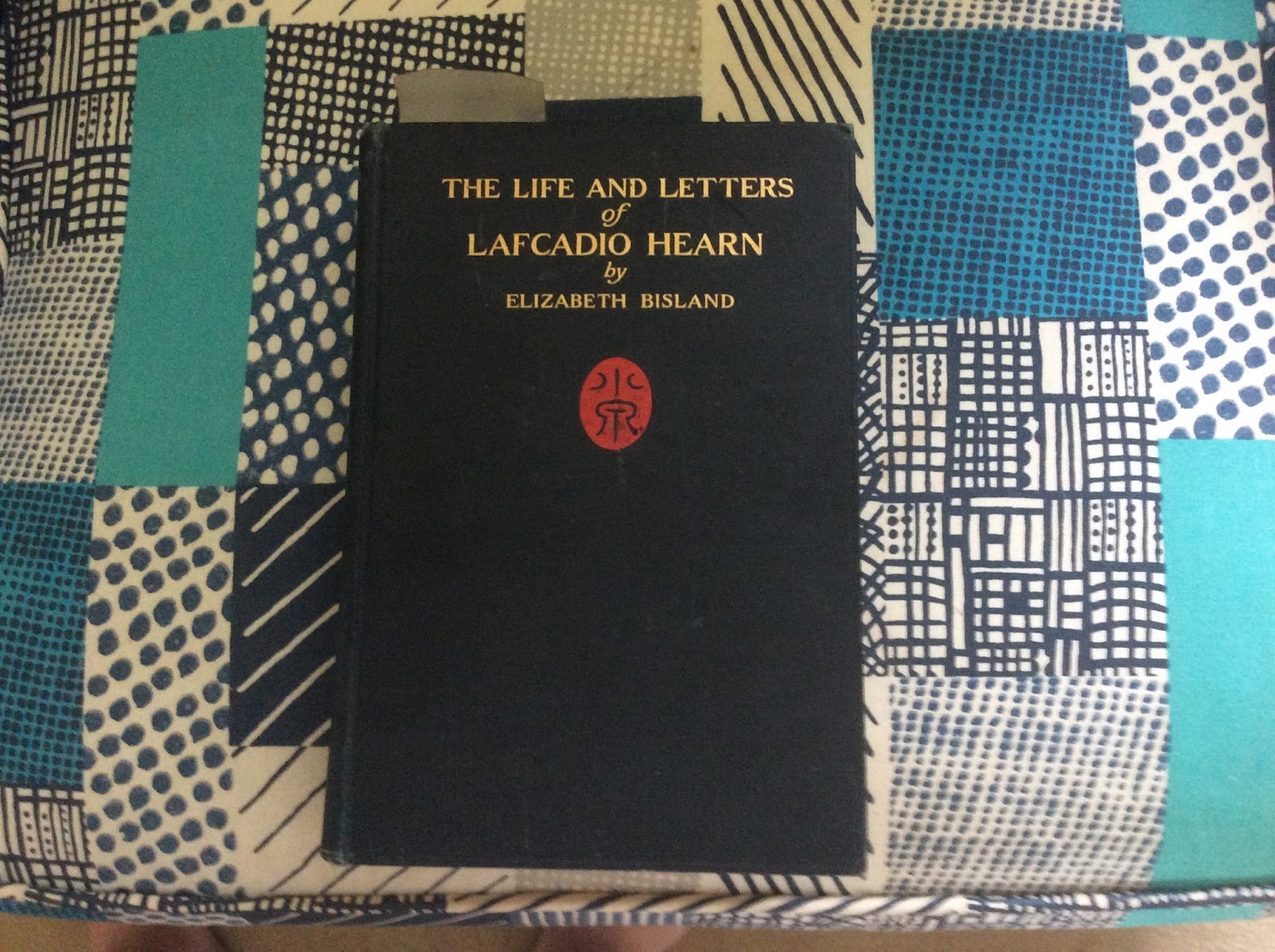
I've been lucky enough to hold a copy of The Life & Letters of Lafcadio Hearn in my hands. Elizabeth Bisland's two volume collection is a remarkable piece of scholarship, and I'd recommend it to anyone with any interest in Hearn. Or even those that don't, because there's plenty here that can be data mined by anyone with an interest in horror.


Lafcadio was born in 1850 to an Irish father and Greek mother. The circumstances of his parents' marriage were straight out of a romance novel. Surgeon-Major 76th Foot Charles Bush Hearn was sent to the island of Cerigo in the late 1840s, where he met Rosa Cerigote. The two fell in love but her family did not approve, particularly since the British were an occupying force. They wanted nothing to do with the oppressors, and one night her brothers ambushed Hearn and stabbed him, leaving him for dead. Rosa found the Surgeon Major and concealed him in a barn, nursing him back to health. When he was well enough the pair eloped, and for a time knew happiness in Greece. Lafcadio, named for the island of his birth, Lefcada, was their second son. The first died soon after birth, and their third, James, was born three years later.

When Britain ceded the Ionian Isles to Greece the family went back to Ireland, but this was fatal to the marriage. Rosa could not abide Ireland, and had no friends there. She became miserable, and after a time believed the Surgeon Major had fallen in love with someone else. The marriage was annulled, and Rosa fled back to Greece.

This disruption broke the family, and Lafcadio was adopted by an aunt, Mrs. Brenane, a staunch Roman Catholic. Lafcadio moved to Wales, and never saw his father or brother again. He grew up with a morbid distrust of attachment, never making friends easily, constantly on the lookout for betrayal.

I'm not going to summarize the book, but I do want to talk about an episode from Lafcadio's early history. It illustrates what I believe to be the one true rule of weird fiction: that the writer must take something that is normal in every respect, and twist it until it becomes unnatural.

Young Hearn had a cheerless life in Mrs. Brenane's household. She was a stern woman, teaching him Roman Catholicism by rote. He understood nothing of religion, but could repeat prayers "only as a parrot might have done." A nervous child, he had been forbidden ghost stories and fairy tales and was under strict injunction not to talk about such things.

One day a visitor arrived, Cousin Jane, a joyless young woman who wanted to become a nun, but did not. "I asked why," says Lafcadio, "I was told I was too young to understand." She seldom smiled, and seemed burdened by some secret grief.

One day she discovered that Lafcadio, though nominally religious, had no real concept of God. This horrified her, and she lectured him with a fervor that says something about the brand of religion she adopted.

I do not remember all the rest of her words; I can recall with distinctness only the following:

"and send you down to Hell to burn alive in fire for ever and ever! Think of it! - always burning, burning, burning! screaming and burning! screaming and burning! never to be saved from that pain of fire! You remember when you burned your finger at the lamp? Think of your whole body burning - always, always, always burning! - for ever and ever!"

I can still see her face as in the instance of that utterance - the horror upon it, and the pain. Then she suddenly burst into tears and left the room.

From that time I detested Cousin Jane, because she had made me unhappy in a new and irreparable way. I did not doubt what she had said; but I hated her for having said it - particularly for the hideous way she said it ... When she left us in the spring, I hoped that she would soon die - so that I might never see her face again. 

But I was fated to meet her again under strange circumstances. I am not sure whether it was in the latter part of the summer that I last saw her, or early in the autumn; I remember only that it was in the evening and that the weather was still pleasantly warm. The sun had set; but there was a clear twilight, full of soft colour; and in that twilight-time I happened to be on the lobby of the third floor - all by myself.

I do not know why I had gone up there alone; perhaps I was looking for some toy. At all events I was standing in the lobby, close to the head of the stairs, when I noticed that the door of Cousin Jane's room seemed to be ajar. Then I saw it slowly opening. The fact surprised me because that door - the farthest one of three opening on the lobby - was usually locked. Almost at the same moment Cousin Jane herself, robed in her familiar black dress, came out of the room, and advanced towards me - but with her head turned upwards and sideways, as if she were looking for something on the lobby-wall, close to the ceiling. I cried out in astonishment, "Cousin Jane!" - but she did not seem to hear. She approached slowly, still with her head so thrown back that I could see nothing of her face above the chin: then she walked directly past me into the room nearest the stairway - a bedroom of which the door was always left open by day. Even as she passed I did not see her face - only her white throat and chin, and the gathered mass of her beautiful hair. Into the bedroom I ran after her, calling out, "Cousin Jane! Cousin Jane!" I saw her pass round the foot of a great four-pillared bed, as if to approach the window beyond it; and I followed her to that other side of the bed. Then, as if first aware of my presence, she turned; and I looked up, expecting to meet her smile ... She had no face. There was only a pale blur instead of a face. And even as I stared, the figure vanished. It did not fade; it simply ceased to be - like the shape of a flame blown out.

Cousin Jane returned to the house at the beginning of the cold season. In the first few hours she made much of Lafcadio, buying him toys and good things to eat.

I ought to have been grateful, if not happy. But the generous shame that her caresses had awakened was already gone; and that memory of which I could speak to no one - least of all to her - again darkened my thoughts. This Cousin Jane who was buying me toys, and smiling, and chatting, was only, perhaps, the husk of another Cousin Jane that had no face ... Before the brilliant shops, among the crowds of happy people, I had nothing to fear. But afterwards - after dark - might not the Inner disengage herself from the other, and leave her room, and glide to mine with chin upturned, as if staring at the ceiling?

Cousin Jane took a turn for the worse the very next day, and did not come down to breakfast. She died of consumption soon after.

I understood only that I had seen; and because I had seen I was afraid. And the memory of that seeing disturbed me more than ever, after the coffin of Cousin Jane had been carried away. The knowledge of her death had filled me, not with sorrow, but with terror. Once I had wished that she were dead. And that wish had been fulfilled - but the punishment was yet to come. Dim thoughts, dim fears - enormously older than the creed of Cousin Jane - awakened within me, as from some prenatal sleep - especially a horror of the dead as evil beings, hating mankind ... such horror exists in savage minds, accompanied by the vague notion that character is totally transformed or stripped by death - that those departed, who once caressed and smiled and loved, now menace and gibber and hate ... what power, I asked myself in dismay, could protect me from her visits? I had not yet ceased to believe in the God of Cousin Jane; but I doubted whether he would or could do anything for me. Moreover my creed had been greatly shaken by the suspicion that Cousin Jane had always lied. How often had she not assured me that I could not see ghosts or evil spirits! Yet the Thing that I had seen was assuredly her inside-self - the ghost of the goblin of her - and utterly evil. Evidently she hated me: she had lured me in a lonesome room for the sole purpose of making me hideously afraid ... And why had she hated me thus before she died? - was it because she knew that I hated her - that I wished her to die? Yet how did she know? - could the ghost of her see, through blood and flesh and bone, into the miserable little ghost of myself?

Anyhow, she had lied ... perhaps everyone else had lied. Were all the people that I knew - the warm people, who walked and laughed in the light - so much afraid of the Things of the Night that they dared not tell the truth? To none of these questions I could find a reply. And there began for me a second period of black faith - a faith of unutterable horror, mingled with unutterable doubt. 

Those who knew her history are dust ... How often have I tried to reproach myself for hating her. But even now in my heart a voice cries bitterly to the ghost of her: "Woe! woe! - thou didst destroy it - the beautiful world!"

When I first decided to post this I thought I would use the story as the kernel for something of my own, perhaps a discussion about ghosts. I find I do not have the stomach for it.

The child was just shy of six when this happened. Imagine living with that pressure cooker of a mind, stuffed full of gunpowder and set alight by a hysterical would-be nun, frightened out of your wits and nobody to talk to. I would not want Lafcadio's early life if you offered it me with a fortune in gold, and fame by the truckload. 

Lafcadio's work has a long, long shadow. If you've played The Mountain Witch RPG, you've been playing in his world. If you've seen Kwaidan, you saw his stories. 


I urge you to seek him out.