Showing posts with label writing. Show all posts

Sunday, 12 February 2023

Final Thoughts - Serpentine

OK, so far I've talked about the basic shape of the chronicle and followed that up with a discussion of the kinds of scenarios that make up any chronicle, whether in this or a different system. I said there were three types: Foundational, Plot Specific and Climactic.

What exactly is a Foundational scenario?

A Foundational scenario does two things. 

  • They elaborate on the established Building and put some flesh on its bones. 
  • They also provide the initial clues which the characters will follow up on for later plot.
Let's go back to the first post and use the examples there for Foundational purposes.

The Strazzaruola are the other family business, the rivals, the no-goods. If a Strazzaruola did it, it must be wrong. Worse than wrong. You never met a Strazzaruola you didn't hate.

Four things:
  • The Strazzaruola run loan sharking in the Night Market and there are few stalls that don't owe them money or favors - often both.
  • Isabetta Strazzaruola is a sorceror, or at least everyone says she is. Dripping with corruption, no doubt.
  • Baldo Strazzaruola is a notorious duelist, when he's not drunk off his ass. Dangerous, certainly - but unpredictable when drunk.
  • Monstrosity: Several Strazzaruola are Drowned.

OK, so already there's some meat on the bones. We know the Strazzaruola are loan sharks; that must mean they have plenty of debtors, and some heavies to help them collect the debts. We know a little about Isabetta and Baldo, enough to put a little plot into them. The next step is to devise some Strazzaruola plot hooks that provide initial clues which can be followed up for later plot.

It'd also be helpful if that same scenario helped make the setting feel more alive, solid, real. If it helped create a situation in which the characters get to explore the world a little and see what's out there. 

Probably you've been to New York, or at least a major city. You know that feeling, when you stand on the street and realize that there's a whole world around you, teeming with life and stories of which you can only be the smallest part? It's easy to think, if you're sat alone at your desk, that the world is your desk and only your desk; that there's nothing more important than what you're doing, thinking, feeling right now. Being in a big city and just looking up shows you that you are, at best, the smallest part of a much larger story. That you and yours don't amount to a hill of beans, but that sometimes you can see a glimpse of the larger reality.


Casablanca

That's what you hope for in a foundational scenario: that the characters see the larger world and understand a small part of it, a fraction - but that's enough. For now.

If I was to take any of the Four Things to make a Foundation I'd pick one of the first three: the loan sharking, Isabetta, Baldo. The Fourth Thing, the Monstrous thing, is where the clues in that Foundational scenario lead.

In any scenario, even the simplest, there's the main hook, the main objective, possibly a Twist, and a conclusion. Fritz Leiber's Fafhrd and the Gray Mouser series, must-reads for anyone who wants to get into swords and sorcery, are very like this. Take Bazaar of the Bizarre as an example. There the heroes are hired by their sorcerous mentors to put an end to a nefarious threat. The main objective is that same threat. The Twist is that one of the heroes has been bamboozled by the threat. The story is about how that situation is resolved. It is as simple as it is possible to be, plotwise, and it's incredibly engaging, fun, and thrilling.

Foundation: Baldo's Triangle

Paulina the sword-swallower from Zavatera's Marvels is pissed off with Baldo. He's spending a lot of time with a mystery woman but he swears blind that isn't so. Paulina wants the heroes to check on Baldo's story.

Now, the heroes may want nothing to do with a Strazzaruola, but they want to stay in Paulina's good graces and they figure the best way to do that is to at least play along with Paulina. 

The truth is that Baldo's sister Isabetta's been plotting behind the scenes. She doesn't like how Baldo spends all his spare time with Paulina. Isabetta prefers it when Baldo is out making money for the family, collecting on debts and roughing up fools. Isabetta also doesn't like Paulina much. However, Isabetta hasn't been able to break Baldo's affection so she came up with a scheme that she thought was foolproof. Isabetta would make Baldo think, through sorcerous means, that she was Paulina. That way she could get Baldo to do what she wanted when she wanted. 

Trouble is, she hadn't accounted for Baldo's passionate nature. When Baldo has a little drink in him, he wants a good time. Isabetta, as Paulina, has found it harder and harder to keep Baldo from her bed.

Isabetta's doing all this by means of a peculiar little puppet that she keeps in her rooms. So long as she keeps that puppet, she can make Baldo think she's Paulina. If the heroes get hold of that puppet ...

The next step is to add the clues that lead to the Monstrous, which in this instance is the Drowned.

From the main book: the Drowned are humans who are puppetted and possessed by an underwater fungal hivemind somewhere in the city. They can instantly communicate with each other and use this hivemind communication to focus on and efficiently eliminate one enemy at a time. The Drowned seek to put themselves in positions of influence and power, all the better to promote the fungal intelligence’s inscrutable plans.

It wouldn't be helpful to have either Baldo or Isabetta as the Drowned, but there are plenty of other Strazzaruola. Let's say that Isabetta's maid and assistant, Sarafina, is a Drowned and she's been trying to recruit Baldo by infecting Baldo with wetlung. So far Isabetta's sorcery has kept Baldo, and the other senior Strazzaruola, safe. However, this new thing with Baldo and Isabetta gives Sarafina an opportunity to advance her plans - unless the heroes discover it and stop her. They might not like Baldo, but do they want him to become a monster?

We already know, because it's part of the Four Things of Sag Harbor, that the only time Sag Harbor feels clean is when it rains. "In downpours people come out to stand in the rain as if it were a crystal-clear waterfall, filling whatever containers they have with rainwater. It's the only way to guarantee freshwater supply." But maybe the Drowned don't care about that, or maybe there's something in the rainwater that they really don't like. So the one thing that gives Sarafina away is her reaction when it rains: she hides and doesn't try to collect the rainwater. Why is that, the heroes might wonder? Well ...

The main hook is the love triangle. The main plot objective is countering Isabetta's spell, which she cast on Baldo and is now regretting. The Twist is the Drowned, which in turn will lead to Plot Specific scenarios. It has the additional benefit of adding one of Sag Harbor's Four Things, which in turn helps develop the campaign's ongoing narrative. 

That's a Foundational scenario. 

Plot Specific scenarios function in much the same way. They have their main hook, the main objective, possibly a Twist, and a conclusion, the difference being that where a Foundational scenario hints at the greater world around it a Plot Specific scenario reveals definite things about that greater world and gives clues that lead to the Climactic scenario. 

The Climatic scenario is broadly along the same lines as its brethren, with this key difference: where before all attention was on the ordinary stuff of the setting - the meat and drink - and there were clues that led to Monstrous, now it's all Monstrous all the time. In Twilight Zone terminology, the eyeglasses have broken and now it's time to face the consequences. 


Time Enough At Last

If the Strazzaruola, say, were infected by Drowned before but not all of them had fallen, now all of them have fallen. If Rattakan were persecuting Zavatera's Marvels because Paulina was protecting those pesky orphans, now most if not all the orphans have died and Paulina may well be a Rattakan host, and so on. The adventurers have to deal with this situation as best they can, and how they choose to deal with it will determine whether or not this campaign ends on a high note, or a low.

What I'm getting at is a bit different from, say, Horror on the Orient Express, where the characters have been following a set path down a particular route, and while they may have made choices along the way the ultimate destination was always the same. The whole point behind the Building, and the Four Things technique, is that the players determine which elements of the setting they choose to engage with. In that sense it's more like Dracula Dossier or Armitage Files gameplay, in which there is a defined structure but the ultimate destination, and the route chosen to get there, is determined not by plot but by player engagement. 

The Building provides 'rooms' - encounters, NPCs, setting elements - and the Four Things helps you furnish those rooms. The players then decide for themselves which of the Four Things they engage with, and that in turn leads them to other rooms and more Four Things, and so on. 

Next week - something different!

Enjoy!


Sunday, 3 July 2022

Start At The End (RPG All)


It's no good starting out by thinking one is a heaven-born genius - some people are, but very few. No, one is a tradesman - a tradesman in a good honest trade. You must learn the technical skills, and then, within that trade, you can apply your own creative ideas; but you must submit to the discipline of form. Agatha Christie

I find it useful, when designing an RPG scenario, to follow Agatha Christie's advice. She was asked many times for writing advice over the years, and as with all advice your milage may vary. However, there's one bit I think is evergreen: start at the end, and work back.

Christie, when writing her murder mysteries, would start with the corpse. She'd plot out the murder from the moment poison met lip, or knife, back. Then she'd unravel the whole narrative from that point, and with that as a blueprint would find time to sit down and write the thing. She knew, from the first moment, where the story ended. What she needed to discover was where the story began, and how the detective - be it Poirot, Miss. Marple, Tommy and Tuppence or whoever it might be - enters the narrative and finds out what happened. 

In an RPG scenario your players might not be trying to unravel a murder but they are trying to unravel something. What that something is doesn't really matter. The essential point is this: whether it's a fantasy swords and sorcery smackfest or that chilling moment when Illithid meets brain, you know from the start where you want the story to go.

All you need to do is get there.

Let's say this is a Night's Black Agents story. We already know from the main book that there are, broadly speaking, nine kinds of story:

  • Destroy. The agents must destroy the local conspiracy apparat.
  • Flip. The agents must flip an asset to their side.
  • Heist. The agents must steal something
  • Hit. The agents must kill someone
  • Hunt. The agents must find someone.
  • Rescue. The agents must rescue someone.
  • Sneak. The agents must infiltrate a secure location.
  • Trace. The agents must find something, possibly something that went missing long ago.
  • Uncover. The agents must uncover a mystery.
We also know that any of those stories can be turned on their head, so for example a Reverse Hunt might be hiding someone from the Conspiracy.

For the sake of this example it doesn't really matter which of these narratives we use. One quick RNG generation later ... 9. The agents must uncover a mystery.

It goes without saying that in order for the agents to uncover a mystery the Director has to know what the mystery is. That's not what we're trying to accomplish. What we want to know is, how does this story end?

You see the same dynamic play out in film. Say this were a heist movie: Le Circle Rouge, for example.


Without giving away the plot, the story revolves around a heist but does not end with a heist scene. Few heist movies do. The heist is often a midway point, something that the characters have been working towards but not, ultimately, the point of the story. 

No, the point of the story is (not a spoiler) an imagined quote from the Buddha, presented as fact within the story's narrative:

Siddhartha Gautama, the Buddha, drew a circle with a piece of red chalk and said: "When men, even unknowingly, are to meet one day, whatever may befall each, whatever the diverging paths, on the said day, they will inevitably come together in the red circle."

That moment of confrontation is the point of the narrative. That is what the story strives towards.

So if you intend, say, a moment of confrontation at the end point of your narrative, then that moment of confrontation is what you must start with when plotting out your narrative. 

Let's say you've been using the Familiar Foe rules from Double Tap, p. 52:

You have done battle with a particular enemy before. Not a generic mook, not just one class of opposition, no matter how distinctive. A Familiar Foe is a named opponent, be they the “Wizard of Waziristan” or the “second Lieutenant of the Death’s Sword Brigade, Johannes Klonsveldt.”

Let's further say that this Familiar Foe is based on one of the Operatives found in the Resource Guide, p 16:

  • Name: Gavin Kroeger
  • Description: Mid-30s, sharp suit, sleek, energetic
  • Previous Patron: Major law firm or hedge fund (Goldman Sachs or similar)

Kroeger’s a legal troubleshooter for the conspiracy. His usual role is to move money around and engage in high-level corporate and legal machinations – buying politicians, fixing elections, bribing key officials, or using the conspiracy’s resources to forcibly acquire companies and assets useful to the vampires.

Therefore the final scene of this scenario is about a showdown with Kroeger. The agents are about to meet their Familiar Foe in the red circle.

You, as Director, already know about as much as is possible about Kroeger and can add extra details as needed. Perhaps he wasn't a Renfield before but is now, because the Conspiracy are considering him for full membership and want to see whether he can handle the pressure. Perhaps he's on the outs with another highly placed Conspiracy operative and is constantly having to defend himself against attacks from the rear. 

That moment, when the agents uncover the secret, isn't the end of the scenario. It will drive them towards the end. It's a stepping-stone towards that final scene.

But that final scene is where you start with. You want to round off the narrative with a moment where Foe meets Foe, and for that reason you want to know everything you can about that final moment. Once you know that, you can plot backwards from that point and work out, say, how the agents encounter the plot hook, or where the secret is kept, or who's guarding it.

You know who - Gavin Kroeger - and you know what you're striving towards. Now ask yourself some questions about that final scene.

Where is it taking place? Let's say Berlin, why not.

What does Kroeger want? Well, that depends on whether the secret is a good one or a poison pill. Let's say it's a poison pill. Let's say it's the equivalent of a Dracula Dossier Fraudulent Item, because Kroeger wants the agents to accept the item as real and pass it on to their contact. That way Kroeger finds out who or where that contact is, so they can be dealt with.

How does Kroeger get what he wants? Well, he has access to power appropriate to the narrative, along with assets and goals. Given Kroeger is who he is, he probably isn't dancing the Hulk Smash Polka across the city. No, he'll be calling in political favors, working behind the scenes, offering massive bounties to whichever mercenary can ... and so on.

With all that in mind:

The final scenes are an extended Heat/Chase sequence across Berlin, in which Kroeger puts every possible pressure on the agents but ultimately wants them to get away so he can find out who their contact is. It doesn't really matter what the secret is or where it is; however, for the purpose of this example let's say it's something hidden in the depths of Teufelsberg, which I've talked about before.

Already you can see, I hope, the structure being built. The end scene is that extended chase across Berlin, with Kroeger and his catspaws putting as much pressure as possible on the agents as they flee from whatever it is they found at Teufelsberg. However, they don't want to actually catch the agents, which means they'll hesitate at the last moment. That hesitation might be the clue the agents need to realize that the secret they've gone to such lengths to uncover is a poison pill.

At this point you'd want to flesh out the details of that final moment. Some Berlin details, for example, with variations depending on whether this is day or night and whether this is a guns-blazing car chase or a delicate cat-and-mouse Thrilling Infiltration moment. Prepare for either one; let the players choose which one they're going to go for. You'd want to know the resources Kroeger can call on, and if there are third parties in play like that backbiting Conspiracy higher-up then you want to know what that third party can bring to bear.

Once you know all those things then you work back. How did the agents get to Teufelsberg? What do they expect to find there, and what do they actually find there? How did they get clued in that there was something at Teufelsberg worth looking for? Did Bothans die to give them that information, and if so who were those unfortunate Bothans? 

Always remember, though, that you didn't start with Bothans. You started with that face-off between the Familiar Foe and the agents on the streets of Berlin - and then you wrote the scenario.

That's it for this week! Enjoy.


Sunday, 12 July 2020

Getting Ideas (RPG General)

A short while ago I gave an interview to YSDC about my experiences with Bookhounds of London. You may have heard it by now - I hope you enjoyed it!

I talked about my scenario writing methods, and I figure now is as good a time as any to deep-dive. In the interview I said I go to my research library, dig out a likely-looking tome, and see what I can borrow from it. Some of you may wonder how to build a library like that. Well, the answer's simple enough. In any library there are going to be some core texts and some useful but not vital ones, and the core texts will vary depending on what you want to achieve.

A lot of my work delves into the fantastic and mystical, so my core texts are:

Standard Dictionary of Folklore and Legend, Funk & Wagnalls. It's a little on the dusty side. My copy's the 1984 version, but it was originally compiled in the 40s and 50s and some of its language choices reflect that. However there's nothing else quite like it out there, so until someone does a better job I'll stick with it.

New Larousse Encyclopedia of Mythology, 1989, Hamlyn Publishing. Again, a little on the dusty side but thankfully much better organized than Funk & Wagnalls.

The Lore of the Land, a Guide to England's Legends, Westwood & Simpson, Penguin, 2006. Much less dusty, and reasonably well organized.

Past Worlds, the Times Atlas of Archaeology, 1993 Times Books. Again, a little dusty but there's so much here for the amateur, and it's explained clearly.

That provides a decent basis. What follows next depends on what I'm working on. I tend to do a lot of work in settings closely aligned to the UK and US circa 1920, so I've got things like Jimmy Durante's book on Nighclubs cheek by jowl with Mayhew's compendium of London Underworld lore. If I had a good research library close by I'd rely on that, but I don't, so I collect the things I need whenever I can get them.

This involves a lot of second-hand bookshopping, as well as regular visits to the National Trust jumble sale.

A quick word about our local National Trust. It looks after historic sites, maintaining them as best it can. To do this it needs a constant influx of money, and one of its charitable exercises is its yearly auction & jumble sale, which includes a decent book collection. The Trust takes in donations, and sells them to whoever will buy. Anything not sold is thrown away, so I try to rescue what I can. Yes, I said thrown away. It's a small island. Nobody has warehouse space, least of all the National Trust.

You can sometimes find some very odd things in those sales. I'm going to base the rest of this post on an item found in the last rummage: Bohemian and Social Life in Paris (Salons, Cafes, Studios) by Sisley Huddleston, Harrap & Co, 1928. It talks about Paris in the 1920s, with a heavy dash of pre-war and 1890s Paris to leaven the loaf. Huddleston first went to France to edit a British army newspaper, later settling in Paris and eventually Normandy. He's also written a book about Normandy which I wouldn't mind getting hold of; it sounds interesting. He turned Vichy during the Second World War and was briefly imprisoned by the Free French.

Point being with this and many of the books I pick up: it's a period piece. Sisley talks about things that were important to him and his at the time, because he was there at the time. It's the closest thing to a primary source that I'm going to get.

The pieces I'll quote now come from the opening chapters:

Or that other Chicago merchant who not only collected pictures by old masters, but dabbled himself in painting. (I have known a number of men and women who have come to Paris after a strenuous life of business and who in a spirit of emulation have suddenly decided to become artists.) My friend was looking at his collection. He was attracted by a certain picture.

"That," said he, "is almost like a Corot. Why, it must be a Corot. And yet it cannot be a Corot. How curious! There is much in it that reminds me of Corot, but then again - no, it cannot be."

"You are right," was the response. "it is a Corot. Only, I have just touched up the sky a little."

Or this piece about nightly entertainments.

Again, at Montmartre the party is shown a 'cabaret' which is also the 'private property of _________.' Needless to say the cabaret is not open except for the express purpose of this visit. The chansonniers are specially hired. The men wear long, flaxen wigs, baggy trousers, flowing neckties; and the girls wear red aprons, and their false hair is arranged in a golden casque. These things are expected, and they are supplied. 

Still, it was just as bad before the War, when the Tournee des Grand-Ducs was in vogue. The Russians - whether Grand Dukes or not - and the rest were conducted to faked apache dens. There were red-aproned, golden-casqued girls, and the sinister looking Apache with caps drawn over their eyes. In the course of the dancing a quarrel would break out. A duel with knives would be fought. The Grand Dukes had their money's worth of thrills, and then the girls took off their aprons and the men donned respectable hats and went quietly home to bed.

The obvious use for these snippets is a Paris-based game, so Dreamhounds of Paris, or perhaps King In Yellow. If I was working on either of these settings I'd probably turn to a source like Sisley for inspiration. However there's no reason why I should restrict myself to Paris. These are ideas; ideas can be used anywhere.

So what's at the core of both these ideas?


  1. An overweening rich man with artistic ambitions ruins an original by touching it up, pretending to more skill than he actually has. 
    1. Imagine being the expert who has to judge whether that really is a Corot, a question that could mean millions. A genuine masterpiece - or a fake? 
  2. A fake Paris is more valuable than the real thing, at least to tourists. 'These things are expected, and they are supplied' - now there's a sentence!
Let's take these ideas to Eversink and play with them there.

Swords of the Serpentine is a fantasy setting in which the glittering jewel that is the city of Eversink is everyone's goal. If you're rich, that's where you want to be - to flaunt your wealth. Tourists flock there every year, eager to see the latest, the best, the craziest thing Eversink has to offer.

So let's talk story ideas.

Genius
A Caprian trader whose wealth comes from alchemical supplies sales (though she doesn't practice alchemy herself) comes to Eversink and, within months, establishes herself as a society doyenne. She has money to burn and wants above all else to acquire that veneer of sophistication that can only come with being a big noise in Eversink.

As part of this self-improvement scheme she dabbles in art and purchases several great works, prizing above all else the landscapes painted by Leonine D'Quinto, a renowned painter of Eversink's glories as they were several hundred years ago. As the trader fancies herself a genius in her own right, she touches up her purchases to better fit her own artistic vision.

This angers the ghost of the great D'Quinto, who goes looking for someone to help him take revenge on this philistine trader. Enter the heroes.

Twist - ghost of D'Quinto? Not hardly. D'Quinto's statue still graces the mansion it was placed in, though that long-abandoned manse is sinking away. No, the ghost is actually forger Gino Boniface who took great pride in his ability to capture D'Quinto's style. The last thing Gino wants is for some sniveling parvenu to ruin the forgeries he took such care to make.

Perilous Opinion
[Either one of the heroes possesses the necessary ability/reputation to value art, or they are hired as bodyguards by one who does.]

A Caprian trader and collector of D'Quinto masterpieces wishes to show off her collection in a specially built gallery, but there is some question as to the art's provenance. In order to bolster her collection's reputation she brings in a proven D'Quinto expert to show Eversink that her collection is not only genuine but the most magnificent collection of D'Quintos ever established in one place.

Problems arise when the expert discovers that the trader has been adding her own personal touches to the D'Quintos. Specifically, she has been adding herself to each crowd scene. It's moderately subtle, but it's there, and each time she does it she drastically devalues the D'Quintos.

The expert ought by rights to expose this fraud. However the trader is backed by the Thieves' Guild and is too valuable to them to be insulted by an art expert. If the expert is to speak freely, he will need protection. Enter the heroes.

Mysteries of Temple Market
Temple Market is known for its high-end restaurants and its mysterious mansions. One daring entrepreneur intends to capitalize on both, and operates the latest sensation: The Lady.

The Lady offers a dining experience. Located in the basement of one of the Market's more obscure mansions, it capitalizes on a near-forgotten murder that took place there two generations prior. Each night at the Lady they recreate the fateful night, and ask patrons to decide who, of the pool of suspects, murdered Eliana Vespacci, newly wedded bride of the Vespacci heir. The family bitterly object to this ruthless monetization of their tragedy, but lack the resources to oppose the Lady directly.

Indirectly, though ... perhaps some money-grubbing heroes could be persuaded to break up the Lady.

Enjoy!

Sunday, 15 September 2019

Assassins (Shaun Hutson)

I forgot I had this.

When I was living in the UK, the first time around - so, late 80s early 90s - I loved the tattered horror paperbacks that seemed to spawn, unasked and unannounced, in second hand shops. This was roundabout the era of the British Horror Writer, folks like James Herbert, Clive Barker, Graham Masterson (The Mirror enthralled me, and I cannot for the life of me tell you why), and, of course, Shaun Hutson. I'm not sure what it was about the 80s that brought their particular style to prominence, but there were a couple things you could absolutely guarantee would be part of any novel any of these people wrote: gore, in large quantities, and sex, in not quite so large quantities. So basically squirting bodily fluids, and squirting bodily fluids.

Assassins is very much in that category. There's a moment in it when a zombie gets a blowjob, and I think I can safely say this scene sums up the story - maggots and all.

Hutson's an author after my own heart. "I have to get money … basically, that's how it works. Someone says 'here's an obscene amount of money, Shaun, would you like to go and write a book,' and then the Muse descends with incredible speed .. I do get writer's block every morning, at ten o'clock when I get into the office. I'd love to sit here now and say 'I go into the office at ten, then I drive my Ferrari for an hour, go write another chapter, then go off to Bermuda and do the first draft. But one doesn't. One clears off into the office, sits there - and I stare at a blank screen sometimes for two hours at a time - until something clicks into place. That's how you have to do it."

I don't know how much I'd like his stuff now. It's been a while since the 80s. I loved different things. Re-reading Assassins was a guilty pleasure, but it's a bit like re-reading Rats or The Mirror, both of which I enjoyed at the time, but would probably feel a bit meh about now. Which doesn't entirely make sense. Sure, they're trashy, but then so are most horror films - particularly if they're about zombies - and I still watch those.

Must admit, what I don't understand is how they made a film out of Slugs, but not this.


Still, if you were wondering what Hutson's style is like - now you know.

Gore isn't something you see a lot of in tabletop. Gunshots, yes, messy deaths, o Lord yes, explosions, Why Yes I Would Like Another. But I suspect if you tried something like this you'd get banned from the table:

Where there should have been a mouth there was just a gaping hole which seemed to stretch from the remains of his nose to the point of his chin. It was surrounded by wisps of grey hair and strands of rotten flesh which hung down like obscene raffia curtains over the gaping maw. The lips were little more than pieces of shriveled flesh which slid back to expel a blast of air so foul that Adam almost passed out. And, from the center of that reeking hole, a tongue emerged. Blackened and covered with thick yellow sputum which dripped like mouldering pus, it writhed like a bloated worm with a life of its own, twisting and turning in that putrescent gap, flicking in and out …

For starters, too many things are Like Something Else. For another, words are jammed together that make no sense together - mouldering pus, for instance.

But I have to admit, there's something there which grabs my attention. There's a quote about James Herbert which fits: Herbert doesn't just Go There, he Goes There, sets it on fire, and sells hotdogs.

I've been Keeper, Director, and what-have-you for more horror games than I care to count, but I can only think of one time I really got under the players' skin, in the same way writers like Hutson and Herbert do. That was the time I had a victim cut to bits and flushed down the toilet, except it didn't quite work, so the bathroom flooded. Happy days of youth, I suppose.

As with all gaming advice, I preface this with a 'check with your players before you do it' mantra. That said, if everyone's on board, (remember Consent, folks), then my advice for creating horror at the table has nothing to do with vampires, things that go bump in the night, or even atmosphere.

No, my advice is this: be prepared to Go There, set it on fire, and sell hotdogs.

Do I recommend this book? Christ Almighty, no. It's bloody awful, not least because the zombie assassins - the whole reason the book exists - vanish about halfway through and don't turn up again till the climax. Instead Hutson tells the story of the Sharon Tate murders, again. And again. The characters are two dimensional and utterly pointless, and the whole thing's about as engaging as Hammer Horror at its worst. Hutson basically takes Get Carter (complete with 'avenge dead brother' plot), Charlie Manson and Graham Ingels, jams it all together, and adds some softcore porn. There's nothing remotely complex about it.

But.

There's something worth learning from the bad as well as the good.

I see Assassins has been reprinted again and again, and can be had right now, in paperback, for less than the price of a pint in London. Even Foyles has it in stock. So there must be something to it, mustn't there? Hutson's published an average of one novel a year since 1982. That's a success story a lot of us would kill for.

Here's my takeaway. First, that the author only ever writes for an audience of one.

You can try to please everyone, and sometimes succeed. After all, Robert W. Chambers made an entire career out of pleasing a particular audience, and deliberately changed both style and subject matter when he felt the audience wanted something else. He wrote The King In Yellow.

Now, without visiting Wikipedia, name six other novels he wrote. The man churned out well over a hundred, and at least a score of them were turned into movies. It shouldn't be that difficult.

(If you managed it, well done, Ken Hite.)

Therein lies the problem. Most writers who try to please an audience churn out bland mush. Popular mush, sometimes. Dan Brown's rolling in lucre, after all. But mush is still mush, and unless you like the same damn thing every damn day, you're going to get bored writing it. Perhaps not bored spending the money, if you're making Dan Brown paychecks. But that would only carry me so far, and I suspect the same can be said of many of you.

Write to please yourself, and to hell with anyone else.

The second is, stop worrying about art, or the muse. I very much doubt Huston cares one bit about what I think of Assassins, or anything else he writes. He cares about the blank page, and he knows the only way to fill that blank page is to sit in front of the keyboard and make something happen.

Stephen King has, in the course of a long and successful career, said many things, but his writing advice is solid. I want to draw your attention to two from King.

First:

You have to stay faithful to what you're working on.

Second:

I recognize terror as the finest emotion, and so I will try to terrify the reader. But if I find I cannot terrify, I will horrify, and if I find I cannot horrify, I will go for the gross-out. I'm not proud.

Hutson ticks both boxes. Faithful to the subject, and gross-out almost every time, because he cannot terrify and only occasionally horrifies. Not that he cares. He's still writing. He's been sitting behind that keyboard for a very long time; he's not going to quit now.

So next time you're behind the GM screen, and you've the complete attention of a group of wide-eyed horror groupies, remember:

Go There.

Set It On Fire.

Sell Hot Dogs.

Enjoy!

Sunday, 2 June 2019

Not Quite Book Review Corner: The Abombinable Mr Seabrook

The Abominable Mr Seabrook, Drawn & Quarterly 2017, Joe Ollmann.

William Seabrook ought to be one of the most famous names in horror. This American pre-gonzo gonzo author and adventurer only went and invented the freakin' zombie; if that isn't an iron-clad claim to fame, what is?

Yet he's largely forgotten by modern audiences. My copy of the Magic Island, Seabrook's Haiti reminiscence, is an Armchair Traveller 1989 reprint of the 1929 original, and for a while there, unless you haunted antiquarian bookstores, this was your only option. There have been reprints since, thank goodness.

In his day, Seabrook was one of the most famous popular authors going - exactly the kind of author, in fact, whose work might be found on the shelves of your Bookhounds' shop. He went to Africa to live among the cannibals, Arabia to see the Bedouins, Haiti to discover the secrets of voodoo, and the asylum to find out what it was like to recover from chronic alcoholism.

That was his besetting sin. Seabrook was a lifelong alcoholic. He spent his entire career drinking across the planet, stopping in now and again to turn out very readable copy. He learned the trick by working for Hearst's papers, and despite everything he never really lost it.

He did his best to lose everything else. Never a contented man, his trick is to find his way into what he thinks is happiness - whether it be tramping across Europe, almost penniless, to owning his own cotton farm, or being partner in a successful ad agency in the 1920s - and promptly throw it away, in search of more happiness. He married three times, and each time it ended badly, though his first marriage was probably the most successful.

His trip to Arabia, in 1924, was a spectacular success, and gave him material for his first big international smash hit, Adventures in Arabia: among the Bedouins, Druses, Whirling Dervishes and Yezidee Devil Worshipers, published in 1927. It gave him the credibility and funds to go to Haiti, where he found inspiration for his Magic Island, published 1929.

That was the very first time anyone saw, and described, the zombie. A creation of Haitian magic, Seabrook said the animated dead man resembled a lobotomy patient, animate, yet incapable of thought. This idea was later turned into the main plot for White Zombie, a poverty row horror quickie that caught fire largely thanks to Bela Lugosi's performance as 'Murder' Legendre.


This is one of the few times a traditional zombie, as described by Seabrook, appeared on screen. Haiti's merely a backdrop here, voodoo barely mentioned. It's Transylvania-by-the-sea, with a plot that doesn't bear close examination. Magic was dropped from zombie lore in later films, starting with White Zombie's sequel, Revolt of the Zombies. In that film zombies are created by means of a secret formula, not the end result of a particular religious ritual; part Lugosi-style hypnotic magic, part alchemical science. Soon zombies became creatures of mad science, cooked up by lunatics and Nazis for unholy purposes. Then George Romero and his investor friends make Night of the Living Dead in 1968, another poverty row quickie, made for gore-loving drive-in audiences. The word zombie isn't even used in the film; to the terrified cross-section of Americana trapped in a deserted farmhouse, the approaching dead are flesh-eating ghouls. That didn't matter. Nobody really cared where zombies came from any more. Night hints at a scientific explanation, blaming strange radiation scattered by a rogue Venus probe, but explanations weren't necessary. Zombies roamed. They ate the flesh of the people they murdered. They could be killed by a shot in the head, nothing else. That was all anyone needed to know.


Speaking personally, while I admire Seabrook as an author, I've always distrusted him as a historian. His stories are just too sensational, too gonzo, too perfect. The Magic Island is a case in point. Seabrook sees everything and tells all, each story more incredible than the last. The zombie story isn't even the most outrageous tale in the book; my personal favorite is the wedding feast, but the account of an actual voodoo ceremony complete with 'human sacrifice' is another strong contender. He's a ballyhoo author to his core, going to sensational places and emerging with even-more-sensational stories. Can the man who gets paid for churning out colorful stories be trusted to tell the truth?

The thing is, Seabrook's the first. Nobody knows what a zombie is, before he sees one and tells the world. What if he was lying? Or exaggerating?

What if there were no zombies, before Seabrook made them up?

That would make Seabrook the inventor of possibly the only truly American horror icon. Vampires, werewolves, mummies, ghosts, Mister Hyde, the Frankenstein monster - they all come from other sources, often European. If Seabrook exaggerated, if the zombie came from his imagination and a healthy dose of white rum … Nobody questioned him. It was taken on faith that Seabrook knew what he was talking about. In his wake came a teeming host of quasi-anthropologists, folklorists, adventurers, looking for voodoo, looking for excitement, looking for monsters. The Haitians knew how to milk credulous foreigners for everything they could get …

Joe Ollermann takes the reader on a guided tour of a colossal, life-long, booze-filled cock-up. Seabrook slowly destroys himself, and his talent, page by page. His sexual appetites, his love of adventure and corn liquor, his peerless imagination, sensationalism and bravado, all combine to create a disaster that some writers would give their soul to emulate. Make no mistake, Seabrook was the man to beat, in his heyday.

In the end, he beat himself. There are few moments more harrowing than the first pages of this novel, showing Seabrook at his worst, almost entirely destroyed, drinking his way across New York. He's on the brink of suicide - but can he pull himself out of the pit, for his ex-wife and young son, if for no other reason?


Image taken from the Guardian book review.

So, why should you pick this up?

First, if you have any love for the 1920s-1930s, this is the book for you. Seabrook saw and did everything, and knew pretty much everyone, from Maya Deren and Man Ray to Aleister Crowley and Theodore Drieser. It's a slice of history, from start to finish.

Second, if you're a Keeper looking for a useful patron, walk-in NPC or similar, William Seabrook's your boy. He's seen Timbuctoo and Brooklyn too. He'd fit in Masks of Nyarlathotep, Horror on the Orient Express or any of the classic stuff. Moreover, as hinted, he'd make an excellent walk-in for a Bookhounds campaign. Or a Dreamhounds campaign, for that matter, given his links with prominent surrealists and his travels to Paris in its bohemian heyday.

Third - well, it's a tragedy. We should remember our tragedies. For all his faults - and God knows there were many - there's something compelling about this poor soul's life. He spirals into a self-destructive black hole with, seemingly, no chance of redemption, and all you can think is, it could have been stopped. But would Seabrook have been happy if it had?

Finally, if you write, and you've wondered if it's worth it, if it can be good - read this book. Here's a man who knew success and disgrace, money and poverty. See if he has anything to tell you.

Sunday, 8 April 2018

Cousin Jane (Lafcadio Hearn)

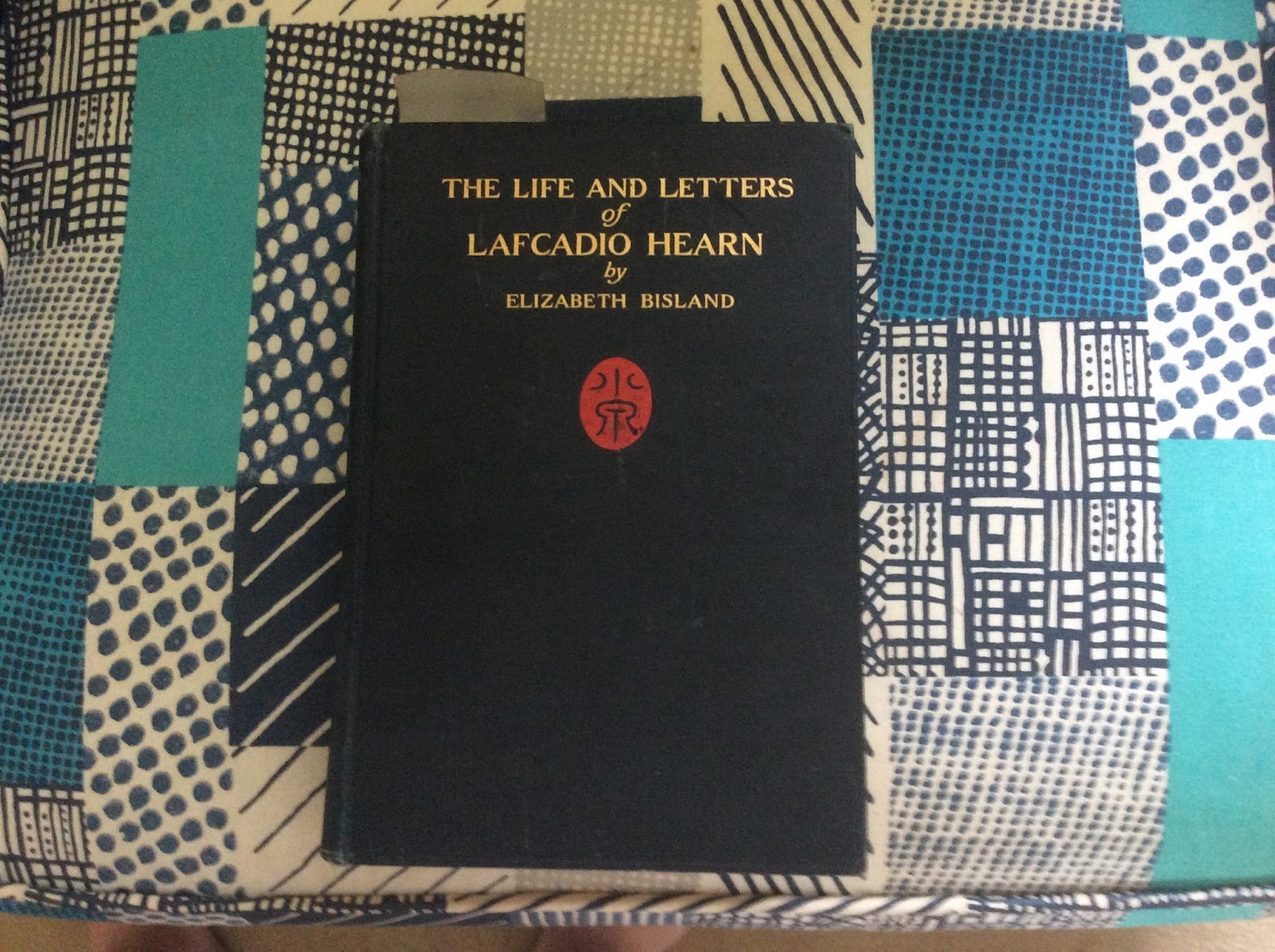
I've been lucky enough to hold a copy of The Life & Letters of Lafcadio Hearn in my hands. Elizabeth Bisland's two volume collection is a remarkable piece of scholarship, and I'd recommend it to anyone with any interest in Hearn. Or even those that don't, because there's plenty here that can be data mined by anyone with an interest in horror.


Lafcadio was born in 1850 to an Irish father and Greek mother. The circumstances of his parents' marriage were straight out of a romance novel. Surgeon-Major 76th Foot Charles Bush Hearn was sent to the island of Cerigo in the late 1840s, where he met Rosa Cerigote. The two fell in love but her family did not approve, particularly since the British were an occupying force. They wanted nothing to do with the oppressors, and one night her brothers ambushed Hearn and stabbed him, leaving him for dead. Rosa found the Surgeon Major and concealed him in a barn, nursing him back to health. When he was well enough the pair eloped, and for a time knew happiness in Greece. Lafcadio, named for the island of his birth, Lefcada, was their second son. The first died soon after birth, and their third, James, was born three years later.

When Britain ceded the Ionian Isles to Greece the family went back to Ireland, but this was fatal to the marriage. Rosa could not abide Ireland, and had no friends there. She became miserable, and after a time believed the Surgeon Major had fallen in love with someone else. The marriage was annulled, and Rosa fled back to Greece.

This disruption broke the family, and Lafcadio was adopted by an aunt, Mrs. Brenane, a staunch Roman Catholic. Lafcadio moved to Wales, and never saw his father or brother again. He grew up with a morbid distrust of attachment, never making friends easily, constantly on the lookout for betrayal.

I'm not going to summarize the book, but I do want to talk about an episode from Lafcadio's early history. It illustrates what I believe to be the one true rule of weird fiction: that the writer must take something that is normal in every respect, and twist it until it becomes unnatural.

Young Hearn had a cheerless life in Mrs. Brenane's household. She was a stern woman, teaching him Roman Catholicism by rote. He understood nothing of religion, but could repeat prayers "only as a parrot might have done." A nervous child, he had been forbidden ghost stories and fairy tales and was under strict injunction not to talk about such things.

One day a visitor arrived, Cousin Jane, a joyless young woman who wanted to become a nun, but did not. "I asked why," says Lafcadio, "I was told I was too young to understand." She seldom smiled, and seemed burdened by some secret grief.

One day she discovered that Lafcadio, though nominally religious, had no real concept of God. This horrified her, and she lectured him with a fervor that says something about the brand of religion she adopted.

I do not remember all the rest of her words; I can recall with distinctness only the following:

"and send you down to Hell to burn alive in fire for ever and ever! Think of it! - always burning, burning, burning! screaming and burning! screaming and burning! never to be saved from that pain of fire! You remember when you burned your finger at the lamp? Think of your whole body burning - always, always, always burning! - for ever and ever!"

I can still see her face as in the instance of that utterance - the horror upon it, and the pain. Then she suddenly burst into tears and left the room.

From that time I detested Cousin Jane, because she had made me unhappy in a new and irreparable way. I did not doubt what she had said; but I hated her for having said it - particularly for the hideous way she said it ... When she left us in the spring, I hoped that she would soon die - so that I might never see her face again. 

But I was fated to meet her again under strange circumstances. I am not sure whether it was in the latter part of the summer that I last saw her, or early in the autumn; I remember only that it was in the evening and that the weather was still pleasantly warm. The sun had set; but there was a clear twilight, full of soft colour; and in that twilight-time I happened to be on the lobby of the third floor - all by myself.

I do not know why I had gone up there alone; perhaps I was looking for some toy. At all events I was standing in the lobby, close to the head of the stairs, when I noticed that the door of Cousin Jane's room seemed to be ajar. Then I saw it slowly opening. The fact surprised me because that door - the farthest one of three opening on the lobby - was usually locked. Almost at the same moment Cousin Jane herself, robed in her familiar black dress, came out of the room, and advanced towards me - but with her head turned upwards and sideways, as if she were looking for something on the lobby-wall, close to the ceiling. I cried out in astonishment, "Cousin Jane!" - but she did not seem to hear. She approached slowly, still with her head so thrown back that I could see nothing of her face above the chin: then she walked directly past me into the room nearest the stairway - a bedroom of which the door was always left open by day. Even as she passed I did not see her face - only her white throat and chin, and the gathered mass of her beautiful hair. Into the bedroom I ran after her, calling out, "Cousin Jane! Cousin Jane!" I saw her pass round the foot of a great four-pillared bed, as if to approach the window beyond it; and I followed her to that other side of the bed. Then, as if first aware of my presence, she turned; and I looked up, expecting to meet her smile ... She had no face. There was only a pale blur instead of a face. And even as I stared, the figure vanished. It did not fade; it simply ceased to be - like the shape of a flame blown out.

Cousin Jane returned to the house at the beginning of the cold season. In the first few hours she made much of Lafcadio, buying him toys and good things to eat.

I ought to have been grateful, if not happy. But the generous shame that her caresses had awakened was already gone; and that memory of which I could speak to no one - least of all to her - again darkened my thoughts. This Cousin Jane who was buying me toys, and smiling, and chatting, was only, perhaps, the husk of another Cousin Jane that had no face ... Before the brilliant shops, among the crowds of happy people, I had nothing to fear. But afterwards - after dark - might not the Inner disengage herself from the other, and leave her room, and glide to mine with chin upturned, as if staring at the ceiling?

Cousin Jane took a turn for the worse the very next day, and did not come down to breakfast. She died of consumption soon after.

I understood only that I had seen; and because I had seen I was afraid. And the memory of that seeing disturbed me more than ever, after the coffin of Cousin Jane had been carried away. The knowledge of her death had filled me, not with sorrow, but with terror. Once I had wished that she were dead. And that wish had been fulfilled - but the punishment was yet to come. Dim thoughts, dim fears - enormously older than the creed of Cousin Jane - awakened within me, as from some prenatal sleep - especially a horror of the dead as evil beings, hating mankind ... such horror exists in savage minds, accompanied by the vague notion that character is totally transformed or stripped by death - that those departed, who once caressed and smiled and loved, now menace and gibber and hate ... what power, I asked myself in dismay, could protect me from her visits? I had not yet ceased to believe in the God of Cousin Jane; but I doubted whether he would or could do anything for me. Moreover my creed had been greatly shaken by the suspicion that Cousin Jane had always lied. How often had she not assured me that I could not see ghosts or evil spirits! Yet the Thing that I had seen was assuredly her inside-self - the ghost of the goblin of her - and utterly evil. Evidently she hated me: she had lured me in a lonesome room for the sole purpose of making me hideously afraid ... And why had she hated me thus before she died? - was it because she knew that I hated her - that I wished her to die? Yet how did she know? - could the ghost of her see, through blood and flesh and bone, into the miserable little ghost of myself?

Anyhow, she had lied ... perhaps everyone else had lied. Were all the people that I knew - the warm people, who walked and laughed in the light - so much afraid of the Things of the Night that they dared not tell the truth? To none of these questions I could find a reply. And there began for me a second period of black faith - a faith of unutterable horror, mingled with unutterable doubt. 

Those who knew her history are dust ... How often have I tried to reproach myself for hating her. But even now in my heart a voice cries bitterly to the ghost of her: "Woe! woe! - thou didst destroy it - the beautiful world!"

When I first decided to post this I thought I would use the story as the kernel for something of my own, perhaps a discussion about ghosts. I find I do not have the stomach for it.

The child was just shy of six when this happened. Imagine living with that pressure cooker of a mind, stuffed full of gunpowder and set alight by a hysterical would-be nun, frightened out of your wits and nobody to talk to. I would not want Lafcadio's early life if you offered it me with a fortune in gold, and fame by the truckload. 

Lafcadio's work has a long, long shadow. If you've played The Mountain Witch RPG, you've been playing in his world. If you've seen Kwaidan, you saw his stories. 


I urge you to seek him out.


Sunday, 14 January 2018

New Gamemaster Month - Trail of Cthulhu

I'm not directly involved with the New Gamemaster Month program, but I thought it'd be fun to kibbitz and offer a little extra advice. The system is Trail of Cthulhu, and the sample adventure on offer is Midnight Sub Rosa, in which a group of investigators are sent to Rosa, Alabama to recover a diary written by necromancer Ezekiel de la Poer. If you want to download the scenario, I recommend you wander over to the New Gamemaster Month website where there is a download link.

I'm going to start the discussion with a note on historical accuracy. Thursday's New Gamemaster post says that you "don't have to have every nook and cranny of the setting committed to memory, either - in fact, the setting is yours to craft, and elements you interpret differently than what's in print (on purpose or by accident) make the setting your own. That's a feature, not a bug." This is absolutely true, but some people may find it difficult to believe, because of the historical accuracy problem.

Trail, like Call of Cthulhu and many similar titles, is set in a particular time period. This can cause novice Keepers, and players, concern. Sometimes this is because certain aspects of history are, at best, unsavory. The example scenario spends some time talking about race, a topic that's bound to come up in 1930s Alabama. However it just as often causes problems because people don't know enough history, and feel the lack. They get nervous that they're "doing it wrong," or worry that a particular technology might not have been available at the time. What does it mean for the scenario when a player says, "I turn on my flashlight," and someone else at the table says, "did they have flashlights back then?"

First thing: don't panic. Confidence, as the Thursday update says, is the only secret sauce. If you, as Keeper, choose to rule thus-and-so, it doesn't matter if history contradicts you.

Second thing: a little history can be very useful, and history's easily had.

You don't have to bury yourself in textbooks. The game manual is your first stop, but there are other sources. Writer's Guides for pretty much every period you care to name are available at very reasonable rates, and because they're pitched to people in exactly your position - creators seeking background knowledge - they're very readable. I have a copy of the Writer's Guide to Everyday Life from Prohibition to World War II, which I see is going for silly money on Amazon, and while I wouldn't base my PhD on McCutcheon's work, it's certainly good enough for game night. It doesn't just give you timelines and dry facts; it has a list of slang terms, an essay on crime and a selection of cop slang, bits on transport, clothing, radio, music, dance, what people were reading, watching, talking about. If ever you want to add color to a scene, this is the kind of detail you need.

For example: Death Valley Days is a radio show that started in 1930 and went on, in one form or another, until 1975. Some episodes are available online. Nothing could be easier than to have that playing in the background; there are many apps that play old time radio, most of them for cheap or for nothing. Heck, even if you don't use these old shows as background noise, it's still worth listening to a couple, if only to steal characters to use as NPCs.

However there's another way history can help: it can give the Keeper ideas. Lots and lots of juicy ideas, many of which can be data mined from Wikipedia.

Consider the telephone. By the 1930s they were common; Rosa, Alabama has a party line, according to the scene Exploring Rosa. The scenario notes that the house where most of the action takes place doesn't have much use for electricity, but there are telephone poles. The characters are presumably staying at the lodging house, which definitely has a telephone.

Let's take a step back. What exactly is a telephone exchange? Well, when telephones were first used, they were single-function devices. You had a phone, it was connected by wire to another phone, and that was that. You could only call that one phone. If you wanted to make calls to other people, you had to install new telephones. This wasn't particularly useful, so someone came up with the idea of the exchange. Everyone's phone was connected to the exchange, and when you wanted to call someone you contacted the exchange and told them which telephone you wanted to connect to. The operator then physically connected you with that phone. This system continued, in one form or another, until the 1960s, when automation replaced human operators. If you read old authors, like Agatha Christie, Dashiell Hammett, or Dorothy Sayers, you'll notice that whenever a character picks up a phone they talk to the operator first, and say "connect me to [letter code] [number]," and after maybe a few seconds, there's a connection. The letter code identifies the exchange, the number, the telephone. Usually the number is anywhere from three to five digits long, depending on the likely number of subscribers. The smaller the catchment area, the smaller the number. The letter code is often turned into a word for easy memorization, as for example with Susquehanna 4 7568.

That tells you, as Keeper, three things. First, that connecting with another phone is a lengthy process. You might have to wait a long time, perhaps several minutes, before you finally got to speak with the person on the other end. Second, that there is a human being, the exchange operator, between you and the other person - and the exchange operator can hear everything you say.

Third, that the number of numbers is limited. Take a look at Susquehanna 4 7568, an episode of The Naked City, a TV show that aired in the 1950s and early 1960s. The story kicks off when a young woman, new to NYC, gets a phone installed at her flat, only to discover that her number used to belong to someone else and she's getting his calls. Exchanges can only accommodate so many subscribers; eventually they have to re-use numbers. In The Naked City, the woman overhears a murder. In Cthulhu, the investigator might overhear almost anything.

The Keeper can complicate this further. As Rosa is a rural community, it has a party line. These are cheaper to run, and don't need an operator. In broad terms, everyone is connected to everyone else, on a loop system. The obvious problem being that there is no privacy on the party line; everyone gets to listen in, not just one operator. Moreover a user can monopolize the line, preventing anyone else from making calls, and this can happen by accident, when someone doesn't properly disconnect after a call. Party lines were still a thing even as late as the 1980s; it wasn't until people started using phone lines for other things, like answering machines and computer modems, that they finally died out. Stephen King, for example, references party lines in his fiction more than once.

The scenario says that the party line only connects three locations, but as Keeper you should feel free to modify a scenario to suit your needs. Remember, it's a feature, not a bug. If you want that party line to connect to other places, you can. Probably not very many other places, since, as written, Rosa is dirt poor. However a couple of the outlying farms could also have telephones, and there's no reason the Derby House shouldn't also be on the party line. It may even be that someone's illicitly connected; after all, it's not as if anyone's marching up and down the line looking for extra connections. This may come in handy if the Keeper intends to run any of the additional material provided with the scenario.

There are two plot-related points to make here.

First, the party line is an excellent way to provide clues, particularly via Oral History. People talk. Often they can't help themselves; they give away secrets and gossip in equal measures. Just listening in can provide an investigator with all kinds of dirt. Imagine what might happen if the investigators catch Sheriff Barnes on the line, discussing the situation with the state police, or listen to some of the citizens of Rosa dishing dirt on people's families and less-than-reputable pasts. "Of course, nothing good ever came from that side of the family. Why, my dear, didn't you know ..."

Second, if the investigators use the telephone, they have no way to ensure their conversation is confidential. It's wiser to assume someone's listening. Or something. After all, there's that o-so-intriguing section about Ghoul Changelings; imagine what might happen if one of those was listening in on an investigator's call for help.

But perhaps the most significant non-plot-related point to make is that a party line can add a lot of color to an otherwise drab setting. Gizmodo makes a similar point, when talking about barbed wire lines. People used to live their lives on these connections. They'd play music, talk about local politics or sports, read newspapers to each other, recite the weather report, pass on important news or alerts to the group. In many ways the phone lines acted in the same way a forum post does today; it passes on group messages, and alerts the group to important information. It adds that extra bit of vibrancy to a location if the Keeper bothers to add a few bits on non-plot related bits to a party line call. "Missus Sullivan's dog's missing? Better let the boys know, they might see 'er out in the long pasture. Gantry's sow dropped a litter of six last night, says he'll be selling off the weaners in a week or so, you want in on this you better go see old man Gantry afore they all leave the nest..."

So, going back to the original point: just by knowing a bit of history, in this case about the telephone, the Keeper can insert clues, link to scenes (even Antagonist reaction scenes), and provide enough color to make the setting come alive. None of this requires specialist knowledge; you can data mine from Wikipedia and similar sources to get everything you need.

So why the telephone? Why not? Everything has a history. Cars, nightclubs, public transport, trains, newspapers, factories and diners and a thousand things besides. You don't need to be an expert. You just need to ask yourself, "is there anything useful here?" Nine times out of ten, the answer's yes. Seek it out, and use it.

To all new Keepers and Game Masters, welcome to the hobby! I hope you enjoy yourselves.


Monday, 16 November 2015

Exercising the Mind

A while back I talked about finding inspiration in the most unlikely of places. As a result, I wrote a mini scenario based around a restaurant in Athens, the To Treno. As you're probably aware by now, I also write short fiction, and I thought I'd use this time to demonstrate one way of structuring and creating short fiction.

Again I'm going to use one of the Guardian's Top Ten lists. This time it's ten of the best hidden bars in New York, which I'm going to use as a jumping-off point. There are all kinds of options here - I particularly like the Blind Barber - but I think I'm going to go with the No Name in Brooklyn. It has a lot of things I find attractive, particularly that anonymous door, the atmosphere, and that it's open all hours so it gets an eclectic crowd. You can just picture it on, say, a Monday night after the restaurants shut down, and there's no civilians on the streets, just the parade of night workers and after hours people who keep the city running. It works, as a setting, for the tale I want to tell.

Now, a short story usually has to be something around four to seven thousand words. Seven's actually a little high. Most of the outlets I've submitted for so far have insisted on a four thousand word cut-off. What that means is you need to get in there quick. You haven't got time to waste on establishing shots and sentences that go nowhere but look pretty. The focus has to be on getting the most done in the least amount of time.

What do you really need? Well, you need at least one protagonist. Supporting characters can be useful, but aren't essential. You need the setting, which we've already established is going to either be the No Name, or be very like the No Name. Then you need a problem, something to spur the protagonist to action. That action will drive the story forward.

What's the best kind of protagonist for this sort of story? Well, bars need bartenders. This person could be a talented mixologist, the kind of person who wins awards and acclaim. He could be a flair bartender, the sort you might have seen in the movies.It can be fascinating to watch; I dread to think how many bottles are sacrificed to the floor paving in order make a talent like that.

Designing a character can be relatively simple. In fact we've discussed this before, when I talked about villain design, and campaign planning. The same tactics that work there, work here. We don't have as much time here to flesh out every least detail, so rather than answer every possible question I intend to focus on the basics:

  • What is the character’s name, age, ethnicity and gender?
  • Name three physical attributes.
  • What is a problem the character faces?
  • What is a secret the character hopes nobody finds out about?
Since I've been on a bit of a Dracula Dossier kick, I think this time the protagonist will be Romanian, a recent arrival in the US. Female, early twenties, and since the Dossier's kind enough to give some name options, she'll be Timea Barbu.

Tall, muscular, and dark hair that she secretly hates, for physical attributes. She's tried dye jobs, but they never work the way she'd like.

Her problem is that one of her least favorite customers has come in the wrong door of the bar. See below for more information about that.

Her secret is that she hopes nobody finds out she's a vampire hunter. She's trying to get out of the life, which is why she left Romania and why she's working as a bartender now.

That brings us to the problem that the character faces, which I alluded to earlier. That problem will spur her to action, which in turn drives the plot. Now, one of the simpler ways of structuring this kind of story is by giving her what amounts to a series of problems, each of which feeds into the other, in the same way that one scene feeds into another in a Night's Black Agents game. The point being that her initial action moves her forward by further complicating the initial problem. Each attempt she makes to solve her difficulty drives her further and further into the plot.

Generally speaking, you can allow for up to three steps in a short story. The initial obstacle, and her proposed solution, drives us to the second obstacle, which in turn leads to a proposed solution. That solution drives us to the third obstacle, and resolution. Obviously in a longer story you can develop this further, but this is short fiction, and we don't have the time for that.

As a rule of thumb, you can perhaps allow as much as a thousand words to establish the setting and the initial problem. The next thousand can deal with her first proposed solution, and so on. Since we've got a cap of about four thousand words, there's only so many times you can get away with that before you run out of words.

With that in mind, the structure is:

  • Initial thousand establishes the bar, Timea, and the problem.
    • The No Name has two doors, each of which is marked only by an antique knocker, no sign. The difference is that one door is used exclusively by normals, ordinary humans. The other is used exclusively by the spirits, undead, and other unnaturals, also out for a good time. So long as they all stick to their own doors, normals can't 'see' specials, and vice versa. Tonight, one of the normals has decided to break the rules. Well, decided probably isn't the best way of putting it; he's drunk as two skunks, and managed to find the wrong door handle by accident.
      • Proposed solution: get him out the door, quick. Unfortunately one of the specials spots him, and decides to keep him in the bar, as a kind of mascot. Or maybe a snack.
    • OK, if Timea can't get the normal out of the bar, she needs to keep the special occupied. If he's not paying attention to the normal because Timea's putting on a show, then maybe the normal can slip out. Or maybe Timea's bar-back can help out by getting the normal outside.  
      • That didn't go so well. Sure, the special's attention is occupied, but so is the normal, which means he isn't leaving. Plus the bar-back, a Penanggalan, scares him silly. Normal's beginning to sober up, which could be very bad for everyone.
    • New plan. Keep the normal drinking, or he'll sober up, and if he sobers up he'll start to question what he's seeing. Also, keep the special drinking, because that way the special won't have the wherewithal to do anything drastic.
      • Ah, nuts. The normal's settling down, after the Penanggalan scare, but the special's just getting belligerent. 
    • Final option. It's closing time, folks. Timea offers to walk the normal home. At least that way the special won't eat him. Except the special really, really wants to eat him ...
      • Resolution! One way or the other ...
There you have it! Once this story is finished it will appear on my Patreon. If I can finish it before the 20th, it will appear this month; if not, then it will appear next month, and something else will fill the slot.

I hope you found this entertaining!

Thursday, 18 June 2015

Patreon! Less of the hmmmm

Well, I bit the bullet. After musing for a while - mainly about PayPal and its relative uselessness to me - I decided to start that Patreon I've been thinking about. For more information on that topic, head over here!

In other news, the Plot Points folks posted the second half of their Pen and Ink interview, and if you haven't already found it, go over here.

Enjoy!

Monday, 30 March 2015

Villains (Escapist)


“So I won’t get away with it, huh? How many times I’ve heard that from dumb coppers, I couldn’t count … You’d give your left eye to nail me, wouldn’t you?” Johnny Rocco, Key Largo

Let’s talk about bad guys. 

If you’re the Keeper, Dungeon Master or whatever other hat of doom you’re wearing this week, you already know the problem: sometimes villains just leap off the page, screaming for attention as they blow up the world, but more often they just sit there, spineless slugs waiting for death. What went wrong, and how can you design a tabletop RPG villain that really catches the players’ attention?

The problem with villains is, too often they exist only to do one thing: be foiled by the player characters. Villains are punching bags, paper Nazis, colorful targets that sit on the far end of the shooting range and never shoot back, or at least not accurately. There’s nothing unique about them, nothing that makes the players think ‘I want to know more about this guy.’ If the players don’t feel engaged by the villain, they won’t respect him, and at that point the whole thing falls flat.

There’s a useful writing exercise for creating characters in fiction, which applies just as much to roleplay as it does that unpublished novel lurking on your hard drive. When designing a villain, think about the answers to the following questions:


  •  What is the villain’s name, age, ethnicity and gender?

  •  Name three physical attributes.

  •  List three favorite items.

  • Where does the villain live?

  •  How does the villain make money?

  • Where is the villain right now? What is he doing or saying?

  • What is a problem the villain faces?

  • What is a secret the villain hopes nobody finds out about?

  •  What is the villain’s core belief?

  •  What does the villain want, long term?

The first five questions on that list are self-explanatory. You need to know who the villain is and what they look like, or have on them at all times. You also need to know how much cash or capital they have, so you can work out what the villain has available to throw at the player characters. The rest of it wants a little explanation.

A villain is a character, with wishes, dreams and plans, just like everyone else in the game world. He didn’t just wake up one morning and decide, ‘I want to rob a bank today.’ The whole idea of robbing banks, or whatever it is the villain does, springs out of his desire to satisfy his long term goals. Maybe he wants to buy a house so he and his young wife and child can settle down, but he can’t afford it. Maybe he knows it’s a mob bank, and he wants to bring down the mob, so he figures hitting that particular bank is a virtuous act. Maybe it’s something else, but whatever it is, it’s tied to his core beliefs, and has the potential to satisfy his long-term wants. 

This influences everything the villain says and does, and he should take no action that fails to satisfy his wants. If he’s doing something, anything, it’s because the thing that he’s doing is important to him in some way: it protects a secret he doesn’t want anyone to know about, it solves a problem for him, it fits in with his core beliefs, or pushes forward a long-term goal. If it doesn’t do any of these things, then why would he bother? 

The bit about where the villain is and what he’s doing or saying is for your benefit. You need to be able to picture, in your head, what this villain is likely to do or say in any given situation, and often this means coming up with something on the fly. It really helps if you’ve worked out beforehand the kind of thing he’s likely to say in a particular situation, because you can use that as a jumping-off point to work out what he’s likely to say in other settings.

So how does this work in practice? 

I’m going to use an example villain from a Bookhounds of London campaign for Trail of Cthulhu. You don’t need to know the ruleset to understand the villain; for the purpose of this example, all you need to know is that Bookhounds is a horror game set in London, England, during the 1930s, and the core idea of the campaign is that the characters are booksellers dealing in occult tomes. That means the villain has to be interested in buying or collecting occult grimoires, for whatever reason.


  •  Stanley David Fentiman. Caucasian Male, in his early 30s.

  •  Tall. Wears good quality clothes that have seen hard use. Is missing two fingers on his left hand.

  • He always has a catalogue on him for a forthcoming book auction. Trench art RFC swagger stick. Webley Mk IV revolver, RFC issue.

Already you can see a bit of his history in what he wears and owns. He’s been injured at some point in the past; that suggests a catastrophic accident, or some kind of fight. The Great War isn’t that far off, and if he’s in his 30s now he could easily have been old enough to have served. The two RFC items indicate he was in the Royal Flying Corps, which means he can fly, and since one of the items is trench art, Fentiman’s probably quite talented as an artist. His clothes have seen hard use, which suggests he hasn’t the money to replace them when they get torn or worn out.


  •  Oxford, and is also a member of two London clubs, which is where he stays when he’s in the city.

  • Private tutor, formerly an Oxford don, disgraced and thrown out of his college.

He’s a very educated man, who formerly held a good position but now does not. That explains the good clothes, and why he can’t afford to replace them. He may also find it difficult to afford his club dues each year, but someone of his social status would probably hang onto those club memberships even if it means he has to eat beans for a month or two.


  •  Fentiman is confronting his enemies just before a fight, either in his tattered apartments or in a school room. “Dear boy, you ought to have a better grasp of grammar at your advanced age. Not that you will have an opportunity to improve …” [draws Webley]

  • Problem: he wants to establish a Satanic school of necromancy, but lacks the resources.

Satanic schools are a staple of folklore. Allegedly the Scholomance high in the mountains of Romania admitted ten students, each of whom was taught by the Devil himself. When the course of learning was complete, one student was sacrificed to the Devil as payment and the others were allowed to go free. Dracula himself is said to have studied there, and the Scholomance also turns up in World of Warcraft

Fentiman considers himself a master occultist, a true Satanic lord, but he’s also a teacher at heart. He wants to pass on his knowledge to future generations of occultists, but for that to happen he needs a lot of money, and also needs to conduct several powerful magic rituals. He may even need a school building, perhaps an old Victorian one that has fallen into disuse which he can then convert to his own purpose. 


  • Secret: he lost his privileges at Oxford when he was caught helping several of his student cheat; he was using the money the students paid him to buy occult books. He gets very angry if reminded of this disgrace.

Secrets can be very useful to the players. They reveal weaknesses, something that the characters can exploit to help them defeat the villain. In this case Fentiman gets angry if reminded of his fall from grace, and anger often makes people careless. Maybe in a critical moment the characters could use this information to upset Fentiman, at which point he starts making mistakes. That could be very bad for Fentiman, if he happens to be in the middle of a ritual or summoning.


  • Fentiman believes he is one of the most powerful occultists alive today, and one of the most knowledgeable.

Just because a person believes something, doesn’t make it so. Fentiman probably has some ability – unless he’s completely delusional – but there may be people more powerful than he, and more knowledgeable. He would probably be very upset if something happened to contradict his core belief.
·        
  • Fentiman wants to establish a Scholomance of his own, to teach others.

If there is such a school, then there are students. Fentiman probably has some picked out already, and if he ever gets this thing going then there will be more students, eager to learn. There may be a school building, perhaps some decayed old Dotheboys Hall, abandoned decades ago after an awful scandal. There may be staff, but what kind of person – or creature – is Fentiman likely to hire?

Consider this tactic, when designing your own villains. Find out what they want, what they fear people will find out about them, what they’re prepared to kill for. Once you know that, you know how to make your villain memorable, and then it’s time to make the player characters shake in their boots. There’s nothing more terrifying than a well-designed villain, out for blood!