Showing posts with label Dungeons and Dragons 5th Edition. Show all posts

Sunday, 6 October 2024

Dungeons and Dragons Player's Handbook 2024


I am the first person to get one of these, on-island.

This according to the store owner, who ought to know.

Short version: this is about 60 pages longer than its predecessor, more or less, and feels as if there's not as much there. 

I'm guessing part of the extra length went on spell descriptions. That section is considerably chunkier, about 100 pages more or less compared to the previous book's 80-odd. However, most of the bulk seems to be character classes and their various subclasses, which has gone from 70-80 pages to about 130.

Gone are the extra creative fillips. Gone are the extracts from writers like Margaret Weis, Tracy Hickman, Erin Evans. Gone are the call-out boxes like Met With Mistrust (Tieflings) Excellent Ambassadors (Half-Elves, now extinct), Monastic Traditions, Druids and the Gods, the example characters Tika and Artemis, the paragraph of description at the start of every class section (A tall human tribesman strides through a blizzard, draped in fur and holding his axe ...). Gone is the list of recommended reading. 

Even the art is kinda gone. Don't get me wrong; there's still pretty things to look at, and plenty of them. But some of the best pieces (like a full page Ravenloft splash with the usual suspects facing off in Strahd's fortress) are taken from other books. The others ... standard stuff, I guess, but to my untrained eye it looked as if someone said 'we have six poses. Six. Don't go nuts. Stick to the six.'

'Oh, and put a smile on those faces. Everyone's having a good time, ok?' 

Not that they all grin like Joker, but there's an odd lack of genuine emotion across the board. Frankly, after a while it feels less like an exploration of epic fantasy and more like a stroll through the lobotomy ward. It's as if there were two emotional states available, neutral, and smiling. Rarely laughing. Just smiling. 

Except for the Ravenloft piece. Nobody's having a good time in Strahd's castle.

I don't mind the rules changes. It makes sense to me that, say, your stat boosts (to STR, WIS, CON and so on) are based on your background not your ra ... species. Someone who spends their entire life working as a farmer is bound to be marked by that experience. Though I will say that, if Wizards are going in that direction, they needed a lot more backgrounds. 

Particularly given that your starting Feat is also based on your background. I can see a time coming when the players say 'ok, this NPC is clearly a Criminal, so they almost certainly have the Alert feat ...'  

I don't mind the bland player character sheet. In this shiny modern day and age there'll be a dozen of those up on teh Internets in all the usual places before the week is out. Within a month there will be far better character sheets available for free than anything Wizards could put in the book.    

It should be simple enough to use existing books with this new manual. The actual changes are slight. It's the work of maybe a minute to take the information in Volo's about, say, Tabaxi, and translate that to this new ruleset. You'd need to rejig the special traits a little and ignore anything about a stat boost. That's about it. 

I don't doubt that there are some rules changes, some feat rewordings, which will cause many arguments at many tables. The one I spotted was Weapons Mastery. 

A weapon is just a stick with a sharp bit, if you don't know how to use it. If you do, you can unlock special actions like Nick, Cleave, Topple and others. The martial classes - fighter, barbarian, paladin and so on - get a kind of mastery for free at 1st level. They have the option of taking mastery in a particular weapon or weapons mentioned in their basekit (eg. paladins get simple and martial weapons at basekit, which covers a wide range of sticks with sharp bits) but they don't get mastery in every weapon they know. Just the one or two out of the basekit list that they pick. They have the option of changing that weapon mastery at Long Rest, so the paladin who was a master of the longsword can switch to being a master of the halberd, eg.

I can almost smell the arguments incoming. "But I can switch!" "Yeah, at Long Rest. Did you? No. You didn't say. You're stuck with that longsword mastery." Or "we're not having a Long Rest right now, there's too much to do." "But I want to change my master weapon!" Or "Hey! You just picked up that weapon, how come you have mastery in it?" "Oh, uh ... by pure chance I trained in this type of weapon at the last Long Rest." Or "If you just escaped from [prison/durance vile/whatever] with no weapons to train with, how come you have mastery in that one?" "Well, before we were captured, months ago, I trained in this weapon type and never lost mastery, so ..." 

Added to all that is the Weapon Master feat which is a different beast (4th level General feat) with roughly the same intended use, which might end up a feat without a user. The people most interested will be the martial classes but if they already have a form of mastery at basekit, why take the feat? There is a stat bonus attached, but there are plenty of ways to get a stat bonus that don't require wasting a feat slot.

Maybe non-martials will want it? But even rogues (damage dealers but not a natural front line weedwhacker) get the base weapon mastery at 1st level. Only the weedy wizard and suchlike don't. Maybe there's a caster build out there somewhere which wants a sub-par weapons feat? As a replacement for one of the much more useful, class-relevant feats out there?

All that said, I think the most telling changes are the switch in priorities.

In the prior edition the book goes from an Introduction (Worlds of Adventure! How to Play!) which is maybe a few pages long and then leaps straight into Character Creation, where who you are - Race, a little over 20 pages, followed by Classes, then a half a dozen pages on Personality and Background - is the important bit. It lures you in with bold, glittering ideas, followed by a spotlight on You, the Hero.

In the 2024 edition it tells you What You Need right from the jump, followed by a lengthy description of game mechanics. You're 48 pages in before it begins to talk about Classes. More than 180 pages in before it talks about Species, the new way to describe Races. 

This is a system where Who You Are is far less important than How You Play The Game. 

That could be a problem. This book, out of all the books in Dungeons and Dragons, is the ambassador. The carnival barker outside the tent, luring in the rubes. It's the one that everyone's going to own, whether player or dungeon master, experienced gamer or filthy casual. 

It needs to be persuasive. It needs to sell itself. 

I don't know that starting out with 30-odd pages of fairly esoteric rules and little significant flavor text is the way to go.

Maybe I was warned right from the jump when I saw the book had dropped all those fantasy novel quotes, the flavor text at the beginning of the class description, the recommended reading list. This is a book about the rules of the game. Not about its soul. 

That's what I meant earlier when I said it felt as if there was less here than before. Reading this is like wandering through an empty house. You see where all the furniture was, once upon a time. Nothing there now.

Ultimately, I can't judge it. Its companion volume, the DMG, isn't out yet; the Tweedledee to its Tweedledum. 

We'll see. 

I blame Greg Tito, that base, villainous dastard, for getting me back into Dungeons and Dragons. I worked with Greg at the Escapist. I remember his enthusiasm for gaming, the way his little chipmunk face would light up talking about Dungeons and Dragons. It was his persuasive spiel that lured me into Ravenloft and from there to other things. I wonder what he's up to these days ... 


Sunday, 30 June 2024

Not Quite Book Review Corner: Proactive Roleplaying

Proactive Roleplaying: Guidelines and Strategies for Running PC-Driven Narratives in 5E Adventures by Jonah and Tristen Fishel, Media Lab Books 2023 


I mentioned this a short while back and I finally got my hands on a copy.  

Short version: It’s a breezy read and I’d recommend it to anyone starting their RPG journey. 

Long version: Well … 

This is a first effort and a fine one from the Fishels. You can sense their enthusiasm. It’s spilling off the page. They do make some egregious clangers but I’d chalk that up to inexperience and, if this first effort is anything to go by, I expect future efforts to be much better.  

I could have lived without the constant pop culture references. If you mention, say, Dune, to me, I no longer know whether you mean the books by Frank Herbert, the ones by Brian Herbert and Kevin J. Anderson, the 1984 film, the 2021 film, the 2024 film, the various different television series, the graphic novels ... Particularly these days when there are more streaming services than fleas on a fat dog’s arse, and other creators line up around the block to create fiction in a dead writer’s style, I do not pretend to keep up with all the pop culture all the time. Nobody human could.  

Those who try come away … changed. By their strangeness ye shall know them. 

That said, I think this is a brilliant book for anyone new to the hobby trying to run a D&D game. Its advice is commonsense. The base idea is that, as DM, you should make your 5E game more player-facing by allowing them to pick their own path through the narrative.  

Some of you may feel a slight twitch at this point; a certain spasm in the spinal column. 

That’s because this is exactly the same argument that Trail of Cthulhu had with Call, sixteen years ago. The argument that led to Trail taking dice out of the equation, allowing the players to pick the direction of the game by allowing them to piece together the threads of the narrative without resorting to dice rolls. Dice rolls when failure is interesting? Absolutely. Dice rolls when dice become gatekeepers preventing players from accessing story? No thank you. 

Later this became systems in which the players were allowed to pick the direction of the campaign, not just the game. The big two are Dracula Dossier and Armitage Files, but truthfully it applies to pretty much any GUMSHOE product. The base argument there is exactly the same as the base argument here. Give players some control over the narrative and you strengthen the narrative.  

The big difference being, this time, we’re talking about 5E D&D. Dungeons and Dragons gave birth to the RPG genre but it also gave birth to the DM-driven narrative. The linear path, carefully scripted by one person. It drives a lot of DMs down that same road, even now.  

With dice. Lots and lots of dice. And charts. God. O Lord. The charts. I see the Fishels still love ‘em some charty goodness. Best of luck to them. Some people’s creative style differ from mine. I found myself wishing for the bare simplicity of GUMSHOE towards the end of the book’s example scenario section. It was beginning to feel like eating an entire cheesecake in one sitting. The first slice? Goes down easy. Second slice? Mmm. Slice eight? O God …   

It does feel at times as if D&D folks drag the mechanics of the game along with them like damned souls hauling chains and weights from now until salvation. As if they don't see the chains as chains, somehow. jhj

Honestly, I’d like to see more DMs make player-facing games. Particularly player-facing D&D games, which often tend to be anything but. I think it can only add to the hobby. This is one of those times when you can see the authors taking their first steps down that path and I wish them well.  

If you’re looking for a birthday present for your DM or hoping for some tips on how to make your 5E game a better experience for everyone at the table, I highly recommend this book.  

See you next week! 

Sunday, 11 February 2024

Low-Level Scenario Design (D&D5E)


Deerstalker Pictures

This week’s post comes courtesy of something I disliked.  

Fuss! Fume! 

I was reading an article about low-level encounters for Dungeons & Dragons groups, encounters which weren’t just ‘go kill the rats in my basement,’ and, while I appreciated the sentiment, the suggested alternatives were … dull.  

Unbearably dull.  

As in, I would leave the campaign if you tried that crap on me, dull.  

The big difficulty Dungeons and Dragons has is that it’s still dragging around Chainmail’s corpse. At heart, it’s a skirmish wargame. Its mechanics, spells, equipment and ethos is all about reducing the other fella’s hit points to zero as quickly as possible.  

Other fantasy games do this. GUMSHOE’s Swords of the Serpentine does this. But the difference between Dungeons and Dragons and Swords of the Serpentine is, Swords doesn’t start you off at level 1 and say ‘go forth, hero, and do great deeds.’ With Swords, and games like it, your character starts pretty much at the peak of their career and things can only get better. Whereas in D&D and its iterations you start with a handful of hit points and a gleam in your eye. 

A gleam which is quickly extinguished if, say, a goblin punches you in the unmentionables. Fury of the Small is not to be sneezed at. 

Other games choose other solutions. Ars Magica deals with this problem by giving you a half-dozen characters or more per player, so if one gets chewed up by a rampaging beast there’s another four or five behind them to fill the gap. Ars also focuses on story goals rather than combat goals, because it didn’t start life as a skirmish wargame with dreams of grandeur.  

But Dungeons and Dragons is a skirmish game which means the solution to any problem posed in the campaign is often ‘hit it till it falls down, then hit it again.’ It’s the wargamer mentality. Nobody asks a Civil War tabletop gamer to hug it out; Lincoln didn’t defeat Davis in a spelling bee. Though it would have saved a lot of lives if he did. 

Which is why ‘kill the rats in my basement’ is such a popular trope. Rats are small. They have almost no hit points. Their damage output is minimal.  It’s a quest that can reasonably be achieved by even the most incompe … the most inexperienced group.  

Still, there are only so many basements to go around. Eventually your band of pest controllers will run out of rats. Or get bored hitting them. What to do? 

Before I start talking about scenarios, let’s nail down some basic principles.

1)    Keep the combat to a minimum. 

Yes, there will be combat. It’s still a combat-focused game. But the characters only have so many hit points and short rests plus clerics working overtime is not going to solve that problem. Plan for one or two thrilling fight scenes, not The Game Of Death.  

It’s fine if the combat is nonlethal. Particularly in an urban setting where there’s active law enforcement and the death penalty (also known as hanging, drawing, quartering and there goes your weekend) it’s perfectly reasonable for the average ne’er-do-well to prefer nonlethal over lethal violence.  

2)    Make sure there are exciting things to do. 

This ought to be obvious but time has taught me that the obvious is anything but. These are heroes. They need to be doing heroic things. Sure, Hercules cleaned the Augean Stables, but he did it in a heroic way and it was one of his twelve heroic tasks. It wasn’t his Sunday second job.  

3)    Make it fantastic. 

This is a fantasy world where Gods, Devils and things beyond imagining walk the earth. Where physics and chemistry take a back seat to mystics in tune with the mythic forces of the universe. One of the reasons why busting rats in basements gets boring is that it’s just rats, just a basement. Where’s the drama in that? 

With all that in mind, let’s talk scenario ideas. 

The Laughing Cat 

Type: investigative; murder mystery. 

This adventure location is a burnt-out travelers’ inn on the high road. When it was still an inn, it was a popular spot for wayfarers on a well-traveled path. The reasonable thing to do would be to rebuild it but it has a bad reputation. Word is, it’s haunted. The [guild/monastery/family/noble house] which owns the land would appreciate it if someone deals with that problem before the inn gets rebuilt. Generous financial reward offered. 

Journey: 2-4 days across forest terrain to get to the Laughing Cat. The heroes may encounter a faerie dragon on the way there which, if treated with respect or properly entertained (it likes music) can provide a clue as to what might have happened at the Laughing Cat. Otherwise, combat.  

The Laughing Cat is a burnt-out shell. Preliminary investigation (DC10 investigation, history, perception) indicates arson. Someone set the main room on fire while everyone was asleep upstairs. If History is successful, the heroes remember that this happened about ten years ago and there were three survivors; everyone else perished, including the Awakened cat which gave the inn its name.  

A DC15 check remembers that the three survivors were Myria Whispermouse, a roguish Halfling who’s gone on to become a renowned hero; Aramil Caerdonel, an elf paladin (now fallen) whose whereabouts are unknown, and the innkeeper Bron, who was badly injured in the fire and now lives with family far away. Among the dead were Proserpine, a renowned Tiefling bard, and her half-orc companion Morg. 

That’s all that can be seen during the day. At night, the Laughing Cat comes back to spectral life once more. All of its people go about their business as if no time had passed – which, to them, it hasn’t. It’s always and eternally the last night of their lives. To them, the characters are just other guests at the Laughing Cat. The survivors are also there, as their dream selves; a nightmare none of them can escape. 

At which point the Cat enters the picture. Peridot is the only one out of all of them who knows that they’re all dead, and Peridot has a proposition: if the heroes can find out which of the three survivors did it and why, the haunting will stop.  

Was it Myria, whose greed for the party’s loot got the better of her? 

Was it Aramil, whose unrequited love for Morg tempted him to do something catastrophic? 

Was it Bron, whose drunkenness finally had disastrous consequences?  

By talking to those present, finding out what they saw and how they died, the heroes can gather the clues needed to reveal the killer. 

Potential combat encounters: 

Skeletal rats in the cellar (they guard a clue to the villain’s identity, a fossilized memory that will only reveal itself once they are destroyed) 

Bar-room brawl with the dead (nonlethal, but Morg has a punch like a mule’s kick). 

The imp Pazzu, whose temptations pushed the killer over the edge. Pazzu has a stake in the game; if it can drag the killer’s soul back to the infernal regions, it gets the soul coin that the villain’s misdeeds will mint. But until the killer dies, Pazzu is trapped at the Laughing Cat with the rest of them. If the heroes reveal who did it, the killer will die that night of a heart attack and Pazzu will be free to collect the coin. If the heroes squash Pazzu before that happens then Pazzu won’t have time to collect. Pazzu is a ‘hide-in-the-shadows, rely on invisibility’ kind of miscreant, but Pazzu can’t resist boasting about their clever scheme. This may trip them up in the end. 

Immortal With A Kiss 

Type: social, romance, urban 

The heroes are hired as extra guards at a rich man’s villa, one week only. The eldest daughter Olympia is getting married and valuable wedding presents are arriving every day. It’s the heroes’ job to make sure those presents don’t go missing and that Olympia’s privacy is respected before the big event. No visitors, no scandal; everything’s being coordinated to create the big event of the social season and there cannot be even the slightest hint of hijinks.  

This is particularly important to the family because Olympia is magically Blessed; all her life she’s had the Bless spell effect as a permanent, but according to fortunetellers and prognosticators that Bless effect will pass to her true love, when she kisses them for the first time. This story is well known; how true it is, is anyone’s guess.  

The villa is besieged by wedding tourists daily. Bards looking to try out their latest ballads; dressmakers wanting Olympia to wear their designs; cake-makers and confectioners who want Olympia to choose their treats for her wedding; ‘friends of the family’ who haven’t been seen in decades who turn up unexpectedly looking for a place to stay, or a short-term loan, or just a quick word with the bride-to-be. The heroes have to manage all of this discreetly.

Among the wedding tourists are a peculiar band of warlocks and astrologers who, day in, day out, prognosticate the wedding based on Olympia’s birthday and that of her husband, Kairon, the handsome and famous Ranger whose exploits and treasure retrieval bought him instant access to high society. These guys just won’t go away; they fulminate and gibber in the street, producing alarming magical effects, incense, smoke, dancing mice – you name it, they’ve got it. Their omens and portents cover the entire wedding from break of day to the last breath of nightfall. 

The heroes soon realize (DC10 insight, perception, deception) that Olympia’s younger sister Callistra is up to something, but it’s not clear what. She’s seen chatting with the astrologers and passing them insider information – but to what end? 

Further investigation (DC15, and this can involve bribing Callistra’s cat familiar with treats) reveals that wizard Callistra plans to use Disguise Self and Friends on the day in question to pass as her sister on the wedding day. She figures she can get away with it because she physically resembles her sister (size, bodyweight) and most of the day the bride will be wrapped up in veils and dresses. The heroes may work this out when they realize that she’s feeding the astrologers her own date of birth and personal information, not her sister’s.  

She thinks she’ll get away with this because Olympia’s planning on skipping the wedding and embarking on her own heroic career as a Thief. Her lover is an important member of the local Thieves Guild who taught her a few tricks. [The guild member may or may not be her true love; they may just be a seducing scoundrel.] The family would be appalled if they knew, and it’s exactly this kind of hijinks that the heroes were hired to stop – if they want to stop it, of course … 

Olympia intends to make her getaway on the wedding day, as that’s when there’ll be the most confusion. 

What nobody appreciates (except possibly the heroes, if they’ve been paying attention to those astrologers) is that the prognosticators are actually burglars. They’ve been casing the joint all week under cover of magical hoodoo. They know how to get in and how to get out without getting caught, which is exactly what will happen if the heroes don’t intervene. 

Potential combat moments: 

Brawl with drunken aristocratic youth who think it’s funny to sing romance ballads under Olympia’s window every day up until the wedding. 

Chase/combat with the astrologer-thieves as they make their getaway. They prefer nonviolence, ball-bearings and tanglefoot bags to cover their retreat, but they may confuse things by running through a rough tavern hoping that the ensuing bar brawl will help them escape. 

Pilgrim’s Passage 

Type: Negotiation/Problem Solving, Insight, Perception, Animal Handling 

Near the village of Three Hills there is a magical well that has become a popular spot for those on pilgrimage. (Life, Light, Nature). The village is within the fief of [noble/church/monastery] and its patron rakes in a small but not insignificant amount of tolls from those on the pilgrim trail. A nice extra comes from the sale of trinkets and medals organized by a small hermit community near Three Hills. It’s also a well-known fact that horses bred near the well have special properties, and the sale of those horses is a nice earner for the family that breeds them which in turn pays the fief holder a tidy sum for the benefice. In short, there’s a fair amount of cash at stake, which becomes a problem when the pilgrim trail is shut down by druids. Angry pilgrims complain to the fief holder, and the fief holder reaches out to reliable third parties to investigate and (hopefully) solve the problem. Enter our heroes, stage right. 

The druids, a trio of halflings, (Garth, Morrin, Gynnie, all novice members of a far-off circle), say that they have the right to shut down the trail when it is clear that the balance is negatively affected, and further that this right is in writing. Three generations back the fief holder agreed to this is negotiation with the druids’ circle, when a blight threatened the land. The druids cleansed the blight and extracted this promise as payment. 

The druids say that the horses bred near the well do not have special properties; quite the reverse, in fact, which hasn’t stopped the breeders from selling them at inflated prices based on reputation alone. Animal Handling DC10 shows this to be true; DC15 shows that this condition is being disguised by the breeders who use magical feed mash to pep up the stock before sale. The feed makes the horses seem great for a week or so; after that, not so much. The DC15 also shows that the older horses, which the family keep for breeding stock, are still as magical as ever; it’s only the current sale stock that is affected. 

The druids say that this shows the well is being over-used, threatening the balance. They demand that the well be given time to recover – perhaps a year or more. This proposal will not please the fief holder, which conveniently lost the paperwork on that druid deal as soon as possible after it was signed. The fief holder isn’t pleased to hear that the druids kept a copy. 

What nobody realizes is that the source of the problem is the hermits, who have become warlocks, tempted to more-than-mortal power by a devil who wanted access to the well for its own purposes. The hermits knew how to bypass the magical wards put there by the druids and they let the devil in. The devil did what it wanted and then left a few infernal serpents behind to watch over ‘its’ property. The serpents allow the devil to come and go as it pleases, bypassing the wards. The serpents can be defeated in combat but can also be instantly defeated by one of the magical horses, if that horse is brought to the well (Religion, Insight).  

If this is revealed then the druids can restore the protective wards and, after the serpents are dealt with, the well will recover.  If the devil is left in place then the well will become permanently affected within a year.  

Potential combat moments:  

A fight against infernal, poisonous snakes. 

A nonlethal brawl with the horse breeding family, or angry pilgrims.  

A potentially lethal scrimmage with the druids, or the warlock-hermits. The warlocks are likely to take to their heels if discovered; they got into this for power, not to get stabbed.  

The devil, if encountered, will insist on a battle of wits (Arcana) – a riddle challenge. If the heroes win, the devil promises to leave. If the devil wins it will remain at the well for a month. This challenge can be attempted more than once; the devil likes playing games.   

Sunday, 4 February 2024

Rewards (RPG All)

OK, it’s end-of-session. The characters have triumphed. Or at least they aren’t dead, which is a triumph in and of itself. The time has come to divvy up the good stuff – or whatever passes for good stuff in your campaign. 

What does that look like? 

Dungeons and Dragons and similar fantasy games have a definite advantage here. Everyone knows what the good stuff looks like. It’s shiny and spendable, glows with magic power, or increases your character’s level and therefore prowess. It’s all easily quantifiable. A +1 sword is a +1 sword, which by default is better than that nasty old ordinary sword you were using five minutes ago. Gaining 500 experience points is an undeniable rush, particularly when you can look at your current totals and think ‘I’m only a few hundred more points from the next level!’  

Call of Cthulhu has a similar reward system, where at the end of the scenario your characters get Sanity rewards depending on what they did and how well they did it. Sanity, for those not in the know, measures the characters’ mental state and can be reduced to 0, through various shocks and trauma. 100 is the theoretical human maximum. 0 = time to book you into a long-term-stay at Casa de Soft Walls, from which you shall not be returning. Nobody’s ever explained what 100 =; I presume you leave your physical body and ascend to the heavens on a cloud of sunshine and rose petals, at which point something quite nice happens beyond the ken & barbie of mortal folk. 

Point being that, in theory at least, if you gain enough rewards you can exceed your original Sanity total. Which in a game like this, where Sanity is the oil that keeps the engine going, is a reward prized above rubies and titles. 

However, there aren’t any other rewards. That’s pretty standard for horror games. You’re not meant to be the dashing hero; you’re meant to be the weedy academic, or similar. Victory for you means survival, not advancement. Sometimes you get to save someone’s life, which is great; saving lives is a good thing. However, it doesn’t fatten your wallet. 

Nor does it have the same impact as that +1 sword or those 500 experience points. It’s not easily quantifiable. The gold you swiped from that dragon all adds up to a total which can then be spent on goods and services. The fuzzy warm feels you got from saving little Suzy from the shoggoth cannot be spent on goods and services. Not unless your in-game economy is radically different from the norm.  

So, to the question: in games where the reward isn’t easily quantifiable, what will make those rewards fun? 

Sometimes the game makes it easy for you. Bookhounds of London is a little like that. You have a shop, which your players are constantly trying to improve. That shop has stock, which your players are constantly trying to get. The obvious reward there is more stuff for the shop, more stock to sell. Replace that dingy little cash box with a shiny new cash register. Design custom book covers for your collection. Thanks to your efforts the shop now has a valuable collection of grimoires on vampire lore (effective increase 2 points Occult). That sort of thing.  

However, as a rule rewards can be characterized as one of three things: 

Reputation 

Resources 

Shiny Things 

Reputation is a bit like pornography. Nobody really knows what it is, but they know it when they see it. There’s a really good reputation tracker in 13th Age which has since been ported over to Night’s Black Agents and other GUMSHOE systems: the Icon system. There are a number of Icons – powerful entities or organizations – whose favor brings a range of powerful rewards, and whose enmity can bring terrible destruction. Your reputation with that Icon helps determine whether or not that Icon will lend aid.  

Point being that reputation is useless without someone to acknowledge it; if, however, the CIA knows you and respects you that could mean you can rely on the local station chief for aid, or get a cache of weapons at just the right time, or transport, or whatever it may be. Reputation = tangible reward.  

This can apply to pretty much every gaming world. Cyberpunk has its corporations, gangs and medias; City of Mist has its avatars and proto-demigods; Troubleshooters has world governments and sinister organizations. Any and all of these can become Icons, which in turn reward gains in Reputation.  

But! It follows that a gain in reputation for one Icon results in a loss for another. If you gain reputation with Scotland Yard because your actions helped foil a cult conspiracy, those cultists are going to have an unfavorable view of you. That can lead to future plot – conflict often does. But it’s something worth bearing in mind. 

Resources are those things that the characters can use either in the current adventure or in future adventures. GUMSHOE has a habit of reducing these things to pool points rather than specific items, which is useful. Pool points can be anything; a gun can only ever be a gun.  

Night’s Black Agents has a fun idea which could probably be ported over to other systems: excess funds. For whatever reason your characters have money to burn. Maybe they had a good run at the local casino; maybe they stole it from some luckless villain. However they got it, they have it and more.  

In fantasy this is often the reward that a swords and sorcery campaign gives. Fafhrd and the Grey Mouser were always rolling in excess funds after a job, and by the start of the next story they were broke again. Easy come, easy go. 

The great thing about this kind of reward is first, it can be abstracted, but second, you can make it more concrete by asking the players how they want to represent this resource. It’s one thing to say you have excess funds; something else to say you have a bag full of cash. That bag can be stolen. It can break open mid-chase, scattering bills all over the street. It can be given to someone else. It can be gambled at the casino. 

Alternatively, it’s one thing to say you have transport; something else to say you have a cherry Ford Mustang with custom detailing. One is an abstract. The other is style.  


Bullitt

Let the player choose the physical representation. They’ll have more investment in something they chose as a resource reward. You can abstract it initially if you like, or need, but they give it form.  

Finally the Shiny Things. 

Those are a little bit like Resources in that they have value, but really, they’re trophies. Let’s say that the characters come away from an alchemist’s lab with a half dozen jars that contain God Knows What, but it’s glowing and has little eyes. Fine. It probably has value to someone. But really, it’s the in-game equivalent of a lava lamp. Pretty, meaningless, and there’s a non-zero chance it might explode showering hot wax everywhere.  

It’s often the case that characters choose their own trophies, but it can be fun to design a few as rewards. The hat made entirely of shadows. The golden spider pendant. The illustrated scroll with alchemical writing on it that nobody living can read. The crystal skull that glows in the dark. The mirror that shows your reflection as it appears in an alternate dimension. The framed Nosferatu poster signed by Bram Stoker. These are the meaningless in-game things that players find attractive; they make excellent rewards.  

I started by asking: in games where the reward isn’t easily quantifiable, what will make those rewards fun? 

The answer, ultimately, is by giving those rewards weight and attraction. Reputation has weight: it confers easily understood in-game benefit. Resources also have an in-game benefit. Shiny Things are a bit different but can be equally useful, because they have attraction. The cool tchotchke that they put in their office, to impress visitors. Nobody asks why the hell Batman wants a giant Lincoln penny in his cave; but all eyes go to it whenever they walk in the room.  

It’s just too fun to ignore.  

Sunday, 28 January 2024

Blighted Villages & Chicken Coops - Description (RPG All)


Launch Trailer via GameSpot

Like half the planet (it feels like) I too have been sucked into Baldur’s Gate 3, developed and published by Belgian game developer Larian Studios. Present to self for Christmas.

God alone knows when I’ll finish it. The damn thing’s huge. I haven’t even gone through Act One. I’m still noodling around goblin camps and wondering whether that nice Auntie who lives out in the forest really can homeopath me back to health. I shan’t tell you what I think of the game. Unless you’ve been living under an RPG rock you already know how good it is. I wouldn’t be writing about it now if I didn’t enjoy it.

That said.

There’s a bit early on that sticks out at me. Very minor spoilers ahoy.

Blighted Village. It’s within a stone’s throw of a temple, now defunct, and easy walking distance of what seems to be a grand monastery (ish) with a tomb underneath it, also defunct. Already you can get a sense of how this community used to work: priests in the temple, monks in the scriptorium, with a village in the middle producing goods to satisfy their needs. Probably there was some little gift shop selling tchotchkes to pilgrims as they wandered through.

Visually the Blighted Village reminds me of those tiny villages out in Northern Italy. You know the type; everything’s made of stone, streets very narrow, and there’s probably someone trying to sell it because nobody wants to live there anymore. Big features include a windmill, apothecary, and school. It’s abandoned, overrun by gribblies.

The more I poke around in there, the more the feeling grows. Is this a once-functioning community, or is this basically a bit of window dressing for the dungeon below? Did this village have a purpose, or is its purpose to get you down in the adventure area ASAP?

Point being if it feels as though the Blighted Village, or whatever it may be, is just set dressing, then the set starts to wobble. Immersion is threatened. Some background material is required for a place to feel lived-in. In Baldur’s Gate that seems to come most often from books and secrets you find after poking through all the crates and shelves; not so much from the things you see on the screen. Every so often you might, say, search through a schoolhouse and find a much-loved teddy bear. What happened to the child who owned that bear? How did the bear end up buried in a hole?

How much is too much, when it comes to background material? There’s no point designing things the players will never experience or care about. But if you set something in, say, an abandoned vineyard, do you want to outline how a functioning vineyard would, well, function? Or do you just want to sketch in some eye-catching details and handwave the rest?

If you’ve read my stuff, you know I prefer setting things in the real world, adding some historical data to make things flow properly and lend a bit of spice to what might otherwise be a boring narrative. Sometimes this leads to trouble, revisions. A while back when I wrote Sisters of Sorrow I realized that submarines in World War One were nothing like I imagined, and that meant rewriting the entire concept. C’est la vie.

I find it useful to poke around in old books and find out how things once worked. If nothing else it can provide plot, or at least an interesting scene.

Let’s wander over to Gutenberg, and ask the question: can I design a Chicken Coop of the Damned?

Probably the better question is why I’d want to do such a damn silly thing, but here we are.

A lot of games have, say, an abandoned farm as a setting. Something happened here in the before times and as a consequence the place is now Ripe For Adventure. Hideous things lurk in the shadows, each of them malignant and dripping with treasure.

For that to work in a scenario, how much do I need to detail about how the farm used to function?

The answer is, as much as is useful to me. However, that’s more glib than helpful. A bit fortune cookie-ish.

I start at Gutenberg because it’s useful to have a basic overlay of how things worked before The Unpleasantness. It’s also a pretty decent source of copyright-free maps and images. I could say the same about Wikipedia. I rely on neither for factual accuracy but then I’m not writing a thesis: I just want ideas.

Gutenberg reminds me that, if my adventure site includes a stable, then that stable needs somewhere to store harnesses and tack; somewhere to store grain and feed; somewhere to put the carriage (if this is that kind of stable); a source of water. Do I need to plan all this out? Probably not. But I do need to know that these things exist, because knowing this allows me to add details that can make the game fun.

It can also be a source of … other things …

From the description found at Gutenberg: The carriage room is sixteen by twenty-five feet, and the manure pit is in the basement beneath this room; to prevent the escape of ammonia from the manure pit into the carriage room a good cement floor should be laid down.

So, if I wanted to design a trap that, say, dumps the characters into, oh, a manure pit why not … I trust you can work out the rest for yourself. A whiff of ammonia might be the one warning the characters get before their moment of unhappiness.

A while back I put out a D&D scenario, For The Sound Of His Horn. In that scenario there’s a haunted mansion. Did I plan out the entire mansion from basement to rafters?

Hell no. This is what I said:

The Manse consists of the manor house, the hunting dog kennels, stables, and formal garden.

Manor House: a minor country house, first built over 400 years ago as a fortified country manor, renovated 150 years ago to be more comfortable and include a glassed sunroom. It was abandoned 100 years ago. Heavily overgrown and the roof is basically gone. In its day would have been home to four of the family and twice as many servants, or about twelve people in all. Rooms include: the great hall, the solar (private lounge for the family only), glassed sunroom now overrun by plants and mold, bedrooms, library, garderobe (latrine, single hole, discharging to outside), kitchen (including pantry and buttery, food prep and storage), attic (in almost complete ruin), wine cellar (ransacked). Most rooms have some furniture in them, but anything truly valuable has long since been stolen. Haunted Effect: footsteps heard in the next room, but nobody is there. Trigger: if anyone finds the library, if anyone is alone in the house.

Hunting Dog Kennels: Stone built with slate roof, space enough for a hundred hounds, or fifty couples. Still stinks of dog even after all these years. Haunted Effect: shadows of hounds flit across the walls. Though they do not attack people, they harass the shadows of anyone in the kennels. Trigger: if anyone is alone in the kennels, or if a hunter (eg. Ranger, someone dressed in hunting gear or similar) is in the kennels.

Stables: Stone built with slate roof, space enough for a dozen horses including tack room for their gear, and the manor house’s carriage, capable of seating four plus driver. The carriage and tack are far too rotten to be any use to anyone. Haunted Effect: the sound of stamping horses being loaded with tack for a hunt. Trigger: if anyone is alone in the stables, or if a hunter (eg. Ranger, someone dressed in hunting gear or similar) is in the stables.

Formal Garden: rolling lawns with tree groves scattered about, small lake now choked with reed and mud, artificial ‘hidden grotto’ cave, artificial ‘antique’ statues (cupids, heraldic animals, foxes). Haunted Effect: the fox statues seem to move about and there are more of them than before. Trigger: if anyone finds the hidden grotto, if anyone is alone in the garden.

Secrets

Manor House: Library. In its day this would have been an impressive collection. That was before the windows smashed and damp got in. Now most of the books are ruined and the carpet is a soggy, stinking mass. Secret: Will & Legal papers. Hidden in one of the books is the last will and testament of Gelbert’s brother Wyllin, including plans of Wyllin’s estate. The papers show Wyllin’s two children, son Bartell and daughter Allecia, were to inherit. Secret: Family Holy Book. The Huntingtower Scriptures of Ezra, annotated on the frontispiece with the family tree. Bartell and Allecia, Wyllin’s son and daughter, are both crossed out. Secret: Estate Plan. A framed copy of the estate’s total land holding hangs on the wall. If Wyllin’s share had passed to his children Gelbert would have been left with less than half; if they didn’t inherit, Gelbert got it all.

Formal Garden: Hidden Grotto. In its day this was a quiet spot with a good view of the gardens and lake, part hidden by a grove of trees. The sort of place lovers and poets might enjoy, on a pleasant summer’s day. Secret: Bartell’s Diary. This is hidden under a stone near the grotto’s bench. Written in a child’s hesitant script, the diary tells how Bartell and his sister were forced from the family home after their father died. For a brief time they hid in the garden where once they played as children, but Gelbert soon found all their childhood hiding spots. ‘But he shall never find our secret wood, and we will hide there until we can get someone to help us!’

Potential encounters

The Butler, manor house only, night only.

Twig Blights, 4-6, formal garden only.

Giant Bats, 3-6, manor house only during the day in what little is left of the attic, night only in the gardens, hunting.

Rats, 10-20, hunting dog kennels and stables only.

Potential Treasure

Bloodstone earrings, 100gp, manor house, bedroom.

Obsidian carved family seal, 50gp, manor house, library.

Book, antiquarian, local history (gives +2 to any History check concerning Mordent), 80gp, manor house, library.

Book, antiquarian, vampire lore (gives +2 to any History check concerning Barovia), 100gp, manor house, library.

3D6 GP, manor house, one time only, any room.

Potion of animal friendship, hunting dog kennels.

1D3 bottles of good wine, 50gp each, wine cellar.

1 bottle of bad wine, DC15 CON save or lose 1D6 CON, CHA, INT for 24 hours (constant retching, nausea), wine cellar.

Enough description to be helpful, not enough to be overwhelming. There’s just enough history to the place that you, as DM, can get a sense in your head of how things used to work and how things work now. That’s all you really need. It might be a little different, in a combat-heavy game, if you need combat areas. Then you want maps. But most of the time you’re not going to need detailed maps, particularly if you’re the only one who’s ever going to see them.

Going back to the Blighted Village, where this conversation began, that’s broadly what you, the player, get. A visual that paints a picture. Enough of a working design that you, the player, get a sense of how it was supposed to function when it was a functioning village. Secrets, hidden away, that you, the player, can find.

Notice I repeat those words, you, the player. That’s who all this is for. Never lose sight of the fact that there is an audience and that audience needs to be catered to. All this description, this verbiage? It has a purpose.

Put it another way. I came up with a concept I called Rome. All roads lead to it. For the campaign, Rome is an event, location or circumstance that is the end state of the game.

That’s for the game.

For you, the DM/Keeper/Director, Rome is the player. Everything you do is headed towards that Rome – player engagement.

Fun.

Now, if you’ll excuse me, I have to stick a tadpole in my eye and go smack goblins.

Sunday, 4 June 2023

Things To Steal From D&D (GUMSHOE)


Honor Among Thieves trailer

D&D was my first system but it's not my favorite for a number of reasons, probably the biggest of which is that no matter the iteration the system still drags around the carcass of its first incarnation - the skirmish combat wargame. Everything goes back to that 10x10 room with an Orc and a chest. Or an Orc with a chest. In a chest. Juggling two chests and a gnome. However you care to word it.

Its more recent incarnation as 5.0 has a lot to recommend it (and I'm glad it brought back Ravenloft) but it occurred to me that there are two things a GUMSHOE game could steal from D&D:

  • Background
  • Treasure
Backgrounds are detailed in the PHB and can be summed up as Personality, Ideals, Bonds, Flaws. Treasure is detailed in the DMG and in particular the Other Rewards section from p.227 on.

I'm not suggesting the players use Backgrounds, though they can. You as Director have more use for them, and you also have more use for Treasure.

As Director you often have to come up with NPCs more or less on the fly, which is why Cameos (p92, Double Tap) are so useful. Still, it's nice to have some NPCs in your pocket for those moments when, say, having a Nemesis walk into the room with a gun fits the narrative, or at least gets the action flowing. Each Cameo has an In Play section which does sketch out a thin personality but it is useful, for those NPCs who might have more plot function, to have something more than the In Play. 

This is where the Background section comes in handy. A Nemesis who's a former cop is going to be different from one who's a former special forces vet, and so on. How to make them feel different, though, is where the Background shines.

When I first read that section it reminded me of the Tarot, specifically the Celtic spread, which in its most basic form can be read as:
  1. The Present
  2. The Challenge/Problem
  3. The Past 
  4. The Future 
It's not an exact match but it performs the same function. It tells you where you are, where you have been, where you are going, and where you might end up. Backgrounds does this with a series of "I" statements, as in "I have been an acolyte, I idolize a particular hero or saint, I believe in tradition, I seek to preserve an ancient text, I am suspicious of strangers."

In Night's Black Agents much is said about Bad Guys (Resource Guide, p23 on) but it's mostly mechanical. Trail doesn't really cover this at all, except to say that to change up the OPFOR you can change up their appearance or stats, so a Deep One, say, might have a hammerhead as opposed to an ordinary fish head. 

Suppose instead you tackle it this way:

Connor Rowe is a Deep One hybrid proselytizer who has left his coastal area to spread the word. He:
  1. Is an acolyte of Cthulhu who believes in the critical mass theory (p 91, ToC)
  2. Believes he is a predestined agent of change.
  3. Thinks his mission is to spread the seed of Cthulhu wherever he goes so that more join the critical mass.
  4. Is prone to obsessive behavior and will not change his plans once they are set.
You don't have to change the stats to make this work. You're changing the personality instead. 

Here you have a roaming preacher who moves from place to place spreading the word. This week he might be in a flophouse in San Francisco. Next week, Chicago. Wherever he goes he spreads the word, starts cults, so that flophouse in Chicago might become an epicenter of Cthulhu worship spreading the word, increasing the critical mass. It might just be preaching, or he may have other means - narcotics, shared dreams, amulets and crystals, whatever best fits. Given that Deep Ones live long lives, as a hybrid he might last longer than the usual human lifespan permits, meaning he could first be encountered as a young firebrand in 1890s San Francisco and still be around as an aged grand master in the 1960s.

The players might not even encounter Connor, at first. They can encounter the cults he leaves behind him instead. That only builds up his reputation, so that when they finally encounter Connor himself the players have an expectation, even a dread, of what this preacher might do.

That's Backgrounds. What about Treasure?

The DMG has this to say:  As much as adventurers desire treasure, they often appreciate other forms of reward. 

Why? Because in D&D, treasure usually boils down to X number of gold pieces plus a scattering of magic items. Rarely is it something interesting, or memorable.

What if it were?

Let's say this is Bookhounds of London. The obvious reward for player success in that game is a mythos grimoire, or possibly even a Windfall for the shop. It's what the central concept is about, after all. 

But let's take a step back. Those are the gold pieces of the campaign. What other rewards can there be?

D&D explains it in terms of 
  • supernatural gifts (a special reward granted by a being or force of great magical power).
  • prestige (fame & power, medals, favors).
  • epic boons (special gifts given to high-level characters).
Let's say this is a Lovejoy or John Constantine situation, two archetypes that work very well in a Bookhounds universe. Lovejoy is a near-supernaturally gifted antiques dealer. Constantine is an occultist who gathers favors; in his original incarnation he acts as a kind of middleman to the heroes and villains of the DC universe, and everyone owes him for one reason or other. His best mate, Chas Chandler, becomes his go-to taxi driver for exactly this reason: Chas owes John big time.

In a Bookhounds world, what kind of supernatural gifts are there?

Straight-up Magic, of course, and Mythos pools, but there are other options. For the cost of 1 point Stability:
  • Healing Hands: once per session you have the ability to heal as if you had 2 pool First Aid, by the power of touch alone.
  • The Lovejoy Touch: you can tell the difference between a genuine Mythos artefact and a fake, and if you don't know where in the room the Mythos artefact is, you can find it by this sense alone.
  • Bane: you create an artefact from whatever happens to be lying around that, for one combat scene only, can prevent a Mythos combatant from attacking you for 2 rounds.
  • Ghost Talker: you can communicate with the recently deceased, once per session.
  • Card Shark: you can win the equivalent of 2 points Credit Rating, once per session only. Any Credit Rating not spent by the end of the session is lost. Easy come, easy go.
How did they get these abilities? That's up to you as Keeper, but they probably had to sweat blood for them.

Prestige is a bit different and usually translates into better opportunities and increased Auction pools. Because your character is an influential person the auctioneer will let them look at the merchandise in a private session before the auction. Because your character is a member of the local Ring they get 2 points Intimidation free, to use during this auction only. That sort of thing. Again, it's up to you as Keeper how they got that prestige, but it probably involves a Windfall of some kind, or a very successful adventure.

Epic boons are a little out-of-scope and may not fit your playstyle, particularly if you go Purist. However, it could be very interesting to have a Mythos entity take an interest in your Bookhound. Let's say, for the sake of discussion, that a group of Ghouls take a liking to one of the Bookhounds. They may even consider the Hound for membership of their little supper club. As a token of their affection they give the Hound a silver ring. That ring has no power in and of itself, but all the other cults currently active in London know what that ring stands for and who gave it to the Hound. It's a kind of bargaining chip for future negotiations: I can't hurt you, but you know who my friends are ...  

Alternatively, let's say a Hound has a nasty experience with a Cthulhu cult, and as a consequence gains heightened Dreaming powers. Not only can they lucidly dream, they gain the ability to invade other people's dreams and interact with them. That may seem great, but there's a problem. Every person whose dream they invade loses 1 Sanity because the Hound isn't just invading their dream, they're spreading the critical mass of Cthulhu believers needed to make the Old One return. That is cumulative Sanity damage; it's possible to drive an ordinary person permanently insane. Which some Hounds might embrace as a tactic against their enemies ... 

That's it for this week. Enjoy!

Sunday, 19 February 2023

The Recent Unpleasantness (Wizards - OGL)

The OGL.

Oh dear.


Ginni Di


Zee Bashew


Legal Eagle

I’m going to assume you’ve a base familiarity with the problem and not go over old ground. If not, talk to the Internet – it has Opinions and is not afraid to share them.

What fascinates me about this situation is, first, it’s beginning to sound a little like a constitutional law question where President Albert issues an Executive Order and everyone assumes it’s there forever, only for President Bluebottle to come along and tear up that Order replacing it with one of their own. Or just not replace it at all.

The assumption is that Executive Orders exist in perpetuity and some of the most famous ones – Lincoln’s Emancipation Proclamation – have. More or less. But the outgoing President’s order can be torn up by the incoming at any time. Or by the next one. Or by the one after that. They give the appearance of solid, binding and enforceable statutory law whereas they are nothing of the kind, laws being the province of an entirely different body. They might last only so long as it takes snowfall to melt on a spring day.

See also the OGL, which basically took the form of a company pinky-swearing not to do a thing, and everyone assuming that the pinky-swear was a legally enforceable contract and How Very Dare You Do The Thing, Sir.

Second, I think this only can have happened in the age of the Internet.

As has been said many times before by wiser minds than mine, the whole point of the OGL and its predecessors was so Wizards could pass off scenario-writing duties to someone else. Scenarios are vital to the hobby but they don’t sell enough to make them viable product, particularly if we’re talking about paper versions.

Ask anyone who’s ever published physical – the Unspeakable Oath magazine springs to mind – how those razor-thin profit margins can make strong souls weep like children, particularly when advertisers vanish like a ferret up a drainpipe. Ask the newspaper industry how it feels about running those presses all day every day.

Wizards in its wisdom decided to give the scenario sales to small press outlets, and everyone was happy.

In the pre-Internet past, third-party scenario and supplement production led to product glut and the fabled bargain bin, the butt of so many Knights of the Dinner Table jokes. Many hours of someone’s blood, sweat and caffeine reduced to a $0.99 ‘please God buy this turkey’ junk sale box. As mentioned, there's a huge up-front cash investment when publishing physical, and a lot of would-be creators were forced out on cost grounds. There just weren't the buyers to support the hobbyist creators.

That's still the case, I suspect, for most producers of content. Ask all those streamers who put out Let’s Plays for 10 viewers at a time, or the folks on sites like DriveThru who sell maybe 20 copies of a book that might have taken them years to write. Such is publishing. The difference being that there isn't the huge up-front cost. There is a cost. It's just nothing like as substantial a cost as it used to be.

As a side note – going back to my days at the Escapist – I remember when the site was basically dead, most of the creators bar Yahtzee having moved on or been kicked out. There were a couple video content creators still kicking around the place like ghosts in a museum, none of them big names. They were being shuffled off to Buffalo, one after the other. I still had back-end access and used to poke around just to see what was what.

I recall one video content creator being given the heave-ho and complaining bitterly that it was thanks to the Libs, who had denied her bid for fame. Having back-end access, I looked at the hits per vid. Less than 20 on average, IIRC.

Content creation is not a fertile field that wants only a few seeds and water to grow beautiful flowers. It’s rocky, unforgiving soil. If you persevere, have talent and a bit of luck, you can make it – but there are no guarantees.

It is much easier than it was, and this is where I come back to the Internet.

Look at the production values in any of Ginni Di’s vids, or Legal Eagle’s, Zee Bashew, Game Knights. There was a time not so long ago when that kind of performance was basically out of reach for most, on cost grounds alone. You’d need to be a midsize production studio at least, with hundreds of thousands of dollars in the bank, before you could even think about doing that kind of work. You’d need Disney level resources to produce a Zee Bashew-style animation. Now someone can work from home on a relatively ordinary desktop setup and produce amazing stuff.

Don’t misunderstand me. What Creators do still takes talent, knowledge, effort. I know that I, for one, haven’t the chops to do what Ginni Di does. But it’s not nearly as expensive or difficult as it used to be, which creates two illusions:

1) The people who do this must be swimming in cash.

2) It’s easy.

I’m reasonably confident that Matt Mercer can pay his rent, or mortgage. I wouldn’t swear as to anyone else’s income. Just because it looks expensive doesn’t mean there’s been a sudden influx of millionaires in the RPG space. It just means that doing this isn’t as costly as it used to be.

Put it another way: there are plenty of creators who may seem to have cash in hand, and yet only be able to do what they do because their spouse has a good job with benefits.

Also, just because content creation doesn’t need a midsize studio any more doesn’t mean there are no studios. Command Zone, Loadingreadyrun, these are studios. They just aren’t traditional studios with network-level cash behind them. They’re small outlets which put out regular content and can afford to pay rent. They make a little look amazing. That’s as far as it goes.

Hell, I can write and self-publish a book, put it on Amazon in front of millions of readers, and pay almost nothing for the privilege beyond my time. That’s absolutely insane. It wouldn’t have been possible thirty years ago. I can put a complete scenario on DriveThru and pay nothing at all, and still collect income from it. If you’d told me thirty years back that this was possible, I’d have called you a liar.

But I’d lose on that book. Because while it seems easy to create content it is not easy to create quality content, nor is it easy to sell product in a crowded market. Not by a long shot. The job still wants editors, draft readers, maybe playtesters, decent art, publicity. Especially publicity. I have yet to meet a writer who’s any good at selling themselves; it’s an introvert’s craft, for the most part.

Or to put it another way, just because Ginni Di makes it look easy to put together a great video or YouTube series, without any apparent resources beyond her time and a dream, doesn’t mean it is. But that’s part of the illusion that the Internet has created.

Ironically this is the future that the folks who created the DotCom Bubble back in the late 90s foresaw and tried to cash in on, but they were too early for the tech and overfed by venture capitalists who, by rights, ought to have been in padded cells rather than throwing cash at the wall to see what sticks. Not unlike some recent venture capitalists I could name, who thought that giving millions to a cryptojackass who liked to play video games during business conferences was a good idea. Funny how venture capitalist seems to be another name for moron no matter which era we live in, but … I digress.

This brave new world has created Creators. If the Internet didn’t exist Matt Mercer would be a talented geek working in a $25/hour office job somewhere, playing D&D with his buddies on the weekend. Always assuming, of course, that D&D survived the collapse of TSR (the original, not New Coke) back in the 1990s. Loadingreadyrun, Command Zone, all of it would be impossible.

However, because the Internet created Creators we now live in a world where anyone, absolutely anyone, has a voice and a means of making themselves heard. To an unprecedented degree. Every day on Kickstarter I see projects that wouldn’t have made it through the submissions stage at an established company ask for $20K and get $2 million, or some equally absurd figure.

Understand, this is the part that’s unprecedented: Creators having their own voice, unfettered. Gone are the days when Cary Grant or Carole Lombard owed everything to the studio. You don’t have to be top of the food chain to have an opinion and be heard. The money situation isn’t unprecedented; control, over the work, the content, is. Having a means of being heard that doesn’t depend on the bosses in corporate is.

It’s worth bearing in mind, as a side note, that this situation kinda underlines the power of white privilege too. If this situation only affected creators who weren’t white, and only attracted complaint from non-white creators, this wouldn’t be a thing. You might hear it mentioned on a podcast. Maybe PowrDragn would be talking about it. There would be no instant takebacks from corporate, no sudden changes in tone or policy. Whereas now, folks have to wait a week for a response from corporate and that week becomes a substantive concern, worthy of ridicule and opprobrium and God alone knows how many thinkpieces on influential online news sites – or even the Actual In-Print Press. Imagine if you had to wait a week for forty acres and a mule. You’d be outraged, I’m sure.

It’s not as if this stuff never happens. Spelljammer: Adventures in Space – remember that? Or the whole business with New Coke TSR? Gee, that was news not so long ago. 2022. What a year.

Back on topic.

As far as the OGL is concerned it appears – at least, it appears to the madding crowd - as though Wizards took one look at the evolving situation, thought about the money they believed they’d thrown away when they gave scenario creation to the nerds, and tried to rake the cash back in. Only to discover that they were biting the hand that fed them. You don’t get to sell $50 game books unless you make the nerds happy, and they weren’t happy about this.

But I submit to you that the alleged motivation for doing this – the money – was illusionary from the beginning. Possibly on both sides. It’s been said – mostly by Wizards – that money was not the company’s primary concern. That this situation has less to do with cash than it does the changing market. Whether or not you believe that is up to you, but judging by the screams the Creators definitely believe it’s about the money.

Yet another side note (they breed like rabbits). It’s been suggested that the reason why Wizards wanted this switch was to protect their rights to the brand; they wanted to ensure they could step in and quash unacceptable use. I can see a case for that. It used to be said, if you were in the software business and Microsoft wanted to buy your company, you had two options. Take the money and run, or say no. If you said no, Microsoft would reverse-engineer your tech, and then steal the business right from under you.

I can see a case for arguing that if, say, Disney, wants to get into the RPG space, it doesn’t even have to reverse-engineer the tech; making it OGL or Creative Commons does all the hard work for them. It’s not as if anyone ever got rich fighting the House of Mouse. You can say that’s unlikely right now, and I’d agree with you. But the more visible Dungeons and Dragons gets, the more movies/TV shows/whatever are based on or reference Dungeons and Dragons, the more likely it is one of the bigger fish in the pond will take note. Then there will be trouble.

Back on topic.

The money.

You can make money doing content creation. Good money. But it’s not anything like as easy as it looks and just because someone, operating on a smallish budget, can put out good-looking content does not mean everyone’s a millionaire and there’s oceans of cash out there waiting to be redirected into your pocket. Or anyone’s pocket.

It’s still the same game as ever was. The production values are better, but don’t get fooled by a pretty outward show.

Anyhow, that’s enough bloviating from me. Have a good one!

Sunday, 14 August 2022

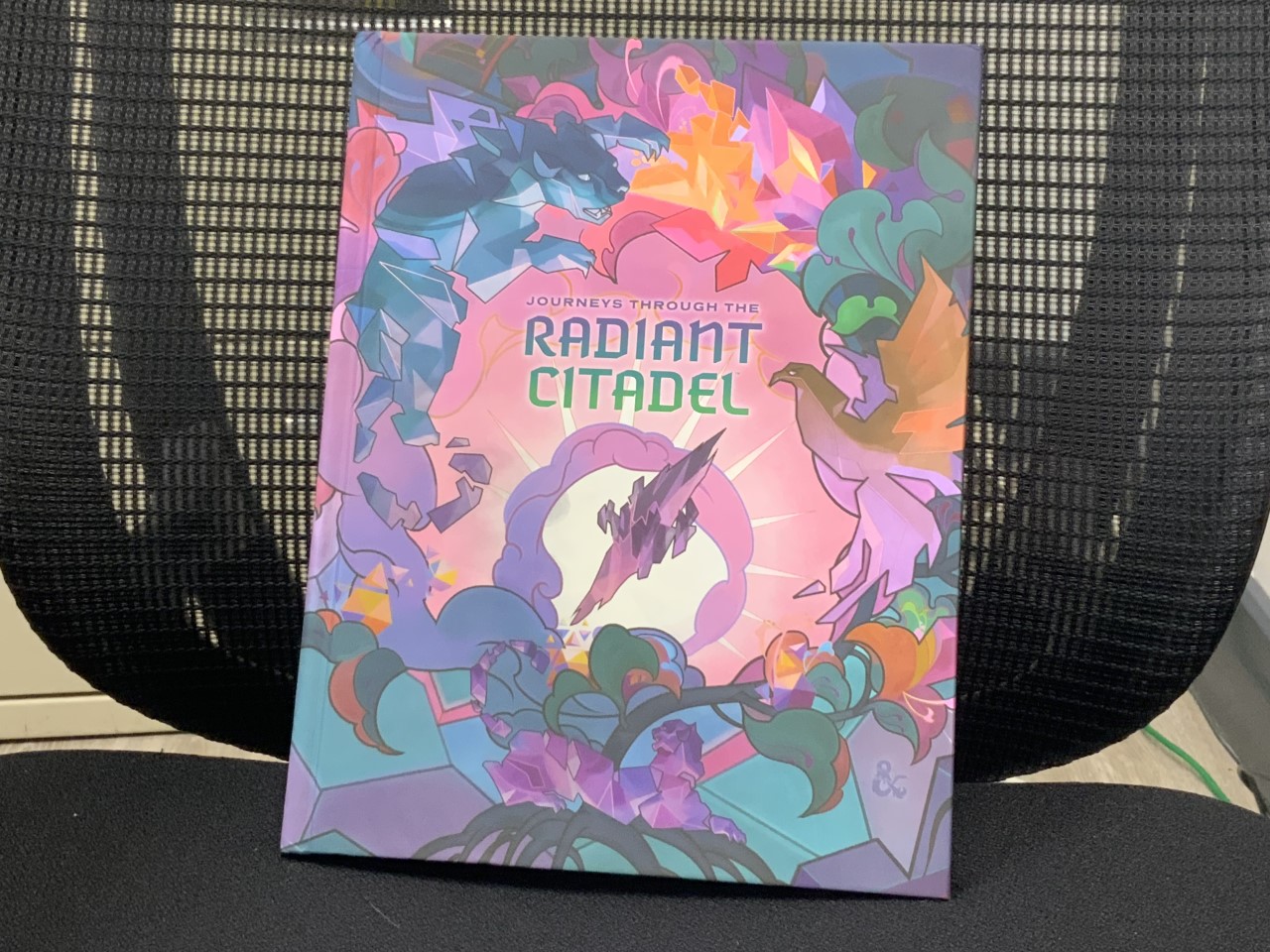
Not Quite Review Corner: Journeys Through the Radiant Citadel (D&D 5e)


Authors: Justice Ramin Arman, Dominique Dickey, Ajit A George, Basheer Ghouse, Alastor Guzman, D. Fox Harrell, T.K. Johnson, Felice Tzehuei Kuan, Surena Marie, Mimi Mondal, Mario Ortegon, Miyuki Jane Pinkard, Pam Punzalan, Erin Roberts, Terry H. Romero, Stephanie Yoon; June 2022 printing. 

I picked this up at Hex & Co way way way up by Columbia. I hadn’t intended to. I knew about it, in that vague ‘I saw it on the Internet and somebody tweeted once, I think?’ way that so many RPG products flash across my cortex these days. I didn’t know much, except that it was a different take from different authors.  

The variant cover was a selling point. Seldom do I see anything so beautiful – very dreamlike, it reminded me of Vertigo comics from back in the day. Sija Hong outdid herself! 

The Citadel drifts in the plane Ethereal linking twenty-seven civilizations in one central hub, itself speared through by the Auroral Diamond, a luminous gemstone shard that acts as a beacon for those lost in the twisting void. Lost for uncounted generations and reclaimed by explorers and heroes, the Citadel is a place where immigrants from across creation gather. They make their home in the great carved gem and use its portals to travel to and from other worlds. 

Those other worlds are what most of the book is about. Everything from the ghost-haunted streets of Yeonido to the suffering arid lands of San Citlan and the packed, happy bustle of Dyn Singh Night Markets – plus plenty more besides.  

As with all collections there’s going to be some ideas you’ll leap on with cries of joy and some that leave you going ‘ehhh …’ That’s not the issue. The issue is, is there enough variety, enough on offer, that even if you don’t like the idea of thus-and-so there’s something here you’re more than happy to have? 

If you’ll recall I said something similar about San Jenaro Co-Op’s Guide To Heists, which boasts 35 Heist scenario seeds. I lacked enthusiasm. The collection felt very weighted. I said at the time: 

So if you're, say, a fantasy or sci-fi Keeper looking for inspiration, you're going to feel left out. Ditto if you're a gamer looking for material set anywhere other than North America in the 2000s, really. The problem's fixable - change up some names, fiddle with the locations. Still, with about 40% of the scenarios set in the US or a US-centric location, mostly modern day, the collection feels unbalanced. 

Journeys doesn’t share that problem. 

God no.  

Journeys is bloody excellent.  

Do you want social roleplay? Done. Do you want to penetrate the heart of a ghastly, ghostly mystery? Done. Like Ravenloft? Here’s a setting. New and memorable creatures? Got you covered. Forgotten temples? Hidden mines? Yes, yes, and over here’s another sunken undersea yes for those of you seeking extra goodies. 

I shan’t go deeply into the production values or art since this is a 5E product and 5E is the top of the food chain when it comes to that sort of thing. I know I’m selling the artists short by not talking about their work, but I only have so many fingers, guys, and they’re being worn to nubbins against the unforgiving keyboard. Mercy! 

The tales I like best are the ones that focus less on saving the world and are more about interacting with it. The Dyn Singh Night Market and the fabulous vice-ridden city of Zinda are my two favorites, closely followed by hunting ghosts in Yeonido. In each the characters are asked to delve deep in the mystery, uncover secrets, perhaps gain renown by completing tasks or earning favor. That’s the kind of thing that really gets me going. 

There's a good spread of adventures from low level to high, and while I wasn't as fond of the high level stuff I think that's mostly down to my personal hang-ups about high level play and not the scenarios themselves. For me, high level play exposes some of the innate weaknesses in a combat-heavy system, and for all its tweaks over the years D&D is still a combat-heavy system. While I see the appeal of, say Orchids of the Invisible Mountain (14th level characters) it's never going to get my blood flowing the same way Wages of Vice (5th level characters) does, because I know in my heart that Orchids will end up being a dungeon bash where Wages is more of a race-against-time thriller.

The best thing about this collection isn't so much the scenarios themselves as it is the world Gazetteers that go with them. You don't have to play any of the scenarios if you don't want to. Each setting has enough detail for a campaign of your own, whether you want to have the entire plot arc in, say, bustling Yongjing or the holy lands of Akharin Sangar, or whether you just want someone to visit there briefly from their base in the Radiant Citadel. Each land has its own aesthetic, its own unique voice, and the Citadel is a handy means of linking all those voices in a conjoined narrative. It's a bit like living in a wide archipelago of nations, with a gleaming spire at its center drawing them all together.

Is it worth your $50? Absolutely. In fact, I'd recommend this to first-time DMs in particular because those are the folks who need the most support when running their games and there's plenty of support here. Someone lost for what to do or where to go next should have no problem working this into their ongoing campaign and perhaps the best thing about it is, with the Citadel at its center, you don't need to worry about ever getting bored. There's always a new adventure just over the horizon and unexplored lands awaiting discovery - or perhaps rediscovery. The Citadel isn't complete, after all; its dormant sections might be reawakened, by determined and clever heroes.

Enjoy!  

Sunday, 29 May 2022

The Die Is Cast: Interchangeable Scenes (RPG All)


James Bond, SPECTRE

There are moments in any RPG narrative where the heroes have has A Moment, whatever that moment may have been, and now need to transition from the Moment to wherever else in the narrative they need to be right now. Maybe they just overheard the bad guys explaining their plan and now need to get the hell out of there, as happens in SPECTRE. Maybe they need to get from their current location to a more useful location, say because somebody in the party died and they need to get to the temple for a resurrection or raise dead.

Maybe this, maybe that, maybe the other thing, but the point is they were Here, and now they need to be There. Right Now. 

Often this involves a chase scene, a dramatic interpersonal showdown, or something that, as Director, you may not have planned for - hence this post.

Many RPG campaigns, no matter the setting, explicitly plan for this moment. Horror on the Orient Express is designed so the ending scenario of the campaign is a race to [LOCATION HIDDEN] to prevent horrible things from happening to the world. Nights Black Agents has Extended Heat chases for exactly the same reason, always linking the agents to the ongoing threat whether they happen to be in Lisbon or Bern this week. 

However, you can't always plan for these moments. Players are unpredictable. They may invent the most peculiar moments and make them the Moment, for no better reason than it seemed like a good idea at the time. Then you, as Master of Ceremonies or whatever shiny hat you're wearing this week, have to pull a scene out of your capacious crevice. 

Or it may be that the players haven't invented a Moment at all, but instead they're stuck in a holding pattern waiting for a Moment that may never come. 


 Waiting for Godot, Harold Pinter (Sir Patrick Stewart, Sir Ian McKellen)

What to do in moments like this? Or even Moments like this?

Cheat.

The great thing about many RPG systems, and I'm going to use Dungeons and Dragons as an example, is that the crunchier they are, the easier it is to cheat, since most of the narrative depends on die rolls. It's not exactly scripted, but it's easy to manipulate a situation so that it appears scripted because everything ultimately depends on whether or not a particular die roll hits a particular difficulty.

That means you can create interchangeable scenes. You take a prewritten sequence, slot it into the narrative, and boom! Instant plot, that looks as if it was made from scratch.

So in any given chase scene, for instance, it almost doesn't matter who's doing the chasing or where the action is taking place. What matters are the DCs scattered along the path, because the DCs determine whether a particular moment goes one way or the other. 

This is more difficult to pull off in player-facing systems where the emphasis isn't so much on hitting a particular number as it is leveraging a particular situation. In those circumstances the GM really does need to know what is going on in that specific scene, rather that rely on a set of generics to help them out of an awkward situation.

However, even then it can be done. Consider Night's Black Agents, with its various Thrilling scenes - chase scenes, infiltration, digital intrusion, and so on. These scenes ultimately depend on the agent hitting a particular sequence of difficulty numbers in more or less the right order. That means it doesn't matter who's the active party and who the subject, or where the scene is taking place. What matters is the sequence of difficulty numbers that the agents have to cope with.

Let's say this is Dungeons and Dragons, Ravenloft, using the Mordent setting.

Mordent is a ghost-ridden coastal community, vaguely Georgian in terms of technology and social mores. There are no cities; the biggest community is about the size of Whitby, Yorkshire. There's vast stretches of lonely moorland, isolated hamlets, spooky mansions on the hill, Christopher Lee and Peter Cushing are chewing chunks out of the scenery, that sort of thing.

So how shall we cheat?

To begin with, on that description we already know that most if not all scenes will take place in a moderately civilized but not urban area. This isn't Tolkein's Middle Earth; you won't find ancient dragons sitting on vast hoards of stolen dwarvish gold down some mountain hole or other. Nor is this Jack the Ripper's fog-shrouded London town, with sinister threats lurking down every dark alley - and there are more dark alleys than there are hot dinners. 

On the other hand, a coach racing down a lonely road trying to outrun a half-dozen highwaymen sounds perfectly in keeping with the aesthetic. Or a skiff out at sea trying to beat the storm and get back to harbor before being driven up on the rocks. 

So any DM wanting to organize a transition chase scene could assume that the available chase options are:
  • Small village (one-horse town).
  • Large community (more than one street and horse, but not a metropolis).
  • Open civilized countryside (ie. something with a road in it, but houses/inns are few and far between).
  • Open countryside (no road, probably a few treacherous bogs or a Hound of the Bonkervilles lurking down an abandoned tin mine shaft).
  • Coastline, shallow water.
You could get more complicated than that if you wanted to, but that should cover most options. 

Then you go through each line item, assign half a dozen obstacles or chase moments (is that a fallen tree trunk blocking the road ahead? What's the Jump DC?) and you're more than halfway there. 

So if the players manage to antagonize, say, a bunch of hellhounds and have to run for their lives, you already have most of the work prepped ahead of time. Or if they're at sea and need to beat that storm back to shore, bingo! One coastline shallow water chase coming up.

Exactly the same works for systems like Night's Black Agents. In fact it's easier, because the players announce ahead of time that they want, say, Thrilling Digital Intrusion scenes by giving their agents 8 pool points or more in Digital Intrusion. Knowing this, you can set aside a couple of Digital Intrusion sequences knowing full well it won't matter whether this sequence is meant for the casino in Monaco or the military base in Germany. Then, when the player announces they want to make a Digital Intrusion, you can slip one of your pre-prepared sequences in  and it will look as though the player's improvised moment is part of the narrative.

Systems like Dungeons and Dragons, which rely heavily on crunch, are particularly easy to manipulate this way because everything those systems do rely on one Difficulty Number or another. Social Interaction is a set of Difficulty Numbers, Stealth is a set of Difficulty Numbers, everything can be reduced to a set of DCs - and it doesn't matter who's making the roll or why, because what matters is someone will have to make a roll eventually.  

This, in a nutshell, is the difference between a player-facing system and a more traditional RPG. A player-facing RPG relies more on the player than it does the game mechanics; a traditional RPG relies on the mechanics rather than the player. Point being, if the game relies on mechanics then as DM you can manipulate the mechanics to make your life easier. Sometimes this can involve outright bullshit, like fudging die rolls behind a screen to produce one result or another, and that kind of thing is always a bad idea. 

But sometimes it can involve using the existing mechanics to your advantage, to save yourself work.

Let's say the players suddenly take it into their heads to interrogate the Master of the Guild of Bakers. God alone knows why. Maybe they want to know how he makes those delicious scones. Doesn't matter. What matters is whether the Master (or whoever the heroes have to talk to before they can get to the Master) is Friendly, Indifferent or Hostile, because that will determine their initial reaction to the heroes. 

Then that NPC will have character traits - ideals, bonds, flaws - which can be manipulated (through die rolls) to change their original rating of, say, Hostile, to Indifferent. At which point, having played the NPC like a Stradivarius, the PC then makes ... you guessed it ... a die roll to determine the outcome.

What this means is, it doesn't matter whether the Master is some critical path character who the heroes have to talk to in order to unravel the plot, or just some random nutbar who the PCs happened to take an interest in this week. Centaur or Goblin, doesn't matter. Alignment doesn't matter. Stats don't matter. 

You could just work up half a dozen profiles with Ideals, Bonds, Flaws and starting Interpersonal rating - Friendly, Indifferent, Hostile - and it will not matter whether you use a particular profile on the sinister vampire lord Strahd Von Whosavitch or Bingo the Wonder Dog. 

But it will look as though you planned it all along. 

That's it for this week! Enjoy.

Sunday, 24 April 2022

Thank Heaven For That (RPG All)

I've been thinking about the unintended consequences of the absence of God.

There was a time when we took God, or Gods, for Granted. That mountain? God did it. The burning bush over there? God - it's a sign of things to come. A magical King who can cure scrofula just by touching you? God's holy power manifest in His human servant.

We don't do that any more, and one of the unintended consequences of this is that we don't think too much about how having an actual God that does actual Things upon this actual Earth affects plot, in any RPG setting.

For purposes of this post I'm going to assume a Pantheon of fantasy Gods each with their own area of expertise, but your campaign may do things differently.

Point The First: Divine Right of Kings 

It's never entirely clear, in any fantasy setting, how the King got to be first in line at the shiny, pointy hat giveaway. It's just assumed the King is the King, and therefore. 

However, there was a point when in order to be King you had to prove your worth, and more often than not this meant proving your lineage. Perhaps you were a demi-god, the offspring of Zeus or Poseidon. Perhaps you were the son of a demi-god. Perhaps you got the nearest religious authority to crown you, thus showing that God approves of your ascension to the throne. Perhaps you have to perform a miracle, such as curing someone of disease by the touch of your divinely inspired hand.

Whatever your proofs may be, you needed proof of some kind to show that you weren't just a Johnny-come-lately with a sharp knife and a winning smile. Otherwise some Johnny-come-even-more-lately might take your place some day.

The flip side to this is that, if you defy the Gods and take the crown anyway through nefarious means, your Kingdom might be punished for your misdeeds. That's essentially the story of Oedipus Rex.


Overly Sarcastic Productions, Red

How does this affect gameplay? Let me count the ways:

  • If your King is the Daughter of Zeus, then another offspring of Zeus might contest them for the Throne by showing off their divine qualifications. The bigger thunderbolt wins.
  • Before you can take the Throne you need to visit the Oracle and get its blessing, and that means Side Quest! Plus Festival! Plus possible shenanigans if all is not well at the Oracle ...
  • In order to become King you had to create a Divine Something - a well, let's say, that cures all who drink its water. This becomes a pilgrimage site. Then the well stops working, or falls into the hands of some hideous evil. Does this mean you have to stop being King?
Whether or not your adventuring band of misfits are Kings-in-Waiting or just the hired help, they can easily become embroiled in these shenanigans. That Divine Well, for instance, could become a quest site. Do the adventurers want to go there in order to cure, or even resurrect, a companion? Are they hired to go find out why the well ran dry?

In a modern(ish) setting there are far fewer Kings and therefore far fewer reasons to explore this trope, but even then there are ways into the mystery.

Let's say this is Night's Black Agents, with a Damned or Supernatural backstory. For there to be Damnation, there must also be Heaven. It might be a Heaven Denied situation where Lucifer's armies are constantly besieging the Pearly Gates and on the brink of victory, but nevertheless there's a Heaven. Often agents try to brew up Holy Water, if that's a bane, or acquire some divine relic like Kusanagi-no-Tsurugi. 

However, that assumes that the agents are worthy of God's favor. Suppose they have to prove their worth before they can wield the powers of Kings? What does that look like?


Fright Night

Point the Second: Pilgrimage and Relics

Kings aren't the only ones touched by God. There are many places, many people, which once were ordinary but now are lumined with Divine favor. Or Satanic, for that matter - Dungeons and Dragons' Ravenloft setting, for instance, is based around the concept of a land irredeemably tainted by evil powers.

It might be an abbey where a Holy Avatar once rested, and left behind a relic. It might be a sinister crossroads where Strahd once committed some hideous act of depravity. Whatever may have happened, it left behind physical evidence and as a consequence became a place where pilgrims gather to pay tribute, or gain unholy powers. 

In history, people went to great lengths to steal relics.  Bishop Hugh of Lincoln once went to France to pay homage to a holy relic of Mary Magdalene, and bit off her fingers in front of the entire congregation so he could carry them back to Lincoln. He would have snapped off her arm, but lacked the strength. 

Some relic vendors made their career, and fortune, out of selling, say, nails from the Holy Cross, or the finger-bones of saints. The wood and nails of the True Cross seem to act on Ship of Theseus principles and there are enough bits of saint scattered about to put together an undead Ziegfeld Follies, but the fact remains that if your church has a bit of saint or scrap of cross then your church is a very very very fine church.

A vendor gets their cash up front but pilgrimage sites made their money after they obtained the relic. Once you have, say, the skull of St. Foy, you can demand golden tribute from every citizen in the locality, and use that gold to make elaborate artefacts for your abbey. It's essentially the same trick the Mafia uses, but with less leg-breaking and property damage. Nice soul you have there. Shame if something were to ... happen to it.

Again, how does this affect gameplay?

  • The land is decimated, but not by plague or war; the clerics at the temple have scooped up every available gold piece, leaving nothing behind. They say their relic needs to be properly honored - but is their relic a true relic? Or is Mammon up to its usual trickery?
  • The relic dealer says they have a genuine holy item of glorious memory, and if true then your knightly patron wants it - but is it genuine? That's what you have to find out. Potential added moral dilemma: the item is genuine, but the relic dealer stole it from its resting place. 
  • In order to cleanse the land of some hideous curse you have to find the artefact that's at the root of it all and carry it to a holy site for cleansing. The skull of the vampire king, say, must be drowned in the Well of St. Dunstan, or the vampire may rise again. Alternatively, the cursed item you just picked up might demand to be taken to an Unholy ritual site, where it can finally fulfil its purpose.
If this is a modern(ish) setting like, say, Trail of Cthulhu, there are all kinds of artefacts you can pick up, but they're usually cursed. The whole point behind Horror on the Orient Express, to name but one, is that you have to go to various unholy sites and pick up dangerous artefacts so you can dispose of them. 

Point the Third: Animals Are Evil

First, thanks to YouTuber Ginny Di whose video about pets inspired this bit, and therefore the entire post. When I heard the age-old cry, 'The DM hates your pets!' my response was 'well, you could always accuse them of murder like in them there olden days - that sounds like an inciting incident if ever I heard one.' The rest of this post followed.

Incidentally if you're keen I highly recommend Hour of the Pig, also known as the Advocate, if you want to see this plotline in action. Also, young Colin Firth. Nudity, and so forth. Fun times.


There was a time when it was considered quite lawful, normal even, to accuse animals of crimes and punish or even execute them. Perhaps your rooster laid an egg, thus proving it was the spawn of Satan. Perhaps your pig committed murder. Perhaps that monkey really is a French spy - better hang him just to be certain.

In some instances the animal trial was a kind of trial-by-proxy. Say a nobleman commits sexual assault, or some other heinous crime. You might not be in a position to accuse, let alone convict, that nobleman. His horse, on the other hand, can be accused - even castrated. By such means are people theoretically above the law punished by the law.

These days we don't believe animals have moral agency and so cannot be held criminally responsible for whatever they may do. However, most RPG settings allow animals elevated rights of one kind or another, or human-level intelligence. Which begs the question, if your horse is so clever it can talk, is it capable of committing crimes - and can it be put on trial?

The anonymous author of Malefactio Animalium argued for two types of animals: those that were beneficial to man, and those that were not. Those which were beneficial had been designated as such by God, and that meant that Satan could work his wicked way on them, much as Satan could do to man. So those animals designated by God to be beneficial could be tempted, could commit evil acts, and thus be punished by law much as humans who committed evil acts were punished. The divine hand of God had effectively intervened, marking some creatures out as capable of doing wrong and therefore capable of being punished for their actions.

Which is an argument that we might consider nonsensical today, but then we don't have an actual God overtly intervening in mortal affairs on a daily basis. Whereas in Dungeons and Dragons and similar fantasy settings there are any number of Gods wandering around intervening in mortal affairs on a daily basis. If not an hourly basis.

It's not unreasonable to think that some of those Gods may have designated certain animals as beneficial to their followers. Elhonna, for example, might have sent a flock of geese to aid her worshippers, perhaps to act as some kind of honking Oracle. Erythnul might have sent some other creature to kill those geese, or corrupted the geese themselves somehow.

Whichever way it goes, it follows that as a God has marked these geese out as being distinct from other animals, the geese can do things other animals can't and shouldn't be treated the same way a so-called ordinary animal is treated. If one of them commits theft or destroys property, should they be put on trial? If a cat kills one, should the cat be accused of murder?

Having considered all that, now let's go further: in cases where the animal has an explicit bond with a person - a spellcaster and their familiar - it's very reasonable to assume that anything the familiar does is explicitly sanctioned by its spellcaster, if not actually an order from the spellcaster. In turn this suggests the spellcaster ought to be held accountable for their familiar's actions. 

Depending on the setting there may be explicit rules for this within the society the spellcaster operates. 
For example, within the Catholic church there's a concept called the ecclesiastical court. For much of the medieval period it was basically impossible to hold any priest accountable for anything, and 'priest' in context often meant 'I speak Latin.' The accused immediately claimed that an ordinary court, even a Royal Justice, had no authority over them; only a priest could judge a priest. 

Within a magical society, where there are actual schools dedicated to teaching magic, I can picture a system in which wizards, say, demand the right to judge other wizards. No ordinary court of justice for them; only their peers have authority. Which in turn would mean that if a wizard's familiar committed a crime and someone tried to punish them for it, the wizard could claim that the court had no authority to act; the familiar would have to be tried by a conclave of wizards. 

So how does this affect gameplay?
  • The characters are drafted in to act as legal counsel. A horse trampled a farmer to death, and is put on trial for murder. The local lord is the prosecution. The characters are the horse's defenders. If the characters play their cards right they could walk away from this with a lot of local fame, possibly a boon or two; but if they anger the local lord they could find themselves in very hot water.
  • The wizard's familiar is accused of theft, and embarrassingly the jewelry in question is found in the wizard's possession. The familiar swears blind they didn't do it. In fact, the crime was committed by someone else who faked it - perhaps a shapeshifter or druid who was able to make it look as if the familiar did it.
  • A holy shrine, well or similar location is polluted and it looks as if animals are to blame; a herd of swine did what swine usually do. The question is, did the pigs act of their own accord or did some supernatural entity push the pigs into action?
As for modern(ish), there tends to be fewer legal consequences for evil animals, but on the other hand there are often more evil animals. Packs of Satanically inspired rats, for instance, or a strange tree with peculiar creatures living in it. Quite often they're used as scouts or intelligence gatherers, occasionally as killers. It can be very useful to give the characters an advance warning of things to come by showing them animals behaving strangely, or flocking where they shouldn't.


That's it for this week. Enjoy!