My collection grows apace. I've known about this for a long time. Pretty sure I first heard of it when Stephen King referenced it, probably in Danse Macabre. I'd never seen it, so when Kino told me a sale was on (I think Kino has my number) I figured I could spend a few bucks and find out what the fuss was about.
Well.
Hum.
It's ... interesting? I can't put myself in the 70s and imagine what it would have been like to see this on the small screen in a darkened living room. I think it hits differently under those circumstances. I can understand why the likes of Chris Carter (X-Files) cite it as an influence on their work. It has flair, even charm.
Where it loses me a little is with the monsters.
Carl Kolchak faces off against pretty much everything you can think of, from relatively ordinary beasties like zombies and vampires to the more esoteric aliens, ghost knights and killer robots. They're a grim bunch. Richard Kiel of Jaws fame plays the gribbly at least twice. Thing is, they lack personality. They exist to menace. But even the ones that might have a little something, like Jack the Ripper, are one-dimensional. This Ripper is a wooden slash-slash killer with almost no dialogue. There's a side character who reportedly has whole conversations with him, off-screen. But nothing out in the open where the audience can see it.
It doesn't help that, since this is a 70s TV show and not a movie, the effects are minimal and there's no blood to speak of. Not that I like to wallow in gore, but if you're going to have a dog viciously attack someone on-screen there ought to be at least a hint of claret.
It's just about as cheaply made as you'd expect. Lots of clips sourced from other stuff with voiceover attached. Cardboard sets. Minimal fight choreography. There was one moment that stick in my mind, where Kolchak meets a source of information. This source is introduced, given a bit of background, but they never speak and you never see their face. It's almost as if they couldn't afford an actor so they dragooned one of the studio lot lice, put him in a dark suit, and said 'wave your arm around when I tell you to.' Somehow I don't think they had a union card.
But when it works, it works. This is due in no small part to the lead, Darren McGavin, who grabs the screen and doesn't let go. It's a treat to watch him scuttle around, fight his bosses with pop-eyed enthusiasm, dive after a story despite compelling reasons to run the other way. His Kolchak does what some Cthulhu investigators fail to do: he investigates. He actively goes after clues. Interrogates witnesses. Challenges authority. He's no angel, but fights on the side of the angels.
I know McGavin didn't like working for TV. He felt the work was soul-destroying. If you know him at all, it's probably thanks to his role in A Christmas Story, not this show. Still and all, this is damn fine work from someone who didn't like television. He put it all out there, and in doing created a character that's fun to watch.
A neat little Kolchak trick: he's at a hospital, trying to get a photo of the patient in their hospital bed. The door between him and the patient is shut and a cop stands outside, not letting Kolchak in. Kolchak engages the cop in conversation, gets the cop to agree to have his photograph taken. At the fatal moment, the hospital door opens and a nurse comes through. Kolchak whips around, gets a shot of the patient. 'Thanks!' Off he scuttles.
Another neat Kolchak trick. He has a recorder in a bag with a strap on it. The crime scene is on a stairwell. He knows he's not supposed to be at the scene, so he hides one floor up and lowers the recorder by the strap close enough to hear the forensic techs gossip. When caught, he loudly protests. When dragged away, his camera pointing at the ground, he makes sure he's dragged over the body on the stairs (which even in the 70s must have been a crime-scene no-no) and the viewer sees the flash go off.
That's Karl Kolchak in a nutshell. He finagles. He twists, he schemes. He does not bluster or start fights. He's no action hero. But he's got a lot of courage and he doesn't mind taking risks to get a story.
The blu-ray set is the full TV series, but it does not include the movie version which kicks it all off in 1972. It has a couple of special features but nothing too fancy, no commentary track. Worth picking up if you like this kind of thing, but not something I'd call a must-have. More a might-if-on-sale.
Keepers want this to steal NPCs from. It's vintage 70s stuff. If you have an NPC or a situation set in that period, you want to watch shows like this. Players want this because Kolchak is their patron saint. He shows you what it means to be an investigator into the mystery, and he never gives up.
A while back I posted my thoughts on the new PHB release, and I wasn’t thrilled. I said at the time that it “feels as if there's not as much there” and that in spite of its increased length there didn’t seem to be as much going on under the hood.
I also said I would have to reserve judgement until I saw the DMG.
Well, that proved prophetic, because I didn’t see the DMG for months after my initial purchase. There was a shipping delay followed by an unexpected cancellation followed by … I’m not sure what, actually. But it meant more delay. I picked up the Monster Manual before I saw the DMG. Not entirely by choice, but I figured since it was on offer I ought to give it a go.
What do I think?
Ehhhhhhh … pass.
As with the PHB, there’s more stuff on offer. Pages of it. The previous edition clocked in at 320 pages, more or less. This one has 60 extra pages of new material. About 20 pages of that is devoted to Bastions, a new concept for this edition, and another 20 pages or so are maps of various generic areas - Barrow Crypt, Crossroads Village, Spooky House, that sort of thing. No monster lists or anything like that. Those are for the Monster Manual, which is packed full of everything that walks, crawls and flies.
Factor in the various trackers, each with their own page, and you've got the bulk of the new material in the DMG.
Very little of it intrigues me.
The only bit that I find genuinely useful is the collection of trackers. I don’t care which edition of Dungeons and Dragons I play, I’m swiping those. But I don’t think I paid north of $60 per book for a set of trackers I could pick up for free from teh internets. Or create on my own with a modicum of artistic skill, come to that.
The bit about Bastions seems a little over-the-top. Apart from anything else, the whole point of adventuring is to go on an adventure. To leave the comforts of home behind and defy dragons, or cleave goblin chieftains in twain, befuddle ogres till they turn to stone by dawn's early light, that kind of thing. Not to spend however many hours in the day keeping track of all the things going on at the hobbit hole I left behind. I don’t mind the concept so much as the execution. This starts at what level, now? 5th? Really? For why? At 5th they've just this minute become heroes, not homebodies!
The Monster Manual is by far the best item in the bunch. Its reorganization of everything alphabetically is a nice touch, and for once the mantra ‘more stuff!’ pays off with, well, more stuff. All sorts of monster entries packed in like happy little sardines, and the stat blocks are sufficiently generic that you could probably mix & match these creatures with the previous edition and suffer no pain. There are probably some changes that might affect CR. Nothing I choose to worry about.
Besides, when in doubt I can always just dip into Mordekainen’s or Volo’s or any of the other books and use their stuff instead.
I mentioned the art last time so I suppose I should go into it again. Worth repeating: not an artist, not trained to appreciate art. But as with the PHB there isn't much here that doesn't seem generic, and the bits that don't seem generic feel as if they were lifted bodily from previous products. Little of it feels inspiring, or interesting enough to be worth more than a glance. Including a hexmap of what I think must be the Forgotten Realms is a nice touch. I'd have to tear it out of the book to be certain that's what it is. A handy resource, if so.
I’m going to be playing the game with some new gamers soon. I think I mentioned the play I’m performing? Tonight's the last night, as I write this; by the time I publish the cast party will have come and gone, leaving me exhausted. I shall break legs. Well, two of the cast are keen to play and I said I’d be happy to run a game for them. There’s a local venue where space can be rented for a fee, so we’ve booked a spot. One of them is so keen to play that she had already grabbed a copy of the previous PHB, not realizing that there was a new one. She and her husband are busy devising schemes and PCs as I type this.
When I mentioned that there was a new edition, she wanted to look at it.
Seldom have I seen a more sour expression.
She criticized the art right away. It didn’t look anything like the art in the previous edition. Nothing like as inspiring, as heroic, or as interesting. Next it was the rules. Too many rules, too confusing. She put it aside after half an hour; not interested.
We’ll be using the previous edition in our game.
For me, I’m not in any rush to pick up any other book in the new version. Not that I was ever going to be in a hurry to grab up, say, the Forgotten Realms material. But still. I said a while back now that the only reason I got back into this game was because of Ravenloft. That creaky old Gothic mansion was my inspiration, my guiding star.
Book and Dagger:the untold story of the academics who became the Spies, invented modern spycraft and helped turn the tide of the war. 2024, Elyse Graham, Harper Collins
I still don't know what to make of this one.
It's proven harder to read than I thought. I didn't take to it right away. I found it too easy-going, a little facile. I'm still not sure why the text rubs off on me the way it does. Maybe it's just writing style. If that's the case, then your milage will definitely vary.
However, the story it's telling is remarkable (though I question the 'untold' bit). Well worth your time, particularly if you ever intend to run or play Bookhounds of London, or Delta Green. This is the story of how the intelligence services in the West became true intelligence services. How they picked up those peculiar skills that would become the obsession of spy novelists in the decades to come.
How the booksellers and academics turned into spies.
Most importantly it tells you who they were and what they got up to. I like to think I know a little bit about the subject matter, but I'd not heard of Adele Kibre before, for example. It's one of those times when you're reminded that actual spy work is not like a Bond novel. That John Le Carre had a point. Here's someone who did very important work, but who did it by talking, by finagling, by paying attention and taking notes. Not for Kibre the daring car chases and escapes across rooftops. She bought or acquired books. Lots and lots of books, and papers, and news.
Judging by what is known of her she seems to be the kind of researcher who would have driven Barbara Tuchman to distraction; the kind that accumulated a wealth of knowledge but seldom put anything down on paper. There was always one more scrap to be had, one missing piece, and Kibre, by the looks of it, would rather have squirreled away that academic nut than published a single word.
Kibre isn't the only character, of course. Graham covers a wide range, focusing mainly on American sources. Her subjects are recruited from their dusty academies, set to training with the likes of Fairbairn and Colonel Applegate, and then off they go to the war, which might be in Spain or Switzerland or France or a dozen other places. There they hoover up knowledge both academic and military, funneling it back to their shadowy bosses.
From a Mythos perspective, or anyone with interest in running a supernaturalist spy campaign, this is definitely something you want to be looking at. This is Bookhounds taken to its logical extreme, where instead of the profit motive the squirrely bookish types are driven by loyalty to country and cause. Who knows what peculiar secrets they might uncover in that library collection?
I just wish I liked it better than I do. I've gone headlong into the likes of Barbara Tuchman and Liza Picard, and those are far more academically rigorous works. I rank Tuchman's March of Folly as one of the finest works of scholarship in the English language, and that covers about as broad a topic as you could wish for, with as much imagination - far more, I'd argue - than Graham displays here.
I suppose it could be writing style, or it could be a lurking suspicion that Graham's attention to detail is a little off. Never anything major, but several minor clangers that threw me out of the narrative.
There's a bit in the section about breaking codes where Graham imagines a conversation between two bigwigs shortly after a successful North African campaign. One asks the other whether the academics figured out how to read Hitler's plans from the flutter of ribbons in little girl's pigtails.
"No," the other responds. "They thought they'd break U.N. custom and actually apply intelligence to their intelligence."
Which works as a comeback, just barely, but all I could think was 'U.N.? As in United Nations? But they don't exist yet, surely? Or is this meant to be U.S.N. as in U.S. Navy - presumably Naval Intelligence?'
It's things like that which throw me off. The minute I start wondering whether the author can be trusted to tell the story straight - the author, mind, not the narrator - I lose interest in the work.
Part of the problem is Graham's use of fictionalized narrative to fill in the gaps, where historical information is lacking. It's a handy device in moderation. However, there's a lot of gaps, so moderation flies out the window. You're never entirely sure which bit is backed by some kind of record (any kind, please our lord Herodotus) or whether it's emerging full-formed like a Greek God from a historian's head. You have to have a lot of trust in the author before you can easily swallow that kind of thing.
It's a bit like the rant at the end of Murder by Death: 'You've all been so clever for so long, you've forgotten to be humble. You tricked and fooled your readers for years. You've tortured us all with surprise endings that made no sense. You've introduced characters in the last five pages that were never in the book before. You've withheld clues and information that made it impossible for us to guess who did it. But now the tables are turned ...'
Murder By Death (1976)
Which brings me back to the likes of Tuchman and Picard. I trust those authors, but they earned their trust by being academically rigorous from the start. Graham never did. She starts with fictitious narrative and carries on in that vein.
Do I recommend it? Yes. After all, I've recommended far worse works, both fiction and non-fiction, precisely because even the bad stuff can be a source of inspiration. The Book of Spies and Army of Thieves, to name but two, are absolute stinkers. They can still be mined for useful ideas.
The same applies here. I do not consider this a serious work of history. It's the historical equivalent of a summertime beach read. But it does have some interesting features and has enough of relevance to Keepers and Directors to warrant a read.
Tho maybe not buy the expensive hardback version? Borrow it from the library; that's the better option by far.
I am the first person to get one of these, on-island.
This according to the store owner, who ought to know.
Short version: this is about 60 pages longer than its predecessor, more or less, and feels as if there's not as much there.
I'm guessing part of the extra length went on spell descriptions. That section is considerably chunkier, about 100 pages more or less compared to the previous book's 80-odd. However, most of the bulk seems to be character classes and their various subclasses, which has gone from 70-80 pages to about 130.
Gone are the extra creative fillips. Gone are the extracts from writers like Margaret Weis, Tracy Hickman, Erin Evans. Gone are the call-out boxes like Met With Mistrust (Tieflings) Excellent Ambassadors (Half-Elves, now extinct), Monastic Traditions, Druids and the Gods, the example characters Tika and Artemis, the paragraph of description at the start of every class section (A tall human tribesman strides through a blizzard, draped in fur and holding his axe ...). Gone is the list of recommended reading.
Even the art is kinda gone. Don't get me wrong; there's still pretty things to look at, and plenty of them. But some of the best pieces (like a full page Ravenloft splash with the usual suspects facing off in Strahd's fortress) are taken from other books. The others ... standard stuff, I guess, but to my untrained eye it looked as if someone said 'we have six poses. Six. Don't go nuts. Stick to the six.'
'Oh, and put a smile on those faces. Everyone's having a good time, ok?'
Not that they all grin like Joker, but there's an odd lack of genuine emotion across the board. Frankly, after a while it feels less like an exploration of epic fantasy and more like a stroll through the lobotomy ward. It's as if there were two emotional states available, neutral, and smiling. Rarely laughing. Just smiling.
Except for the Ravenloft piece. Nobody's having a good time in Strahd's castle.
I don't mind the rules changes. It makes sense to me that, say, your stat boosts (to STR, WIS, CON and so on) are based on your background not your ra ... species. Someone who spends their entire life working as a farmer is bound to be marked by that experience. Though I will say that, if Wizards are going in that direction, they needed a lot more backgrounds.
Particularly given that your starting Feat is also based on your background. I can see a time coming when the players say 'ok, this NPC is clearly a Criminal, so they almost certainly have the Alert feat ...'
I don't mind the bland player character sheet. In this shiny modern day and age there'll be a dozen of those up on teh Internets in all the usual places before the week is out. Within a month there will be far better character sheets available for free than anything Wizards could put in the book.
It should be simple enough to use existing books with this new manual. The actual changes are slight. It's the work of maybe a minute to take the information in Volo's about, say, Tabaxi, and translate that to this new ruleset. You'd need to rejig the special traits a little and ignore anything about a stat boost. That's about it.
I don't doubt that there are some rules changes, some feat rewordings, which will cause many arguments at many tables. The one I spotted was Weapons Mastery.
A weapon is just a stick with a sharp bit, if you don't know how to use it. If you do, you can unlock special actions like Nick, Cleave, Topple and others. The martial classes - fighter, barbarian, paladin and so on - get a kind of mastery for free at 1st level. They have the option of taking mastery in a particular weapon or weapons mentioned in their basekit (eg. paladins get simple and martial weapons at basekit, which covers a wide range of sticks with sharp bits) but they don't get mastery in every weapon they know. Just the one or two out of the basekit list that they pick. They have the option of changing that weapon mastery at Long Rest, so the paladin who was a master of the longsword can switch to being a master of the halberd, eg.
I can almost smell the arguments incoming. "But I can switch!" "Yeah, at Long Rest. Did you? No. You didn't say. You're stuck with that longsword mastery." Or "we're not having a Long Rest right now, there's too much to do." "But I want to change my master weapon!" Or "Hey! You just picked up that weapon, how come you have mastery in it?" "Oh, uh ... by pure chance I trained in this type of weapon at the last Long Rest." Or "If you just escaped from [prison/durance vile/whatever] with no weapons to train with, how come you have mastery in that one?" "Well, before we were captured, months ago, I trained in this weapon type and never lost mastery, so ..."
Added to all that is the Weapon Master feat which is a different beast (4th level General feat) with roughly the same intended use, which might end up a feat without a user. The people most interested will be the martial classes but if they already have a form of mastery at basekit, why take the feat? There is a stat bonus attached, but there are plenty of ways to get a stat bonus that don't require wasting a feat slot.
Maybe non-martials will want it? But even rogues (damage dealers but not a natural front line weedwhacker) get the base weapon mastery at 1st level. Only the weedy wizard and suchlike don't. Maybe there's a caster build out there somewhere which wants a sub-par weapons feat? As a replacement for one of the much more useful, class-relevant feats out there?
All that said, I think the most telling changes are the switch in priorities.
In the prior edition the book goes from an Introduction (Worlds of Adventure! How to Play!) which is maybe a few pages long and then leaps straight into Character Creation, where who you are - Race, a little over 20 pages, followed by Classes, then a half a dozen pages on Personality and Background - is the important bit. It lures you in with bold, glittering ideas, followed by a spotlight on You, the Hero.
In the 2024 edition it tells you What You Need right from the jump, followed by a lengthy description of game mechanics. You're 48 pages in before it begins to talk about Classes. More than 180 pages in before it talks about Species, the new way to describe Races.
This is a system where Who You Are is far less important than How You Play The Game.
That could be a problem. This book, out of all the books in Dungeons and Dragons, is the ambassador. The carnival barker outside the tent, luring in the rubes. It's the one that everyone's going to own, whether player or dungeon master, experienced gamer or filthy casual.
It needs to be persuasive. It needs to sell itself.
I don't know that starting out with 30-odd pages of fairly esoteric rules and little significant flavor text is the way to go.
Maybe I was warned right from the jump when I saw the book had dropped all those fantasy novel quotes, the flavor text at the beginning of the class description, the recommended reading list. This is a book about the rules of the game. Not about its soul.
That's what I meant earlier when I said it felt as if there was less here than before. Reading this is like wandering through an empty house. You see where all the furniture was, once upon a time. Nothing there now.
Ultimately, I can't judge it. Its companion volume, the DMG, isn't out yet; the Tweedledee to its Tweedledum.
We'll see.
I blame Greg Tito, that base, villainous dastard, for getting me back into Dungeons and Dragons. I worked with Greg at the Escapist. I remember his enthusiasm for gaming, the way his little chipmunk face would light up talking about Dungeons and Dragons. It was his persuasive spiel that lured me into Ravenloft and from there to other things. I wonder what he's up to these days ...
Regency Cthulhu: Dark Designs in Jane Austen's England, Chaosium 2022, Andrew Peregrine, Lynne Hardy & Friends
This is a fun one!
I'm always happy to see Cthulhu taken to new and interesting historical periods. Setting an entire campaign in the English Regency (late 1700s early 1800s) has a lot of charm. If you're a fan of the old Gothics (Sheridan LeFanu, Matthew Lewis, Mary Shelley and the like) this is meat and drink to you. Ghosties, ghoulies and long-leggedy beasties! What could be better?
Peregrine does the Keeper an incredible favor by including the setting of Tarryford, a quaint little town in Wiltshire, partway between Bath and Salisbury. Lots of valleys, high downland, and remnants of ancient forest to get lost in, plus the occasional barrow mound, dolmen and stone circle to marvel at. Even if, as Keeper, you never use either of the scenarios in the book you still have plenty of material to draw on for your campaign. Peregrine also updates it for 1913, which means if you want to have a century-spanning game with dark secrets from the past looming over the 'present day', you can have that and welcome!
All told, you're looking at a little shy of 80 pages worth of history and setting, with two substantial scenarios and a further 35 pages of Appendices - equipment tables, pregens, maps, handouts and the like.
I'm going to start with the things I didn't love and then pass on to the things I did.
Personally, I'd have liked to see a little more history outside England proper, for two reasons: first, this is when England fights a lot of the wars that will define it, and the Empire. Second, this is the period of the Grand Tour, when well-to-do Englishmen went abroad for their education. The English are going damn near everywhere, establishing colonies where they please, and it seems a pity not to explore that.
It might also have been interesting to go into a little more depth about what it means to be a town in England. As opposed to a Cathedral town, or a village. It feels at times as if the book assumes you already know a lot of things that aren't really common knowledge outside England. The history of Catholicism in England, for instance, is something that people outside England might not understand, and it could have been interesting to explore that.
The scenarios are both solid, with lots for the characters to do, but I didn't really fall in love with the opposition. I dunno; I'm sure it's me, but it felt a little as if the core concept went ahead of its skis. The second scenario, The Emptiness, seems stronger than the first.
It’s difficult to get into this without spoilers, but to misquote Stephen King a little bit: these concepts do not come up to you, grab you by the lapels and say: ‘I have this story. I want to tell it to you.’ They stand at a respectful distance and whisper ‘if it’s not too much trouble, I would like to menace you now.’
The art is solid and serviceable. No real standouts. It does what it was supposed to. There are a few moments where the artist clearly draws on art ideas from the period, which is an excellent way to go. I would have liked a little more creepiness; the cover art for Green and Pleasant Land is more inspiring, for instance.
OK, having said all that …
I think the historical information that is on the page is great. I wish there were more of it, but if wishes were horses, then writers would ride. I especially liked the section on Race and Ethnicity and appreciated the reference to Mary Prince, since her day is coming up (2nd August) – she’s an important part of our history.
I think the extra Regency rules are interesting, and the section on Reputation could be very valuable if played out. It’s ideas like this that sell a setting. If you’re going to have a campaign set in a particular period, you need to be able to say what makes this time different from any other and having the option to make Reputation a kind of extra Sanity pool (slowly it drains away …) is clever. It implies penalties for character missteps, but unlike Health or Sanity if the Reputation pool drains the character is still alive and (theoretically) capable of taking action. It’s more of a roleplay tool than anything and encouraging roleplay can only be a good thing.
The idea of a fictional town that isn’t Arkham, Kingsport or any of the usual suspects as a setting for an extended Cthulhu campaign is stellar! There’s a lot of information here for the Keeper to use as they see fit. This could have been twice the length and I’d have enjoyed every bit, but as with the historical info I shall take what I can get.
Would I recommend this? Yes, to people looking for something a little different. If it has one besetting sin, it's that it doesn't feel all that different from Cthulhu by Gaslight, though there's a new edition of that coming soon so it's possible my opinion may change when I see Gaslight. The Reputation rules are its main standout, the thing that makes it different from other eras. What might have made it a little more interesting is using those rules in one of the scenarios; a touch of Wicked Little Letters, for instance.
It's not a must-have in anyone's collection, but it's a useful add-on.
Proactive Roleplaying: Guidelines and Strategies for Running PC-Driven Narratives in 5E Adventures by Jonah and Tristen Fishel, Media Lab Books 2023
I mentioned this a short while back and I finally got my hands on a copy.
Short version: It’s a breezy read and I’d recommend it to anyone starting their RPG journey.
Long version: Well …
This is a first effort and a fine one from the Fishels. You can sense their enthusiasm. It’s spilling off the page. They do make some egregious clangers but I’d chalk that up to inexperience and, if this first effort is anything to go by, I expect future efforts to be much better.
I could have lived without the constant pop culture references. If you mention, say, Dune, to me, I no longer know whether you mean the books by Frank Herbert, the ones by Brian Herbert and Kevin J. Anderson, the 1984 film, the 2021 film, the 2024 film, the various different television series, the graphic novels ... Particularly these days when there are more streaming services than fleas on a fat dog’s arse, and other creators line up around the block to create fiction in a dead writer’s style, I do not pretend to keep up with all the pop culture all the time. Nobody human could.
Those who try come away … changed. By their strangeness ye shall know them.
That said, I think this is a brilliant book for anyone new to the hobby trying to run a D&D game. Its advice is commonsense. The base idea is that, as DM, you should make your 5E game more player-facing by allowing them to pick their own path through the narrative.
Some of you may feel a slight twitch at this point; a certain spasm in the spinal column.
That’s because this is exactly the same argument that Trail of Cthulhu had with Call, sixteen years ago. The argument that led to Trail taking dice out of the equation, allowing the players to pick the direction of the game by allowing them to piece together the threads of the narrative without resorting to dice rolls. Dice rolls when failure is interesting? Absolutely. Dice rolls when dice become gatekeepers preventing players from accessing story? No thank you.
Later this became systems in which the players were allowed to pick the direction of the campaign, not just the game. The big two are Dracula Dossier and Armitage Files, but truthfully it applies to pretty much any GUMSHOE product. The base argument there is exactly the same as the base argument here. Give players some control over the narrative and you strengthen the narrative.
The big difference being, this time, we’re talking about 5E D&D. Dungeons and Dragons gave birth to the RPG genre but it also gave birth to the DM-driven narrative. The linear path, carefully scripted by one person. It drives a lot of DMs down that same road, even now.
With dice. Lots and lots of dice. And charts. God. O Lord. The charts. I see the Fishels still love ‘em some charty goodness. Best of luck to them. Some people’s creative style differ from mine. I found myself wishing for the bare simplicity of GUMSHOE towards the end of the book’s example scenario section. It was beginning to feel like eating an entire cheesecake in one sitting. The first slice? Goes down easy. Second slice? Mmm. Slice eight? O God …
It does feel at times as if D&D folks drag the mechanics of the game along with them like damned souls hauling chains and weights from now until salvation. As if they don't see the chains as chains, somehow. jhj
Honestly, I’d like to see more DMs make player-facing games. Particularly player-facing D&D games, which often tend to be anything but. I think it can only add to the hobby. This is one of those times when you can see the authors taking their first steps down that path and I wish them well.
If you’re looking for a birthday present for your DM or hoping for some tips on how to make your 5E game a better experience for everyone at the table, I highly recommend this book.
The setting is the real Earth and the characters are all humans. A terrible new element has been added to the war, but the true horrors of the real war are part of the story as well. The game is set in the years between when the Veil was torn in 1916 and when the war really ended in 1918. The focus is on the front-line soldiers who are fighting and experiencing the worst of the magic and monsters. There is some mention made of, but little exploration of, the “home fronts” of any of the belligerents and civilians only appear in passing …
First published via Kickstarter this has since become a multi-volume horror RPG setting. I never knew about the KS; I picked up some (but not all) of the books via DTRPG.
This is a folk horror setting that presumes the belligerents all discover – whether by accident or design – occult powers which they instantly weaponize, shortly after (during?) the battle of the Somme. Their continuing abuse of those powers causes catastrophe, as those occult powers start taking over the armies of the world. Your allies become your enemies. Your officers are now leading the forces of the abyss. There’s still a war on; you’re just not sure who you’re fighting for.
The only thing you know for certain is you’re never going home …
The idea intrigued the hell out of me when I saw it on a friend’s bookshelf but I wasn’t that keen on picking up physical when .pdf would do nicely, please and thank you. Having read, I’m still intrigued, but a little more puzzled than intrigued.
It’s a strong idea. It just doesn’t seem to go anywhere.
The main book lays out the basic premise and then gives you three scenarios, presumably meant to be an introduction to the setting: the Belly of the Beast, the Lamps, and Sword Quest.
Sword Quest?
Sword Quest.
The whole thing’s only about a hundred pages so it can’t cover everything, which is a pity because the war alone could eat up several thousand pages. About 28 pages go on background material – no man’s land, allies, central powers, world at war – and another 30-ish pages go on rules stuff. The rest is adversaries and scenarios. The other books go into more detail (I particularly like Tears in the Sea, which focuses on U-Boat adventures) but in the main book much of the war is sketched in. There isn’t much attention paid to the air war, for instance. Tanks are essentially a McGuffin in one scenario but don’t otherwise affect the narrative. There’s almost no mention of any location other than France; this is all about the Western Front. (the Japanese appear to be missing in action). There are other sourcebooks; I’m focusing on the main book.
Want to shoot something? Roll 1D6 per dot of training in Ranged; two dots, say, equal 2 dice. If you roll 5 or 6 on a die, that’s a success. If your number of successes meets or exceeds the Target Number (the system’s way of designating Difficulty) yay! If not, boo.
You can adjust your result by manipulating the roll, using a relevant attribute (Guts, Smarts, Brawn). Add extra dice, push a failure to a success, reroll dice. Pray you have sufficient attribute to make a difference when the chips are down.
What will you be shooting at?
Oh, dear. Whatever it is, it can probably tear your face off with consummate ease.
This is where the game really starts to shine: superlative antagonist design. Hideous, nightmarish Silent Hill types which stagger out of the Veil to do harm. Everything from mischievous little trench Gremlins to the shambling Skin Thieves and Cackling Horrors, these long-leggedy beasties will have your players wishing they were anywhere but here.
All of which seems very Purist, to borrow a Trail of Cthulhu term. This isn’t one of those games where your characters turn up, mow down fools with their machine guns, then retire for tea and biscuits. This is a game where even if you win, you probably die. Or become part of the cults and groups of madmen who want to take over the battlefield and, by extension, the world.
Then there’s the scenarios, and I can feel the wheels beginning to fall off the wagon.
Belly of the Beast is interesting. It introduces the main dilemma of the ongoing narrative – the occult is creeping in, and our superiors are embracing it – and reinforces it when the characters’ officer orders them to do something unspeakable. So far, so in keeping with the central idea.
Then there’s the Lamps, where cultists gather victims to power a ritual to summon a giant bat.
Hm. Giant Bat, eh? It’s certainly .. monstrous … but I can’t help but wonder if we’ve lost focus. The other scenario was tied directly to the war. This one could be taking place anywhere in any system or setting; I can picture it in any standard D&D scenario book, and you wouldn’t need to change much, if anything. Put it in Baldur’s Gate and the only variable would be which character decides to seduce the bat.
Then we have Sword Quest, where Merlyn entices a PC to pull a magic sword from a something-or-other to become the King of all Blah-blah. Which is where the wagon loses its last remaining wheel.
It looked Purist. Then Ash Williams showed up and Purist went out the window.
Deathwatch
The Bunker
Up to this point I’ve been picturing this as a kind of creepy Deathwatch, Bunker, R-Point, Dog Soldiers kind of setting. Horror with a strong dose of noir. The setting is by definition larger than the characters; if they fail, it’s usually because they were crushed and beaten by the situation. That’s still the case; the characters are going to be crushed and beaten by the situation.
What is the situation?
This is the first mechanized war, the first modern total war. The flowering of the propaganda machine. Motorized transport brings millions to the lines. This is a war where cruise liners were repainted and armed for conflict; where the German liner Cap Trafalgar engaged the British liner Carmania in a gun battle near Trindade and Martim Vaz archipelago, and the remains of Cap Trafalgar with all its finery, crystal and sun gardens is at the bottom of the ocean even today as a reminder. A war where giant gasbags floated over London and dropped bombs in the heart of the city. Where Paris woke and went to bed with artillery fire ringing in its ears. Where troops from all over the world were brought to a place they’d never heard of, to die. Where the Newfoundland Regiment was wiped out in 15 minutes at the Somme, almost to a man.
It makes perfect sense that all the belligerents would adopt occult methods to attain their war aims if they were proven even somewhat effective. After all, they used flamethrowers and poison gas, trench guns and mortars. They took the Wright Brothers’ gift to mankind and turned it into an engine of death. What difference do a few demons make to that bubbling cauldron?
Sometimes this works. The Disfigured, Trench Gremlins, Blightworms, Carrier Pigeons, Flaming Aces, Hellfighter Tanks – these work with the setting and design intent. Others … well, they could be in any horror game.
I’m just not sure were the giant bat fits in. Or the Arthurian quest for Welsh magic swords. (Arthurian? Really? Why? We’re not even in Brittany.) There’s a strong central concept here bursting with horror, but I wonder if everyone involved in the project got the memo. Where’s the war? The grinding, mechanized, bloody-teeth war? Is it hiding under the bed?
It feels at times as if the war is just an excuse for gribbly beasties to slaver a bit so the characters can shoot at them. Not so much horror. A little D&D-ish. The mission design doesn’t help. The characters are given a mission: go here, do this. They go there and do that. As a result there is another mission: go here, do another thing. And so on and on. There’s not much investigation, not much input from the players at all, really; they go there, do that.
All that aside: I do like the idea, and I like the setting. Some of the antagonist design is the best I’ve seen in a horror product. I would definitely run this as a one-shot.
There’s just not as much there there as I would like.
Mick Herron's Slough House series, a must-read for Night's Black Agents players and Directors alike, has two major themes that it rams home again and again.
The English are their own worst enemy.
Boris Johnson is an arsehole.
Which is fair enough so far as it goes. I don't think anyone would disagree with point 1. Point 2 depends largely on whether you believe Boris is a Blofeld or an idiot. Or both, but personally I lean towards idiot and have done for many years. For that reason I think Herron gives Johnson too much credit.
The Slough House series is set in modern Britain of the mid-to-late 2010s. It presumes there is a dead letter office for spies, Slough House, where the cack-handed and past-it are sent to while away the days waiting for retirement. Its nominal leader is Jackson Lamb, a cold warrior whose glory days are so far behind him you couldn't see them with a telescope. He's the anti-Bond, charmless and bullying, who somehow manages to get things done despite everything. Underneath him are an ever-changing band of misfits. One or two may drop off the twig from book to book, but Slough House survives.
Despite being a spy series unlike a le Carré narrative nearly all the action takes place in London. The George Smiley lookalike is dead by his own hand after selling Her Maj's secrets to the Russians, and the current leadership is more Judi Dench M than anything else. Though you presume all these actual spies doing real jobs over at Park House - the ones who haven't been shitcanned to Slough House - have adventures in foreign lands, the ones at Slough House are lucky if they get a day trip to the Barbican which, as it happens, is right next door.
The main antagonist of the series is Joris Bohnson, aka Peter Judd, who crops up again and again in several different roles across the series. He doesn't have it in for Slough House per se, at least not in the early books (I haven't read the entire series). However, his latest wheeze always seems to involve Jackson's lambs somehow, whether on the periphery or as the main event.
Herron had a very tedious trick in his first novel, Slow Horses, which I'm glad to say he has dropped. Slow Horses revolves around a kidnapping by a British terror group, BNP-adjacent white supremacists who've decided to execute a British Pakistani Muslim in retribution for some tedious thing or other. In that novel Herron would strongly suggest in the narrative that X has happened when in fact it was Y, and when Y is revealed Herron does a little dance to show how clever he has been. This misdirection is fun once. Fun twice. On the three-hundred and forty-ninth repetition it gets wearisome.
Thankfully he does not overuse it in the other Slough House novels.
He does do one thing he deserves praise for: he mentions Brexit. Not by name. Rather like Yog-Sothoth, Brexit must not be named. However, it does turn up as a plot point, which is something I've not seen other authors working in modern-day settings do.
Real Tigers has a plot device that Night's Black Agents Directors, and possibly Dracula Dossier Directors, ought to steal. Without giving the game away, the device is this: the British Secret Service keeps what it calls Grey Books, a series of files about conspiracy theories and the people who believe them. They do this for two reasons. First, the people who believe that the Queen was in fact a Reptilian are sometimes one Armalite away from doing something tragic. Second, there might (just might) be some useful intel in there somewhere.
The villains of the piece want those Grey Books and coerce Slough House into getting it for them.
The Grey Books are plausible. You can imagine every intelligence service keeping something like them, and there are real-world examples. In Night's Black Agents there's every reason to think those Grey Books contain useful intel about everyone's favorite conspiracy theory: the vampires that secretly Rule The World. They'd be prime targets for every Night's Black Agents group and the great thing about it is, every national government would have something like those Grey Books. You don't have to restrict this to a London setting. It could as easily be the Vatican, or France's DSGE, or German's BND.
To that end:
Tiger, Tiger Burning Bright
Your tiger team is tasked with breaking into the national intelligence agency's archives and stealing the Grey Books, their version of the nutjob files. Every conspiracy theory that gained traction is in there. It's considered a relatively safe thing to steal; not exactly the crown jewels of the nation's security secrets, but important enough to be kept behind a door with more than one lock.
Your supposed Mr. Johnson (no, not that Johnson) is a high-ranking politician who wants to tweak the tail of the security services. They think that embarrassing the current Head of Security will get them leverage in their latest political scheme. What Mr. Johnson doesn't realize is that his second-in-command has personal reasons for wanting that file and will take the first opportunity to steal it from the group.
That leaves the agents swinging in the wind. Mr. Johnson, seeing how his scheme has fallen apart, will deny all knowledge. Hire a tiger team to test national security services? Never! Not our Mr. Johnson. Meanwhile the second-in-command is in the wind and the agents are effectively on the run - unless they can somehow get that file back. Even if they do, will they be able to buy their way back into the government's good graces or are they permanently ruined?
On top of all this: just what's in that nutjob file that everyone seems to want so badly?
Authors: Justice Ramin Arman, Dominique Dickey, Ajit A George, Basheer Ghouse, Alastor Guzman, D. Fox Harrell, T.K. Johnson, Felice Tzehuei Kuan, Surena Marie, Mimi Mondal, Mario Ortegon, Miyuki Jane Pinkard, Pam Punzalan, Erin Roberts, Terry H. Romero, Stephanie Yoon; June 2022 printing.
I picked this up at Hex & Co way way way up by Columbia. I hadn’t intended to. I knew about it, in that vague ‘I saw it on the Internet and somebody tweeted once, I think?’ way that so many RPG products flash across my cortex these days. I didn’t know much, except that it was a different take from different authors.
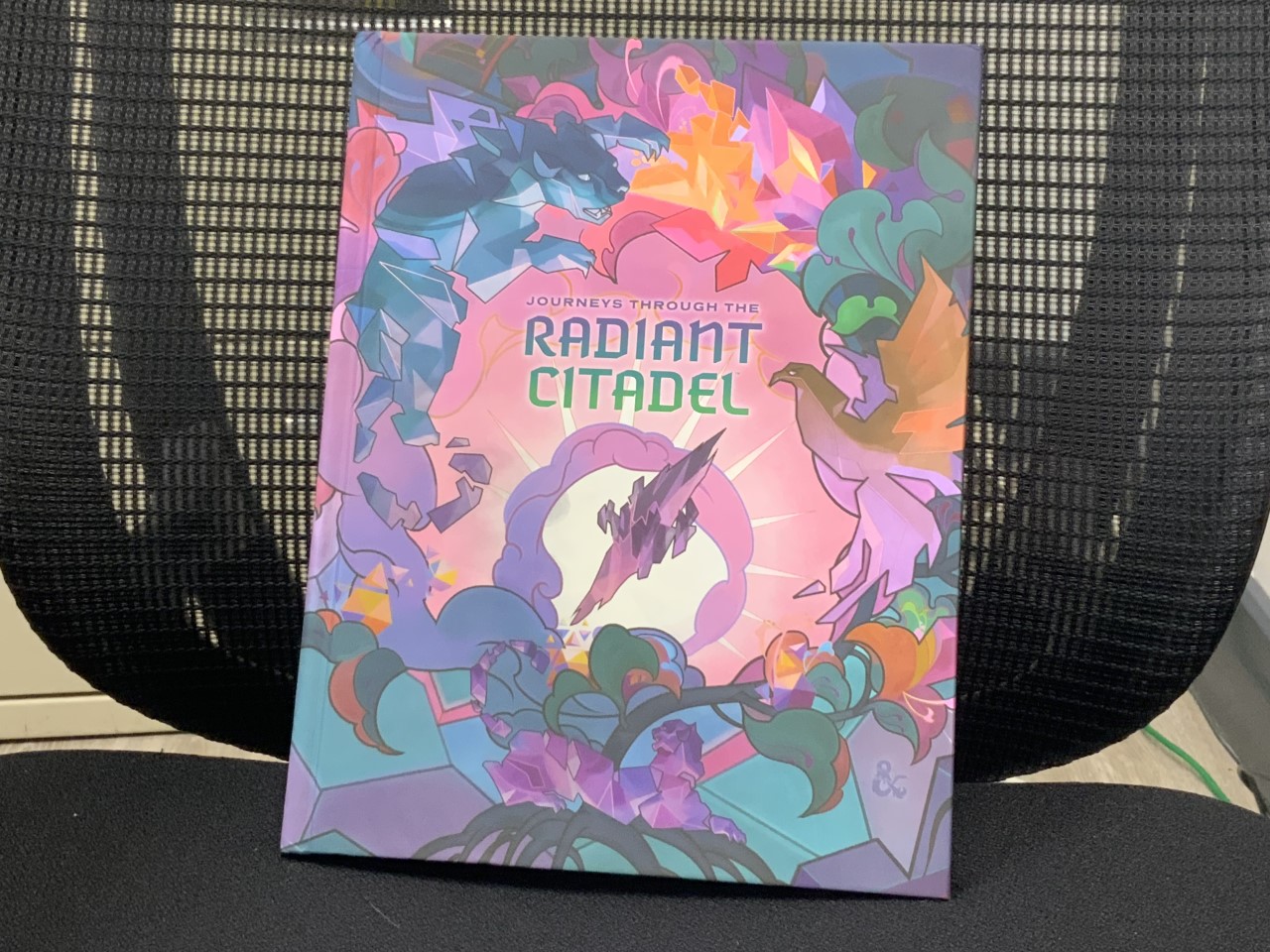
The variant cover was a selling point. Seldom do I see anything so beautiful – very dreamlike, it reminded me of Vertigo comics from back in the day. Sija Hong outdid herself!
The Citadel drifts in the plane Ethereal linking twenty-seven civilizations in one central hub, itself speared through by the Auroral Diamond, a luminous gemstone shard that acts as a beacon for those lost in the twisting void. Lost for uncounted generations and reclaimed by explorers and heroes, the Citadel is a place where immigrants from across creation gather. They make their home in the great carved gem and use its portals to travel to and from other worlds.
Those other worlds are what most of the book is about. Everything from the ghost-haunted streets of Yeonido to the suffering arid lands of San Citlan and the packed, happy bustle of Dyn Singh Night Markets – plus plenty more besides.
As with all collections there’s going to be some ideas you’ll leap on with cries of joy and some that leave you going ‘ehhh …’ That’s not the issue. The issue is, is there enough variety, enough on offer, that even if you don’t like the idea of thus-and-so there’s something here you’re more than happy to have?
If you’ll recall I said something similar about San Jenaro Co-Op’s Guide To Heists, which boasts 35 Heist scenario seeds. I lacked enthusiasm. The collection felt very weighted. I said at the time:
So if you're, say, a fantasy or sci-fi Keeper looking for inspiration, you're going to feel left out. Ditto if you're a gamer looking for material set anywhere other than North America in the 2000s, really. The problem's fixable - change up some names, fiddle with the locations. Still, with about 40% of the scenarios set in the US or a US-centric location, mostly modern day, the collection feels unbalanced.
Journeys doesn’t share that problem.
God no.
Journeys is bloody excellent.
Do you want social roleplay? Done. Do you want to penetrate the heart of a ghastly, ghostly mystery? Done. Like Ravenloft? Here’s a setting. New and memorable creatures? Got you covered. Forgotten temples? Hidden mines? Yes, yes, and over here’s another sunken undersea yes for those of you seeking extra goodies.
I shan’t go deeply into the production values or art since this is a 5E product and 5E is the top of the food chain when it comes to that sort of thing. I know I’m selling the artists short by not talking about their work, but I only have so many fingers, guys, and they’re being worn to nubbins against the unforgiving keyboard. Mercy!
The tales I like best are the ones that focus less on saving the world and are more about interacting with it. The Dyn Singh Night Market and the fabulous vice-ridden city of Zinda are my two favorites, closely followed by hunting ghosts in Yeonido. In each the characters are asked to delve deep in the mystery, uncover secrets, perhaps gain renown by completing tasks or earning favor. That’s the kind of thing that really gets me going.
There's a good spread of adventures from low level to high, and while I wasn't as fond of the high level stuff I think that's mostly down to my personal hang-ups about high level play and not the scenarios themselves. For me, high level play exposes some of the innate weaknesses in a combat-heavy system, and for all its tweaks over the years D&D is still a combat-heavy system. While I see the appeal of, say Orchids of the Invisible Mountain (14th level characters) it's never going to get my blood flowing the same way Wages of Vice (5th level characters) does, because I know in my heart that Orchids will end up being a dungeon bash where Wages is more of a race-against-time thriller.
The best thing about this collection isn't so much the scenarios themselves as it is the world Gazetteers that go with them. You don't have to play any of the scenarios if you don't want to. Each setting has enough detail for a campaign of your own, whether you want to have the entire plot arc in, say, bustling Yongjing or the holy lands of Akharin Sangar, or whether you just want someone to visit there briefly from their base in the Radiant Citadel. Each land has its own aesthetic, its own unique voice, and the Citadel is a handy means of linking all those voices in a conjoined narrative. It's a bit like living in a wide archipelago of nations, with a gleaming spire at its center drawing them all together.
Is it worth your $50? Absolutely. In fact, I'd recommend this to first-time DMs in particular because those are the folks who need the most support when running their games and there's plenty of support here. Someone lost for what to do or where to go next should have no problem working this into their ongoing campaign and perhaps the best thing about it is, with the Citadel at its center, you don't need to worry about ever getting bored. There's always a new adventure just over the horizon and unexplored lands awaiting discovery - or perhaps rediscovery. The Citadel isn't complete, after all; its dormant sections might be reawakened, by determined and clever heroes.
Recently Hurricane Humberto breezed past the island, and when that sort of thing happens I download a horror film and break out the beer. This time, I figured I'd try something different, and went for Jim Jarmusch's comedic zombie apocalypse feature, The Dead Don't Die.
Starring a ton of people, set in an unmemorable little town called Centerville, featuring everyone's favorite ghoul.
If you don't want spoilers, stop reading now. I didn't like it. I didn't laugh once. Make of that what you will.
Now, on with the show.
Bill Murray, Chloe Sevigny and Adam Driver are cops in a town that makes no sense. Centerville's big enough to have three cops, a juvenile correctional facility, a diner, a motel, a cemetery, a funeral parlor, a gas station-cum-memorabilia-store, and a hardware store. Nobody actually lives there, or if they do, you couldn't tell it from this movie.
There's one point, where Murray and Driver are in the squad car headed back to home base, and they're discussing whether or not to warn people the zombies are coming. They decide warning people is a good idea. Then Driver says, "You know, we passed by Farmer Miller's place, back there. Should we go warn him?" To which Murray replies, "No, Miller's an asshole." Which is fine so far as it goes, except, as they're delivering this witty banter, they're passing by half a dozen other houses, all of which presumably have people living in them who might like to know about the impending apocalypse. I guess those folks were assholes too.
Into this town pour an assortment of misfits, including, but not limited to, a woodlands hermit (Tom Waits), Selena Gomez and a pair of hipster sidekicks, passing through, Tilda Swinton in the Kill Bill funeral director role, Iggy Pop and Sara Driver as coffee-obsessed zombies, and, and, and, and … oh dear God, there are too many warm bodies in this movie about dead bodies.
This is the film's besetting sin. With so many people doing so many things, nobody, bar Murry and Driver, gets more than two minutes' screen time, much of which is wasted. I lost track of the number of times I said to myself, 'you could cut that line. And that line. This entire bit of business could be cut. Why are we spending any time in the JDC? None of these characters are relevant to the plot or doing anything interesting. They're just reacting to what's on the TV screen - any other cast member could do what they're doing. Cut this. Cut that. Cut the other thing." All of which makes the film feel bloated, and given the damn mess is 1 hour 44 minutes long in an industry that's tending towards two hour films, that's an achievement.
Frankly, towards the end I began to wonder whether the whole thing wasn't some misguided scheme on Jarmusch's part, to give fifty or sixty of his actor friends a paycheck and, for the kids, something to put in their showreel.
The actor I feel sorriest for is Chloe Sevigny, who's the third wheel in the cop shop and never gets to do anything cool, or have any big scenes. I hoped there'd be at least one defining moment before the inevitable, but I guess there wasn't enough time to shoehorn that in. Plenty of time to shove in another dead-on-arrival George Romero reference, though.
None of the actors seemed to be having any fun. Their whole shtick was deadpan delivery, so I suppose that's a partial explanation. But Tilda Swinton really seemed to revel in it, and so did Iggy Pop, where Tom Waits drifted, disconnected, and Murray just looked bored, most of the time. He was much more engaged in Zombieland. Waits was more fun to watch in Buster Scruggs. What the hell went wrong on the way to … wherever this is supposed to be?
That's the central problem. This is a film that doesn't know where, or what, it wants to be. It tells a few jokes, and shuffles off the stage. But a comedian that wants her career to last more than five minutes doesn't tell a few disconnected giggles and hope for the best. That comedian puts together a whole routine, and polishes it to a mirror shine. Till they can tell it in their sleep. This film is unpolished. It's a bloody mess.
So, bottom line: if you like Jarmusch's work and are prepared to sit through a flatulent, overcooked garbage pile featuring just about every single indie film maven you can think of, and others whose names you can't quite remember but are sure were great in that thing with the stuff, then by all means, see The Dead Don't Die.
Otherwise, avoid like the plague.
Side note: I see Hurricane Jerry's due to visit Bermuda next week. I wonder what I'll rent?
William Seabrook ought to be one of the most famous names in horror. This American pre-gonzo gonzo author and adventurer only went and invented the freakin' zombie; if that isn't an iron-clad claim to fame, what is?
Yet he's largely forgotten by modern audiences. My copy of the Magic Island, Seabrook's Haiti reminiscence, is an Armchair Traveller 1989 reprint of the 1929 original, and for a while there, unless you haunted antiquarian bookstores, this was your only option. There have been reprints since, thank goodness.
In his day, Seabrook was one of the most famous popular authors going - exactly the kind of author, in fact, whose work might be found on the shelves of your Bookhounds' shop. He went to Africa to live among the cannibals, Arabia to see the Bedouins, Haiti to discover the secrets of voodoo, and the asylum to find out what it was like to recover from chronic alcoholism.
That was his besetting sin. Seabrook was a lifelong alcoholic. He spent his entire career drinking across the planet, stopping in now and again to turn out very readable copy. He learned the trick by working for Hearst's papers, and despite everything he never really lost it.
He did his best to lose everything else. Never a contented man, his trick is to find his way into what he thinks is happiness - whether it be tramping across Europe, almost penniless, to owning his own cotton farm, or being partner in a successful ad agency in the 1920s - and promptly throw it away, in search of more happiness. He married three times, and each time it ended badly, though his first marriage was probably the most successful.
His trip to Arabia, in 1924, was a spectacular success, and gave him material for his first big international smash hit, Adventures in Arabia: among the Bedouins, Druses, Whirling Dervishes and Yezidee Devil Worshipers, published in 1927. It gave him the credibility and funds to go to Haiti, where he found inspiration for his Magic Island, published 1929.
That was the very first time anyone saw, and described, the zombie. A creation of Haitian magic, Seabrook said the animated dead man resembled a lobotomy patient, animate, yet incapable of thought. This idea was later turned into the main plot for White Zombie, a poverty row horror quickie that caught fire largely thanks to Bela Lugosi's performance as 'Murder' Legendre.
This is one of the few times a traditional zombie, as described by Seabrook, appeared on screen. Haiti's merely a backdrop here, voodoo barely mentioned. It's Transylvania-by-the-sea, with a plot that doesn't bear close examination. Magic was dropped from zombie lore in later films, starting with White Zombie's sequel, Revolt of the Zombies. In that film zombies are created by means of a secret formula, not the end result of a particular religious ritual; part Lugosi-style hypnotic magic, part alchemical science. Soon zombies became creatures of mad science, cooked up by lunatics and Nazis for unholy purposes. Then George Romero and his investor friends make Night of the Living Dead in 1968, another poverty row quickie, made for gore-loving drive-in audiences. The word zombie isn't even used in the film; to the terrified cross-section of Americana trapped in a deserted farmhouse, the approaching dead are flesh-eating ghouls. That didn't matter. Nobody really cared where zombies came from any more. Night hints at a scientific explanation, blaming strange radiation scattered by a rogue Venus probe, but explanations weren't necessary. Zombies roamed. They ate the flesh of the people they murdered. They could be killed by a shot in the head, nothing else. That was all anyone needed to know.
Speaking personally, while I admire Seabrook as an author, I've always distrusted him as a historian. His stories are just too sensational, too gonzo, too perfect. The Magic Island is a case in point. Seabrook sees everything and tells all, each story more incredible than the last. The zombie story isn't even the most outrageous tale in the book; my personal favorite is the wedding feast, but the account of an actual voodoo ceremony complete with 'human sacrifice' is another strong contender. He's a ballyhoo author to his core, going to sensational places and emerging with even-more-sensational stories. Can the man who gets paid for churning out colorful stories be trusted to tell the truth?
The thing is, Seabrook's the first. Nobody knows what a zombie is, before he sees one and tells the world. What if he was lying? Or exaggerating?
What if there were no zombies, before Seabrook made them up?
That would make Seabrook the inventor of possibly the only truly American horror icon. Vampires, werewolves, mummies, ghosts, Mister Hyde, the Frankenstein monster - they all come from other sources, often European. If Seabrook exaggerated, if the zombie came from his imagination and a healthy dose of white rum … Nobody questioned him. It was taken on faith that Seabrook knew what he was talking about. In his wake came a teeming host of quasi-anthropologists, folklorists, adventurers, looking for voodoo, looking for excitement, looking for monsters. The Haitians knew how to milk credulous foreigners for everything they could get …
Joe Ollermann takes the reader on a guided tour of a colossal, life-long, booze-filled cock-up. Seabrook slowly destroys himself, and his talent, page by page. His sexual appetites, his love of adventure and corn liquor, his peerless imagination, sensationalism and bravado, all combine to create a disaster that some writers would give their soul to emulate. Make no mistake, Seabrook was the man to beat, in his heyday.
In the end, he beat himself. There are few moments more harrowing than the first pages of this novel, showing Seabrook at his worst, almost entirely destroyed, drinking his way across New York. He's on the brink of suicide - but can he pull himself out of the pit, for his ex-wife and young son, if for no other reason?
First, if you have any love for the 1920s-1930s, this is the book for you. Seabrook saw and did everything, and knew pretty much everyone, from Maya Deren and Man Ray to Aleister Crowley and Theodore Drieser. It's a slice of history, from start to finish.
Second, if you're a Keeper looking for a useful patron, walk-in NPC or similar, William Seabrook's your boy. He's seen Timbuctoo and Brooklyn too. He'd fit in Masks of Nyarlathotep, Horror on the Orient Express or any of the classic stuff. Moreover, as hinted, he'd make an excellent walk-in for a Bookhounds campaign. Or a Dreamhounds campaign, for that matter, given his links with prominent surrealists and his travels to Paris in its bohemian heyday.
Third - well, it's a tragedy. We should remember our tragedies. For all his faults - and God knows there were many - there's something compelling about this poor soul's life. He spirals into a self-destructive black hole with, seemingly, no chance of redemption, and all you can think is, it could have been stopped. But would Seabrook have been happy if it had?
Finally, if you write, and you've wondered if it's worth it, if it can be good - read this book. Here's a man who knew success and disgrace, money and poverty. See if he has anything to tell you.
I played Vampire in the 90s. I had that book with the green marble cover and the o-so-evocative red rose. My heart belonged to Wraith, but I couldn't always get players for that haunted setting. Vampire was always the more popular game, because it fed into the power fantasies that the players enjoyed.
I don't know where my old books are now. In the basement, probably. Or given away. I still have the Wraith stuff. I have a new gaming group now, and some of them remember Vampire fondly, so I picked up a copy when I was last in the UK, shortly after its general release. Ken Hite's name attached to the project lured me in. I see Neil Gaiman's in there as well, not sure where. Some of the background material, presumably.
This thing's huge, and it doesn't waste a page. Even the endpapers are covered with 50 vampire victims for the characters to snack on. Hardback, full colour, a thing of beauty. I found it difficult to read at times and I'm not sure why; I compared it to the old Wraith books and there doesn't seem to be a huge difference, except in line thickness and colour plates. The new book's thinner font may be the problem, or perhaps it's just the difference between colour and black and white. One's prettier, the other clearer.
Rules-wise, while there have been changes, seasoned veterans will soon wrap their heads round them. It's still the old d10 mechanic at core. You have a dice pool, you roll your pool against a target number, the more times you make or exceed the target number the more spectacularly you succeed. Botches and critical successes are possible. There's more to it than that, but if you can understand that base concept you're laughing.
The old game had backgrounds, blood-powered Disciplines, and so does this. It's all basically the same as before. There's just a lot more than there used to be. This wealth of information is bound to be intimidating to neophyte and veteran with poor memory alike, so be prepared for lots of hand-holding if you're the Storyguide. For that matter, if you are the Storyguide, read the main book at least six times. You'll thank me later.
Is this a horror game? Yes. In fact that may be its greatest weakness, because the original wasn't.
Back in the before times, Vampire aspired to be Gothic with two Gs and extra Vathek. Yes, you played Vampires, tragic figures cursed with a lust for … something, it's on the tip of my tongue. Gaze not into the abyss, lest it steal your credit card information and run up a whopping bill on Amazon. Play pretty people power gamers controlling things behind the scenes.
But horror? Nooo, never heard of that. You must be thinking of some other Vampires.
This was a game that, more than most, was guided by its fans, and what the fans wanted was a power trip dosed with a hefty slug of Anne Rice - which, again, was pretty vampires doing Gothic things, often in a historic setting, without serious consequences for the main character. Humans? They were your toys, but in practice what this meant was you controlled things behind the scenes - local government, state, the cops, the Feds. For someone in their teens, being able to tell the Mayor of New York where to get off, or the cops to go screw, was heady stuff.
Yes, there was a Humanity mechanic, and going into Frenzy was a pain in the ass - but that could be contained, and there was always the promise of Redemption, where you went up to Nirvana on a big pink cloud so long as you filled in all the squares on your celestial Bingo card.
People, meanwhile, were handy-dandy blood tacos you consumed to power up your Bejeezus Stick. Few players gave serious thought to the mechanics of hunting, or what it might mean for the faceless, nameless prey. Humans were a means of recharging Disciplines, which you then used on the more important stuff, like Dominating the Mayor of New York.
One Hunt stands out in my memory. I thought it might be interesting to play through rather than just handwave it, and God, was that a mistake. The player hadn't the least idea what to do. It was like watching Inspector Clouseau chasing a guy in a gorilla costume round a roundabout. In the end the prey got away. The player thought I was in the wrong for making him go through it. He just wanted a good time, and this wasn't it.
The designers, poor lambs, expected people to get deeply involved in the lore, the political intrigue, the social cut-and-thrust. That was doomed from the start. You don't give a player a Bejeezus Stick and expect her not to smack some fools with it. Often quite a lot of fools.
Maybe somewhere out in Neverland where the flying fishes play there was a group that played the political game, but it soon became clear to everyone, including the designers, that what the gamers wanted was More Power, Please and Thank You. That led to a deluge of books. Camarilla, Sabbat, setting books, Clan books, more Clan books, special Sabbat Clan books, each with upgrades to the Bejeezuz Stick, till the thing resembled a nuclear powered Christmas tree with extra smiting. If you were a Gothically inclined Munchkin, this was the game for you.
I referenced the Nietzsche bit earlier about staring into the abyss. That got quoted frequently in Vampire circles; it was heady stuff for those greasy teens. It sounds good, sure. Nietzsche gives quotable stuff, but if you're a self-obsessed 15 to 23 year-old, to you, the abyss is old hat. You're already convinced you're dark and tragic, and have a poetry diary to prove it. This is the kind of thing Vampire gamers flocked to; that pop psychology 'yes, I am both interesting and tragically flawed, even doomed' reinforcement of an idea you're already convinced is the Ultimate Truth. All that, and power too - the power you didn't have in real life. Very attractive message.
This thing, though? Vampire 5th Edition? It's horror through and through, in one large package.
There's absolutely no question what you are, in this game, and it's not a tragic antihero. You are the enemy, touched with Evil, hunted, slaughtered on sight - and this is because you hunt, and slaughter. You don't run things. Your Bejeezus Stick is pretty nifty, but it won't save you if the Second Inquisition comes calling. Humanity is monitored the same way someone with life-threatening allergies checks each and every thing they come into contact with. Frenzy can be character-ending. The Hunt is real. All too real.
You're no longer the baddest man in the whole damn town, friend. You're meat, and if you want to keep on … whatever it is you're doing … you'd better get with the program.
The clearest indicator of this is the Thin-Blooded, who've come to the end of the bloodline and now know how much it sucks to be undead. The central conceit of Vampire is that, back in the days of Caine, there was a first generation of Vampires. Each generation sires another, and each generation is weaker than the last. Vampire 5E goes one step further and gives you the Vampire without a clan, because there wasn't enough of the clan left to go around. Like mules, they're sterile. Unlike their kin, they haven't the dubious comfort of a working Bejeezus Stick; since the warranty expired on their bloodline, they don't have access to the full set of Disciplines. They can fake it till they make it, eating a stronger Vampire to join an actual clan, but until then they're the lowest of the low.
All the old institutions have been destroyed. The Tremere Chantry is gone, the Nosferatu hacker network blown away. There's a new player in the game, the Second Inquisition, and it's here because Somebody, naming no names, let the Masquerade slip once too often. Now governments know what Vampires are, where they can be found, and how to kill them. As you might expect, the 'how to kill them' bit is what really fires them up. There were Hunters in the old game, Buffy-esque Scooby Gangs of civilians and witchy folk who pounded stakes into corpses on weekends. Now they're out of the picture, replaced by Langley spooks and NSA watchers with drone squadrons at their command. So don't say anything on the internet or your cell phone you don't want Uncle Sugar to hear, or you might find yourself on the wrong end of a well-equipped government sponsored kill team.
As a Vampire, you have to do some horrible things to keep going. So the game goes into detail about your style of hunting. Do you engage in Consensual vampirism? Cleave to your old mortal family, only ever drinking from your own people? Are you a Farmer, drinking only from animals, or a Bagger, taking only cold, bagged blood? Victim types, when described in the text, are precisely that - Victims. There is no romantic pretext that you're doing anything other than killing people. You might have been Compelled to do it by your lack of blood, but that's still a corpse on the ground.
Not just any faceless corpse, either. Remember those 50 Victims on the endpapers? That's Kevin, he was stuck in a dead-end job but wanted to be a poet. That's Faye, who wanted to fix the system. That's Maddie, who was trying to start her own business.
Then consider some of the gruesome aspects of your chosen path. Cleavers feed covertly from their mortal family, which can include children. The most extreme Cleavers adopt children, marry a human, and try to maintain a family life for as long as they can [p176]. The Sandman attacks sleeping victims. The Siren feigns sex to get what he wants. Child abuse, sexual assault, stalking - it's all there, bubbling under the surface.
If what you are looking for is a horror game, then this is what you're looking for. Ken Hite's on record as saying that if it were up to me nobody would ever get to play the good vampire ever again in any medium [NBA p126] and these most definitely are not the good vampires. These are the bloodsuckers, the killers, the villains, and if that is the game you are looking for - the game where you sink as low as you can go, and then sink further - rush to your friendly local game store and buy this now.
Think very carefully about that for a second.
By now I'm sure you've heard that White Wolf no longer calls the shots for this franchise. Paradox, the parent, absorbed the White Wolf team into the company. Sections of the Camarilla book have been retconned, and by now I suspect unaltered versions of the Camarilla and Anarch .pdfs are very popular downloads on shadier parts of the internet. This is in response to a specific section of the Camarilla book, which puts vampires in effective charge of state-level butchery in Chechnya.
I've not read the Chechen section of the Camarilla book. I have read sections of it reprinted on various websites. I will say that if your RPG supplement ends up being blasted by Russian crime news sites then things have gone badly wrong. According to the author of the Chechnya bit it was an editing error more than anything else. Judging by some of the customer commentary there are certainly plenty of those.
[Side note: does nobody attribute, anymore? I've spent the last however-long trying to find out who wrote the Camarilla book. It might have been Winnie the Pooh for all I know. Nobody refers to the author by name; even the site linked above just refers to whoever it is as 'the author.' Mark Rein-Hagen and Matthew Dawkins provided 'insights and perspectives' which isn't the same as saying they wrote it, but I suppose that's as close as I'm going to get to solving that mystery. Vampire 5E has ten different people listed as writers or contributing writers, so I'm guessing that Rein-Hagen and Dawkins weren't the only two involved in Camarilla, but you'd probably have to own the book to know who the others are.
Mind you, there's no Vampire 5E author info at White Wolf or Modiphius either; for all I could prove to the contrary, Vampire 5E might have been written by that talented polymath, Fartknockers McGee. If I'd talked Neil Gaiman into writing for my RPG setting I'd be shouting that from the rooftops, even if all he did was add an extra comma to paragraph 3, page 56. The only reason I know about it is I looked at Vampire 5E's front page. Until I did that, I had idea he was involved, and I've been following the progress of this book for a while.]
In this version of the game, those greasy teens and their power fantasies wrapped up in Gothic romanticism get a nasty shock. There's no disguising what you are, not even with a handy-dandy Nietzsche tag-line. In fact, I'm not even sure Nietzsche gets name-checked in the 5E book, though my memory could be faulty. You don't have the authority you used to, and forget about Dominating the Mayor of New York, lick. Stick your head up above the parapet, and a government assassin will blow it off. The moving hand has writ, and not one word or quote from your poetry diary can lure it back to cancel even half a line. You aren't the vampire you thought you were. You're the bloodsucker of the 21st century, a thin-blooded, bottom-feeding, treacherous asshole. Therein lies the problem.
Maybe the audience doesn't want a horror game where they're the monster. Romantic, doomed antihero, yes. However this time you have no redeeming features. You can pretend you have redeeming features, if you're into self-delusion. You can pretend to have a moral code.
Kevin, the wannabe poet, might challenge your world view.
If you're feeding off your family - including the kids - sneaking into people's homes at night to attack them while they sleep, tricking the gullible lovelorn into giving up all they have, there's no pretending you're anything other than evil. That's what makes this work, as horror. If horror is what you're looking for.
Like Charlie Hall over at Polygon, you may find this game isn't for you. Frankly, played straight, I'm not sure I'd want to play a full campaign of this. Some one-shots, sure. I don't know how my new gaming group will react to it either. The ones who played Vampire back in the day may be into it, or they may not. I can think of at least one player who won't want anything to do with it.
Charlie Hall brings up one more good point: how to do this so you don't squick out, weird out or emotionally scar the group. A White Wolf representative tells him the company wants to put out a series of essays about caring for the folks at the table, but it wasn't going to be available right away.
“We saw it as a separate product, as a separate SKU,” [Jason] Carl said. “I
think the timing is inconvenient because we wanted to have it ready for
Gen Con [when V5 will first be available for purchase] and I don’t know that it will be ready for Gen Con.”
Maybe a Gen Con release date without the essays wasn't wise, in hindsight; maybe releasing those at the same time would have blunted some of the criticism. Yes, a Gen Con release is good for sales, but this is going to be a tough one to find an audience for, which is all the more important because a quality production like this needs good sales to make its nut. One reason why, back in the day, black and white was preferable - less expensive means a lower break-even.
It's good stuff, well written, excellent production values. It's a mass-market book looking for players who want to be evil. Not murder hoboes, not doomed and tragic, not Gothic with two Gs and extra Vathek. Evil.
One tough sell.
Now, since I complained about attribution a while ago it's only fair I attribute:
Vampire 5E
Developed by: Ken Hite, Karim Muammar
System Design: Ken Hite, Karim Muammar, Karl Bergstrom Story & Creative Direction: Martin Ericsson
Written by: Ken Hite, Martin Ericsson, Matthew Dawkins, Karim Muammar, Juhana Petterson Additional Writing: Mark Rein-Hagen, Karl Bergstrom, Jason Andrew, Freja Gyldenstrom, Neil Gaiman Edited by: Freja Gyldenstrom, Karim Muammar, Jennifer Smith-Pulsipher