Sunday, 28 August 2022

Deep Cover (NBA)

A team of investigators claim to have unmasked a deep-cover spy from Russia’s military intelligence agency, the GRU, who spent a decade posing as a Latin American jewelery designer and partied with Nato staff based in Naples. 

The investigators say the woman went by the name of Maria Adela Kuhfeldt Rivera, and told people she met that she was the child of a German father and Peruvian mother, born in the city of Callao, Peru. 

In fact, she was a career GRU officer from Russia, according to research by Bellingcat … 

You may recall a recent example of legend failure when Russian deep cover agent Sergey Vladimirovich Cherkasov managed to completely balls up an infiltration of the International Criminal Court. Here we have an example of a more successful agent, Maria Rivera, who for more than a decade managed to pass herself off as Peruvian even though the Peruvian authorities rejected her application for citizenship. Despite this setback she travelled on a Russian passport, claiming to be a Peruvian who happened to be born in Moscow thanks to an accident of travel. 

As has happened to us all, I’m sure. Airports are full of pregnant women who, through unforeseen circumstances, have to have their babies in foreign shores and promptly abandon them to the vagaries of fate and charity. There’s special charter flights for this sort of thing, you know. Nothing but screaming newborns for eight hours at a time. Or at least eighteen hours if you happen to fly via Singapore. 

This is exactly the kind of scheme a Night’s Black Agents Conspiracy would love to get away with. The Dracula Dossier was made for this sort of thing: a deep-cover mole in place for [however long], hoovering up data and passing it on to their shadowy bosses. 

Ideally if you’re the shadowy boss in this scenario you’d like to limit the possible connections between you and the operative, which is why Rivera tried to get Peruvian citizenship rather than rely on a fib an eight-year-old would reject as being too cheesy. Flimsy or not, that fib worked, but you can imagine the kittens Rivera's Moscow bosses were having.

In Dracula Dossier terms you’d prefer the deep cover operative to have no vampiric or supernatural connections whatsoever. No nibbling the hired help, basically. No working your witchy wiles on the watcher. If you agent has an adverse reaction to garlic it bloody well better be an actual allergy. 

Which is an interesting dilemma because one of the things the Conspiracy does very well is force its victims to behave through supernatural means. If that’s off-limits then you’re forced to rely on the traditional MICE – Money, Ideology, Coercion, Ego. Those do work. They work very well. They’re just not as reliable as alien mind control. 

Which, if your Conspiracy is the micromanaging kind, might be a problem for the powers that be. They understand mind control. They like Renfields. What they don’t like is the uncertainty that comes with having to rely on more traditional methods.  

Imagine what happens when a helicopter parent is also your boss. Plus, blood-drinking psychopath paranoiac.


The Atlantic

One other thing the Rivera story illustrates is how much better it is to be on the periphery. The socialite who runs a jewelry store is much easier to overlook than a postgrad student trying to get direct access to the ICC. One option requires detailed security checks; the other meets you at a nice little bistro round the corner for a cocktail. Direct access to the ICC would have been infinitely more valuable to the Russians, just as direct access to Ring would be infinitely more valuable to Dracula’s people. But then, you can’t always get what you want. 

Sometimes it's better to have the barmaid at the pub round the corner where the lads go after work on your team than it is the new hire with the dodgy CV. The barmaid gets less scrutiny and will probably hear a lot of juicy information once the drinks start to flow.

Finally consider these words of wisdom from the Edom Field Manual:

Edom is the player characters’ day job, but they have lives outside it. Include a scene or two every session which explores the player characters’ personal lives, their family and friends (especially if the Agents suffered a significant Stability loss that session). You can use these scenes to give an external perspective on Edom activities — they get to see what their cover-ups and intrigues look like from the outside. This gives them the conspiratorial frisson of knowing that, say, the recent fire in the London Underground was actually the destruction of Count Orlok, or who really pushed the Icelandic Diplomat over the falls at Barnafoss. 

It’s considered gauche to put a player character’s dependent NPCs in jeopardy too often, but in a Fields of Edom campaign, it’s almost obligatory. After all, you have the perfect literary antecedent; Dracula targeted the spouses and partners of his enemies in the novel, so you should do the same. If the Agents don’t take steps to protect their loved ones and keep them hidden, they’re fair game for attacks by Dracula, his minions, the Opposition, rival vampire programs, or even rival Dukes.

Why endanger those friends and family directly when it might be much more interesting to have someone on the sidelines taking down their every unguarded word? The fellow journalists down at the Frontline Club just having a natter, the waitress at the trendy little French place not far from Seward's Asylum, the Sculptor, almost any of the Legacies ... any one of them could have been bought off by sinster forces and be patiently waiting in the wings. If those friends and family learn more than they ought, will they tell that friendly face all about it?

Finally a scenario seed:

Background Checks

Someone close to your agents - a Civilian in every sense of the word - vanishes from the social scene one week and reappears a week later. An unexpected holiday perhaps, or an illness. The agent might think nothing of it but their bosses (and perhaps an unfriendly Duke who they've upset or burned Bureaucratically) calls them in demanding an explanation. This person was seen in Romania in the week they were away and has a Romanian passport. Why? What do they know about current operations?

Options:

  • The Civilian is really Romanian but passes themself off as English because they've been treated badly in the past by xenophobes. They claim to be English when asked to avoid conflict. This was an innocent trip abroad by someone with nothing to hide, but it doesn't look that way to the Dukes and treating this as anything less than serious will cost the agent Bureaucracy. 
  • The Civilian is an enemy operative who's been milking the agents' friends and family for [however long], managing to get one or two interesting leads. They went to Romania last week because the agent let slip something that the enemy operative needed to report on, soonest, and they couldn't rely on the usual means of communication. This will negatively affect the agent's career, if it comes out.
  • The Civilian is an enemy operative who was called in by the Fanged Powers that Be, who still don't like having someone on the team they can't supernaturally control. The Bosses demanded an in-person report. This, and other instances of micromanagement, has pissed off the enemy operative to such an extent that they're ready to Flip, if approached with subtlety and discretion. Subtlety and discretion are what your agents are known for, right?    
That's it for this week. Enjoy!

Sunday, 21 August 2022

Rose Colored Spyglasses (Night's Black Agents)

Russia's FSB overestimated Russia's chances of success in Ukraine, and Russia's army is paying for that mistake. As the Washington Post puts it:

“There was plenty of wishful thinking in the GRU and the military, but it started with the FSB,” said a senior Western security official, using the GRU abbreviation for Russia’s main military intelligence agency. “The sense that there would be flowers strewn in their path — that was an FSB exercise.” ... the FSB now faces difficult questions in Moscow about what its long history of operations against Ukraine — and the large sums that financed them — accomplished.

How did it come to this? Wishful thinking played its part, but this habit isn't limited to the FSB. Every would-be cardshark who's ever set foot in a casino knows that losing is somehow unthinkable, that the next turn of a card will be exactly the card you want.

Let's assume that they knowingly lied or exaggerated. Why might that be?

If your promotion depends on it, you lie.

If your bosses expect a certain outcome, you lie.

If your budget depends on good news, you lie.

If everyone around you tells you that the lie is the truth, you lie.

If an expert tells you something and you believe the expert, you lie. Unknowingly perhaps, but it's still a lie.

If there are no consequences for telling lies but there are consequences for telling the truth, you lie.

Where else might we see an environment where people's budgets, promotions, depend on lies? Where there are no consequences for lying but there are consequences for telling the truth?

Edom. 

The Edom files make it clear that each of the Dukes has their own department, their own agenda. Hound is the most obvious about her objective, but they all have objectives of one kind or another which may or may not advance the goals of the Edom project. Then of course there's always the possibility that Dracula left a gift behind in the 1970s. Are all the Dukes loyal? Is one of them deep in the enemy's councils?

Let's suppose for the sake of argument that Edom has a long-term project it's pursuing in, say, Romania. Not unlike the FSB in Ukraine Edom is going to cultivate assets in the project area, carry out punitive operations against enemy assets, and generally try to gain maximum advantage for minimum effort. 

But.

The people running those operations know Hound doesn't want to hear bad news. They know their budgets, promotions, depend on funneling good news up the chain. They have experts from Edom telling them one thing, and perhaps the situation on the ground is telling them something else but acknowledging that reality would mean admitting the experts were wrong.

Most importantly of all they know that if they keep telling lies there will be no consequences but if they start admitting unpleasant truths the bosses will not be happy.   

If things start going wrong it's natural to assume it's because of enemy action, but what if it's because your own side is letting you down?

Audit Trail

Location: Bucharest

Asset: Romanian Mortician

Task: Evaluation

Summary: an important location (doesn't really matter which, but for the sake of this discussion a Heal The Children office) was the target of a black bag job and the Mortician was assigned to make the initial evaluation. Elvis trusts her evaluation; Osprey does not. The agents are tasked with auditing the Mortician using a second opinion of the black bag job as an excuse. This may be their first visit to Romania; a nice, low-stress bit of fieldwork.

Possibilities:

  • The Mortician has given a straight, no-nonsense report on the black bag job that contains one nugget of embarrassing information. Heal The Children is meant to be an Edom asset, but it's been diverting funds - which means Edom's cash - to its own executives to fund a luxurious lifestyle. Those executives have direct, personal connections to Osprey; he helped them get their jobs. If the Mortician's evidence gets out and is believed by Elvis and the other Dukes, that's very bad news for Osprey. He'll do his best to make sure the agents get buried in Bureaucracy, if it looks as if they back the Mortician's story. Osprey would never take direct action against Edom agents, but those Heal The Children execs aren't above hiring a few goons to protect their interests.
  • The Mortician's report is pretty basic, and that's because the Mortician knows that Hound has taken a personal interest in Heal The Children and doesn't want to get in the way. As far as the Mortician's concerned she likes her job and wants to keep it. She knows that if she tells the truth Hound will make her life a living hell. What Hound doesn't want the rest of Edom to know, since Romania isn't her territory, is that she was following up on Tradecraft rumors that Heal The Children is connected to some Conspiracy actors outside Romania, in Saudi Arabia. Hound's information is false but by acting she's compromised herself and Project Montsieur, which is something she doesn't want the rest of Edom knowing about. Especially not Elvis.
  • The Mortician has told Elvis exactly what he wants to hear, which is that the Heal The Children job was backed by the Conspiracy. Elvis thinks everything in Romania is Dracula's doing. If his agents agree with him they get rewards and promotion; if not, they get punished. The Mortician is only doing what she's been doing for years: telling the bosses what they want to hear. In fact, the Heal The Children job was carried out by the mafia, and only so the mafia could use Heal The Children's computers as part of a crypto scam. Elvis will argue that the mafia's connections to the Conspiracy are well established, which is enough to foozle the other Dukes. Except Hound, who's often wondered whether the Romania desk wouldn't be better under her control.
That's it for this week! Enjoy.

Sunday, 14 August 2022

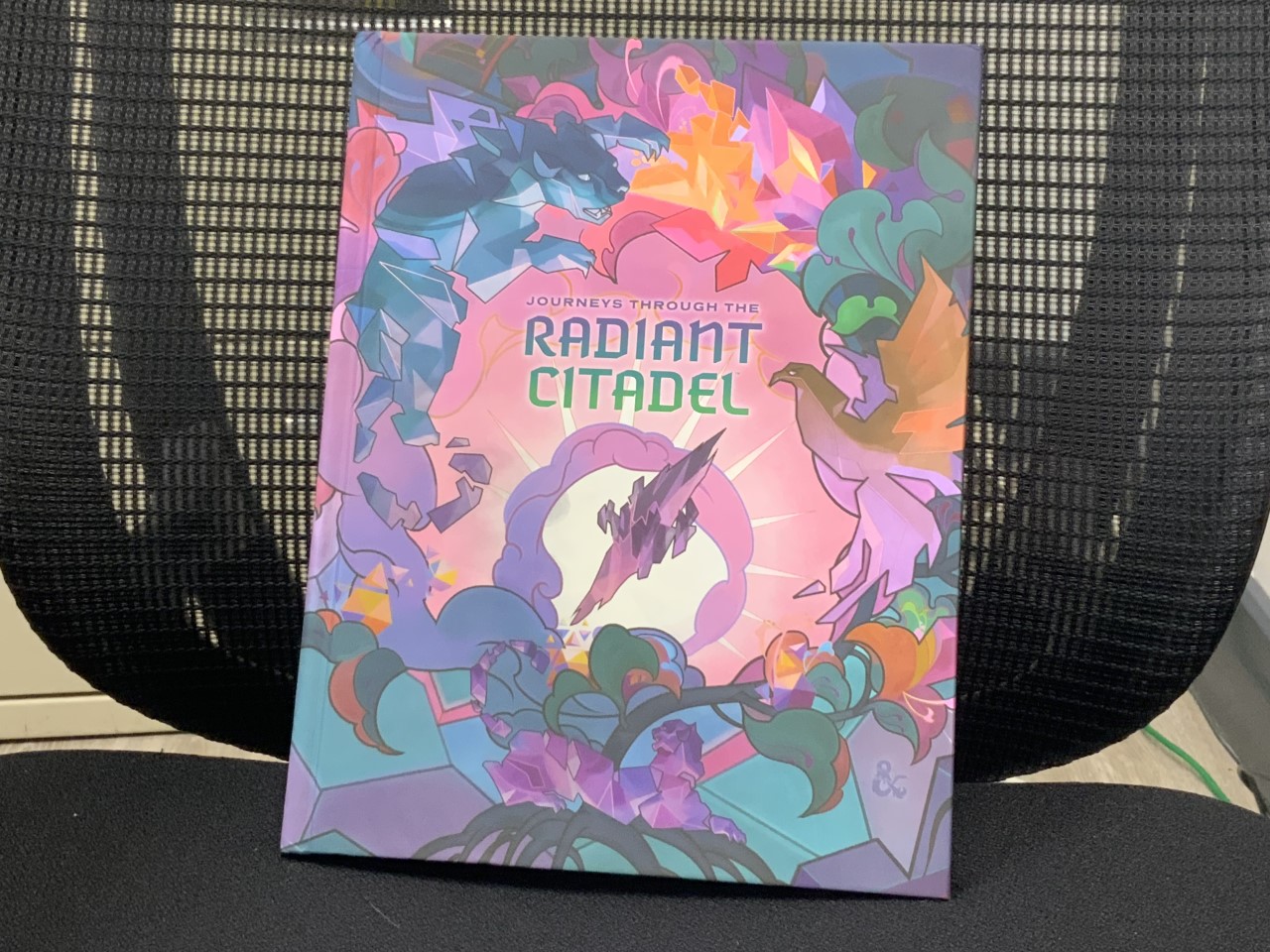
Not Quite Review Corner: Journeys Through the Radiant Citadel (D&D 5e)


Authors: Justice Ramin Arman, Dominique Dickey, Ajit A George, Basheer Ghouse, Alastor Guzman, D. Fox Harrell, T.K. Johnson, Felice Tzehuei Kuan, Surena Marie, Mimi Mondal, Mario Ortegon, Miyuki Jane Pinkard, Pam Punzalan, Erin Roberts, Terry H. Romero, Stephanie Yoon; June 2022 printing. 

I picked this up at Hex & Co way way way up by Columbia. I hadn’t intended to. I knew about it, in that vague ‘I saw it on the Internet and somebody tweeted once, I think?’ way that so many RPG products flash across my cortex these days. I didn’t know much, except that it was a different take from different authors.  

The variant cover was a selling point. Seldom do I see anything so beautiful – very dreamlike, it reminded me of Vertigo comics from back in the day. Sija Hong outdid herself! 

The Citadel drifts in the plane Ethereal linking twenty-seven civilizations in one central hub, itself speared through by the Auroral Diamond, a luminous gemstone shard that acts as a beacon for those lost in the twisting void. Lost for uncounted generations and reclaimed by explorers and heroes, the Citadel is a place where immigrants from across creation gather. They make their home in the great carved gem and use its portals to travel to and from other worlds. 

Those other worlds are what most of the book is about. Everything from the ghost-haunted streets of Yeonido to the suffering arid lands of San Citlan and the packed, happy bustle of Dyn Singh Night Markets – plus plenty more besides.  

As with all collections there’s going to be some ideas you’ll leap on with cries of joy and some that leave you going ‘ehhh …’ That’s not the issue. The issue is, is there enough variety, enough on offer, that even if you don’t like the idea of thus-and-so there’s something here you’re more than happy to have? 

If you’ll recall I said something similar about San Jenaro Co-Op’s Guide To Heists, which boasts 35 Heist scenario seeds. I lacked enthusiasm. The collection felt very weighted. I said at the time: 

So if you're, say, a fantasy or sci-fi Keeper looking for inspiration, you're going to feel left out. Ditto if you're a gamer looking for material set anywhere other than North America in the 2000s, really. The problem's fixable - change up some names, fiddle with the locations. Still, with about 40% of the scenarios set in the US or a US-centric location, mostly modern day, the collection feels unbalanced. 

Journeys doesn’t share that problem. 

God no.  

Journeys is bloody excellent.  

Do you want social roleplay? Done. Do you want to penetrate the heart of a ghastly, ghostly mystery? Done. Like Ravenloft? Here’s a setting. New and memorable creatures? Got you covered. Forgotten temples? Hidden mines? Yes, yes, and over here’s another sunken undersea yes for those of you seeking extra goodies. 

I shan’t go deeply into the production values or art since this is a 5E product and 5E is the top of the food chain when it comes to that sort of thing. I know I’m selling the artists short by not talking about their work, but I only have so many fingers, guys, and they’re being worn to nubbins against the unforgiving keyboard. Mercy! 

The tales I like best are the ones that focus less on saving the world and are more about interacting with it. The Dyn Singh Night Market and the fabulous vice-ridden city of Zinda are my two favorites, closely followed by hunting ghosts in Yeonido. In each the characters are asked to delve deep in the mystery, uncover secrets, perhaps gain renown by completing tasks or earning favor. That’s the kind of thing that really gets me going. 

There's a good spread of adventures from low level to high, and while I wasn't as fond of the high level stuff I think that's mostly down to my personal hang-ups about high level play and not the scenarios themselves. For me, high level play exposes some of the innate weaknesses in a combat-heavy system, and for all its tweaks over the years D&D is still a combat-heavy system. While I see the appeal of, say Orchids of the Invisible Mountain (14th level characters) it's never going to get my blood flowing the same way Wages of Vice (5th level characters) does, because I know in my heart that Orchids will end up being a dungeon bash where Wages is more of a race-against-time thriller.

The best thing about this collection isn't so much the scenarios themselves as it is the world Gazetteers that go with them. You don't have to play any of the scenarios if you don't want to. Each setting has enough detail for a campaign of your own, whether you want to have the entire plot arc in, say, bustling Yongjing or the holy lands of Akharin Sangar, or whether you just want someone to visit there briefly from their base in the Radiant Citadel. Each land has its own aesthetic, its own unique voice, and the Citadel is a handy means of linking all those voices in a conjoined narrative. It's a bit like living in a wide archipelago of nations, with a gleaming spire at its center drawing them all together.

Is it worth your $50? Absolutely. In fact, I'd recommend this to first-time DMs in particular because those are the folks who need the most support when running their games and there's plenty of support here. Someone lost for what to do or where to go next should have no problem working this into their ongoing campaign and perhaps the best thing about it is, with the Citadel at its center, you don't need to worry about ever getting bored. There's always a new adventure just over the horizon and unexplored lands awaiting discovery - or perhaps rediscovery. The Citadel isn't complete, after all; its dormant sections might be reawakened, by determined and clever heroes.

Enjoy!  

Sunday, 7 August 2022

Books, Glorious Books


via the Mercatus Center

I have returned from New York City and now know what Brunch is. 

I was sitting in my usual coffee shop about a week or so back building up the mental strength to go to work and someone sat next to me asked if I was a local. She went on to ask if I could recommend a good place to eat brunch, which puzzled the hell out of me. We don’t eat brunch down here. We don’t have a brunch culture. The hotels offer something like, but that’s a purely tourist thing so it’s not something I can comment about intelligently. 

It’s different in New York. 

Very different. 

I fried myself in NYC. I always forget just how hot it is in the summer. It’s so tempting to walk everywhere; after all, it’s only a few blocks from here to there, it won’t be that bad. Followed swiftly by repentance and heat prostration. Mind, some of the subway cars are air conditioned now, which I don’t remember being an option the last time I was in town. 

I got to see some people. Hello, people! It was fun. 

I spent a ton of money on books. Shocking, I know. The Strand was my first visit, and I was slightly taken aback by how gentrified it’s become compared to the version I knew when I first began visiting NYC. Tote bags and coffee mugs must be a significant part of its bottom line, these days.  

I went to the Mysterious Bookshop down on Warren Street, which I highly recommend to anyone who enjoys whodunnits, whatdunnits and howonearthdidyoudunnits. Also, Dracula puzzles. Very pretty looking Dracula puzzles.  

However, the prize was, as always, the Americana section of the Argosy, where I blew the budget and also my suitcase; as I was disembarking the plane on the way home the case handle gave up on life. ‘Alas, cruel fate!’ it wailed, as it snapped forever.  Today I bought its replacement. Here's hoping the replacement lasts at least as long as its predecessor; I had that one since Uni.

The Argosy was the only place in NY to insist on mask wearing. Theoretically you were supposed to wear a mask on the subway but very few people did. Pretty much everywhere else was mask optional, which meant no masks at all. Despite NY’s best efforts I avoided COVID, continuing my streak of testing negative. I attribute this to blind luck, mask wearing at the airport and other public areas, and the 2oz bottle of hand sanitizer I bought before the flight. Thanks, Handy; you did me proud. 

Seriously, Handy, good job. I've lost track of the number of people I know in Bermuda who've come down with COVID these past few weeks. Meanwhile I stroll through 42nd Street Station many times over the course of a few days without so much as a sniffle.

I’ll spare you the full list of purchases but thought it would be fun to talk about the Argosy haul. 

Lafcadio Hearn, Two Years in the French West Indies (1890). You’ve heard me mention Hearn before. Believe me when I say I laughed for joy when I saw this and immediately snapped it up. Anything Hearn wrote is worth your time. 

The Iron Gate of Jack & Charlie's, various authors, anniversary edition detailing the 21 Club’s history up to publication. God alone knows what will happen to the Club post-COVID; Jack and Charlie would weep to see it. However, if you have any interest in Prohibition or NYC club life you ought to know something about the 21. I’ve read this book before but never had the chance to own it. I’ve also visited the Club, once, and saw the fabled secret cellar. Fond memories! 

Critical Years at the Yard, 1860-89, (1956) Belton Cobb. True crime, and this paired with the title below were my two true crime purchases of the trip. I often go a bit nutty for this sort of thing. This one's about Scotland Yard's early years, shot through with bribery scandals and botched investigations.

The Newgate Noose, (1957) Howard Culpin. A collection of the hanged and their many, many crimes. As with a lot of true crime there's a strong risk of picking up something you already know or have read before. However, no matter how much you know about the luckless pickpockets, murderers and highwaymen who fed the hanging tree there's always a new story. I've just finished the tale of Jenny Diver, a new one on me. Industrious, clever, lucky for a long while, she and her fellow pickpockets ran riot for a long time before she was sentenced to transportation. Not liking America very much she returned to England and for a while avoided notice, but it was death to return from transportation. She swung in 1740 leaving a three-year-old child behind her - at least, according to the Newgate Noose, which may or may not have the right of it. Probably not, since the Noose says she was 'all but a child herself' when she died and Wikipedia puts her actual age at early 40s, which - let's be honest - isn't youth's first bloom.

That's the risk with collections like these. They often talk a load of old bollocks. However, even rubbish can be useful material if you're looking for inspiration for a character in a novel - or an RPG.

This Was New York! A Nostalgic Picture of Gotham in the Gaslight Era, (1969) Maxwell F. Marcuse. This, like the next one, is research material. New York in the misty far-off days when it was building itself into the metropolis we now know. 

The Boss and the Machine, Samuel P. Orth (1919, Yale Uni Press) volume number [something or other] in the [I don't care] collection of American history. For every great fortune there is a great crime. Or, put slightly more accurately, the secret of a great success for which you are at a loss to account is a crime that has never been found out, because it was properly executed. By that definition this is a crime that was found out and therefore not a great success for which we are at a loss to account - but it was a great success, nonetheless.

Now, enough! Hence! I have reading to do. 

Sunday, 24 July 2022

KGB Museum Kaput (NYC, Night's Black Agents)


Once upon the Before Times I went to NYC and visited a charming little KGB Museum down on 14th Street. I gave it a moderately glowing review. 

I’m going back to NYC after a longish hiatus and have been planning out my day-to-day schedule. Go here, buy books there, maybe find time to see Dementia 13 at the Film Forum, so on and so forth. It suddenly occurred to me: did the KGB Museum survive COVID? 

Alas, Babylon! No, it did not. 

The NY Times recorded its demise back in October of 2020. The originator of the collection, Lithuanian enthusiast Julius Urbaitis, said he was closing up shop due to, well, the world in general, alack the day, and the collection would be put up for auction. Artnet goes on to give a date for that auction: Feb 13, 2021. 

So much for a kitschy bit of New York. Mind you, it does mean that the hokey gift cup I bought for my brother that Christmas is a valuable collector’s item, being as they can’t have sold many before the business went belly-up.  

Urbaitis claims, in the Times article, that the museum “was “very successful” in attracting visitors who paid $25 to enter.” I mean, anything’s possible, but when I was there it was me and two other people. Admittedly that was early hours on a Friday. Here’s hoping it was busier on other days. 

The collection was liquidated by Julien’s Auctions out in Beverly Hills, California, which has in its time dealt with everything from Elvis to Betty White. According to the auction results most of the items went for reasonable sums – nothing earth-shaking, often in the hundreds and sometimes in the thousands.

All of which brings me to two things. 

First, this is the last post this month. Next weekend I shall be enjoying the COVID-riddled fun times of NYC and will bring back exotic grimoires from long-forgotten dens of iniquity, like the Argosy and the Mysterious Bookstore. With luck I’ll find time for Hex & Co, which is a new one on me.  

Second, with all of the above in mind let’s have a Dracula Dossier scenario seed based on the all-too-short career of the KGB Museum. 

Babylon The Great Is Fallen. 

A notorious and unlucky collector of spy ephemera, mostly World War Two vintage stuff with a bit of early Cold War thrown in for fun, has been forced to liquidate his collection. The job of turning tat into cash has been given to a Californian auction house, and all signs indicate the Californians have their work cut out for them. 

However, you’ve discovered (either through your contacts or some other means) that someone closely connected with the Conspiracy shall attend the auction in person. You’re not sure why. You don’t know what they want to bid on. It’s very rare for this person to even leave Europe, never mind go to California.  

What can they be up to? Is there something genuinely valuable amongst the dross? 

  • Option One: the Conspiracy bigwig is genuinely interested in one of the items, a World War Two era assassination tool that, Vampirology confirms, would actually be very useful against vampires and might have been used to kill a Conspiracy member, back in the day. It’s not clear whether the bigwig wants this killing tool for their own reasons or because the Conspiracy wants it. 
  • Option Two: the Conspiracy bigwig is attempting a Yojimbo Option swindle. The bigwig is on the outs with another bigwig and is trying to make it seem as if B1 is after a genuine relic. This, B1 hopes, will lure in B2, at which point B1 will finagle it so B2 buys a fraud at eye-watering prices. This will reduce B2’s standing within the Conspiracy, which will make B1 very, very happy. Of course, if the agents were to intervene … 
  • Option Three: the Conspiracy bigwig has been lured in by an Edom artefact which, by some happenstance, managed to find its way into the collection. Or so the bigwig thinks; in fact the artefact was deliberately placed there by Edom as a lure. Edom wants to flip the bigwig, and this is all part of a scheme to lure them to California, out of their comfort zone, where they can be fooled into doing something stupid/compromising. With that handy blackmail material, Edom will have enough to flip the bigwig. Enter the agents. Are they working for Edom? Are they free agents? Are they about to do something remarkably foolish and/or dangerous in Beverly Hills? 

That’s it for this week! Enjoy.   

Sunday, 17 July 2022

The Knocking (Bookhounds of London)

It was hard to believe that Mr. Francis, along with Mr. Joell and Corky, had pushed a barrow of books, sometimes to the Old Caledonian market, sometimes as far as Epping market, and that they had got their supplies by ‘knocking’ – calling at houses in the hope of getting something good. 

Death of a Bookseller, Bernard J. Farmer 

Until relatively recently the Caledonian Market laboured under an infamous reputation as a place where stolen goods might legally change hands, owing to an obscure medieval law known as market overt (or marché ouvert), which guaranteed a buyer title of ownership if an item was bought in good faith here between sunrise and sunset, whatever its provenance. The law was abolished in 1994, after which the market was said to have suffered a damaging drop in trade. (Hidden London)

A brief stop at the Bookhounds of London this week, with some knocking on offer. 

I highly recommend Death of a Bookseller to any lovers of books, the book trade, and Bookhounds. I may well do a Bookshelf on it, but for now I just want to borrow the paragraph quoted for a bit of fun. 

Let’s say this is close to the opening of a Bookhounds campaign and you’d like to do a quick one-off in which the characters find enough cash to open their own shop. That implies a coup of legendary proportions, the kind of thing that makes reputations – and probably ruins someone else’s reputation.  

If this is taking place prior to a proper Bookhounds game that suggests it might be set prior to the 1930s. Not, perhaps, by much; late 20s, let’s say. The characters are younger, still have their health, full head of hair, that sort of thing. They don’t have a store, yet. They have a barrow which they push themselves, not having any other means of locomotion. 

Let’s further suggest that they’re on their way to the Caledonian Market which, at this point in its history, is actually close to the Caledonian Road. That means it’s cheek-by-jowl with the cattle market, with all the stink and blood that implies. It also means the characters can take advantage of the marché ouvert; they can sell whatever they like to whomever they like and suffer no penalty, so long as they get it done quickly and can get the hell out before someone decides to point the finger at them. No crime if you sell between sunrise and sunset, after all, and the buyer’s hardly likely to squawk. 

All of which leads to: 

The Knocking. 

You and your motley crew have, in a fit of daring, tried a knocking at a rather fancy manor house not that far from the Caledonian Road. This neighborhood would have been fashionable, once; times change, neighborhoods decay, and nowadays what looks as though it ought to have a well-dressed family and pots of servants only has the mister at home. 

Except he’s not at home. He’s dead. You find him stabbed through the heart in his library, surrounded by what you can tell at a glance is a book-hoarders paradise. You could live like kings if you could liquidate the lot, but there’s no chance you could carry it all away.  

Clues to be had:  

Sense Trouble tells you it’s only a matter of time before someone turns up. There’s every reason to think this fellow had a servant; at any rate, someone will miss him. The police could be here at any moment. 

Occult tells you that the dead man was a devotee of occult incunabula. Some of these books are incredibly rare mystic texts, Satanic compendiums, rich both with the stink of history and the stench of sulfur. In fact there’s every reason to think that he was conducting some kind of occult experiment when whoever-it-was did him in. A 2-point spend tells you that yes, he was conducting an occult experiment; a summoning. There’s no indication that whatever-it-was is still here, but then if it is a spirit it could be … well … anywhere. The Keeper might allow a 2-point spender to identify the creature being summoned: options include a Star Vampire, Rat Thing, Dimensional Shambler, Nightgaunt - anything that might be invisible, too small to notice, or fly away. How hideous you make it will determine how frightened the players are of it.

Forensics tells you that the dead man was killed by one swift strike from a bladed weapon of some kind. No hesitation, and no indication that he tried to defend himself. That suggests surprise. It also suggests the victim knew the killer and didn’t see them as a threat. There’s no sign of the weapon nor is there a lot of blood, except directly in front of the victim. There’s a pool of blood on the table over which the dead man is slumped. This blood has soaked the book he was consulting, making it almost unreadable and definitely unsellable. Pity; it would have been very valuable otherwise. 

Mythos immediately spots one book in particular that will fetch a remarkable price: De Vermis Mysteriis, the 1587 German black-letter edition. Leather binding, original parchment label pasted to front cover with printer's silver seal. Additional color plates tipped in at some point between 1620 and 1650 by an unknown artist. The Hounds can think of several collectors who might give two hundred pounds or more for it. It’s up on one of the shelves, easily taken. Of course, if you take it there will be a gap on the shelf, which might indicate to someone that something was taken. That may or may not be a concern for you. 

There's obviously a significant quantity of rarities but Document Analysis can tell the actual stuff from the tosh, allowing the Hounds to scoop another two hundred pounds in other works if they want to clean the place out. However, this takes time. Those who spend 2 points do the job quickly enough avoid being caught in the act. Those who don't hear feet tramping down the corridor ...

Once the characters decide what they want to do with the fortune that lies in front of them, or if they take too long blithering among themselves, the house servant comes back with a constable in tow. They’re in a frightful state; the mister’s upstairs, murdered! At which point the characters have to get out of the house with their loot without getting arrested or, worse yet, charged with murder. This may immediately move to a Fleeing moment should they have taken too long to gather the loot.

Next step: disposal of the loot and counting the proceeds. Easier said than done. They can take it all to the Caledonian if they wish, but such obviously pilfered stuff will take some clever moving. Otherwise, the Hounds are likely to see their profits cut considerably to mere pennies on the pound. All very well to rely on marché ouvert, but the people most likely to buy hooky goods are the ones least likely to pay a good price for it.  

The Hounds now have the following problems to solve:

  • Avoid suspicion. They may have been seen. They may have left evidence behind. They may still have the most valuable items, if they didn't immediately offload them at the Caledonian. The coppers will be sniffing round their usual haunts. Time to make yourselves scarce ...
  • Avoid Retaliation. If that fellow really was murdered then there's a murderer out there somewhere who may think that the best way of avoiding the hangman is making sure the Hounds swing instead. Who put the knife in that poor unfortunate occultist?
    • It was one swift stab, and all indications are the killer was either very lucky or knew his victim well enough to avoid arousing the victim's suspicion. That suggests someone in the victim's immediate circle did it and judging by his bookish interests the victim knew a lot of occult and Mythos minded folks ...
  • Avoid Occult Retaliation. If that fellow summoned something up, where is it? Shall it follow the Hounds home? Will they jump at every least shadow? Perhaps it wasn't a human murderer after all; perhaps this strange spirit did him in. If so, will it come back for more?
  • De Vermis Mysteriis. That one book could make their fortune. It's worth at least as much as everything else they stole. The question is, what shall the Hounds do with it now? What about those mysterious tipped-in color plates; is there something more to this book than meets the eye?
That's it for this week. Enjoy!

Sunday, 10 July 2022

The Clue Trail (GUMSHOE All)


GUMSHOE is a player-facing RPG that uses a clue-gathering system as its main mechanic. Find a core clue, and you uncover part of the mystery. Find a non-core clue, perhaps by spending points, and not only do you uncover part of the mystery you also gain some other advantage. The exact nature of this advantage will depend on the situation and the needs of both the player and Game Master. The player may want a specific advantage; the Game Master may find it prudent to slip the player an advantage that they don’t yet know they need. 

All of which begs the question: how many clues make a clue trail? 

As a very broad-brush approach I recommend the Rule of Four, spread across the various disciplines each system uses.  

Naturally you’re going to want to adapt this depending on the needs of your narrative and the situation you find yourself dealing with. However, GUMSHOE, unlike crunch-heavy systems, relies on an improvisational style. If this were Dungeons and Dragons you’d be doing a lot of advance planning, literally populating every room in the dungeon and giving a call-out box for descriptions. A system like, say, Night’s Black Agents is a little more fluid. The agents may decide to go to Paris to talk to the mysterious socialite, or to Berlin to track down the drug smuggling network, or to Rome to confront the crypto-terrorists. It’s not quite the same thing. No ten by ten, orc, chest, initiative, death saves, new PCs please, is what I’m getting at.  

As a reminder, the Rule of Four works like this: 

Whenever designing OPFOR - or for that matter anything else, whether it's the town the adventurers start in, the organization they work for, or the theatre which they notice as a potential adventure location, design four highlight points and no more than four. 

The average player's attention span is short, and yours is not any better. You could go deep in the weeds and design twenty different things about the OPFOR, but who apart from you will ever know it? Even you won't, not really; in the heat of play you'll forget half your notes and curse yourself later when you realize you could have used the Thing, dammit, the THING, and never did. 

As luck would have it in GUMSHOE there are generally four different sets of Abilities, representing four different ways into the problem: Academic, Technical, Interpersonal, and General. General is a little different from the others in that it represents those moments when you do a whatsis and might suck at doing the whatsis, so you roll dice. However, General can also be used for clue-gathering, and when that happens it works in much the same way as other Abilities. Spend 1 point, get a reward. Spend 2 points, either get 2 rewards or 1 really good reward. 

How do you layer the clue trail to make it seem as if the agents are following an actual line of breadcrumbs to Granny’s gingerbread house? 

Rule of Four. There are Four ways in: Academic, Technical, Interpersonal, General. What you need is one clue for each of the ways in, so one Academic, one Technical, one Interpersonal, one General. 

Why do it this way? Well, apart from the usual benefits that come with the Rule of Four, you get one extra: split four ways among the four Ability lists, someone in the group will have at least one of those Abilities with points to spend. That means no matter how Scooby Doo it gets one of your dream team will find their way to the mystery. 

It might even give the spotlight to someone who usually doesn’t get a spotlight moment. The Bang-and-Burner, happy little pyromaniac that she is, might finally have a moment to use her Flattery skills. Or whoever use their whatever – point being someone is going to get the spotlight moment, and it might not be the usual spotlight-hogger. 

Let’s put this into practice.  

Let’s say the players went to Berlin and you want them to find their way to Teufelsberg. You weren’t expecting them to be in Berlin this week, but what the heck, they’re there, and that’s what matters. Now the agents are looking for adventure in all the unexpected places. You already have Teufelsberg prepped (or at least semi-prepped) as an adventure location. The question is, what clues will lead to Teufelsberg?    

Rule of Four: no more than four clues, of which one must be Academic, one Technical, one Interpersonal, one General, and no matter what each one has to lead to Teufelsberg. What’s more, because the agents might spend 2 points in their pool, you have to have at least some idea of what might happen if they spend that extra point.  

Academic – History. One point gets the agent a general history of Teufelsberg plus the idea that the NSA left behind some interesting artefacts, buried in the rubble. Two points gets that plus some background information on Operation TOADSTOOL, the dumping-ground for potentially dangerous Nazi artefacts back in the before times. Maybe there's a specific Nazi artefact you want to drop hints about - now's the moment.

Interpersonal – Tradecraft. One point gets the agent a general history of Teufelsberg plus some old NSA files, slipped to the agent by a friendly at the local CIA station. Two points gets all that plus a free Contact, an ex-Stasi agent from the Cold War days who’s now more of a free-thinking hippie type who likes to graffiti tag Teufelsberg. 

Technical – Urban Survival. One point gets the agent a general history of Teufelsberg plus some maps and design schematics from back in the day, giving the agent a free Architecture bonus should they want it. Two points gets all that plus a guaranteed location at Teufelsberg where they will find more stuff – if they’re brave enough to go get it. 

General – Sense Trouble. One point gets the agent a general recent history of Teufelsberg plus some spooky extras (unexplained deaths, criminal activity, ghost activity, whatever suits best). Two points gets the agent all that plus one very specific clue about the type of OPFOR they will find at Teufelsberg. 

See the process? The first clue is always a general history of the encounter location, which in this case is Teufelsberg. It could have been anything really, but the larger point is this: one point gets the agent enough information to go from point A to point B, with just enough extra juice (old NSA files, hints of ghost activity) to make spending a point become an exciting option for the player.  The only slight difference is General, which gives recent history as opposed to ancient history. General tests tend to be more active in-the-moment tests, so it makes sense that a General ability used as a clue-gatherer gets up-to-date intel. 

Without the extra juice the clue becomes a core clue, or a zero-point clue. It costs nothing and gets no extra benefit.

Two points gets all the value of the first point spend, plus something special on top. A free Contact, a guaranteed reward, valuable information about the OPFOR, what-have-you. Point being, that extra spend gives the agents something of definite benefit. It might be anything but whatever it is, it’s something the player will definitely want and therefore definitely want to pay extra for. Kinda like Kickstarter, but without that pesky shipping delay. 

By keeping to a standard you can allow yourself several options. It didn’t have to be Academic – History. It might have been Academic – Research, or Occult Studies. But if you know what you need the agent to find in the first instance then it doesn’t matter which way they choose to go in. What matters is what they find when they get there.  

So if they foozle you by going in a path you hadn’t anticipated, you can still make it look good. Plaster on your blandest Cheshire Cat smile and say, ‘Vampirology? Well, as it happens you do discover …’ 

Clue planted.  

Enjoy!